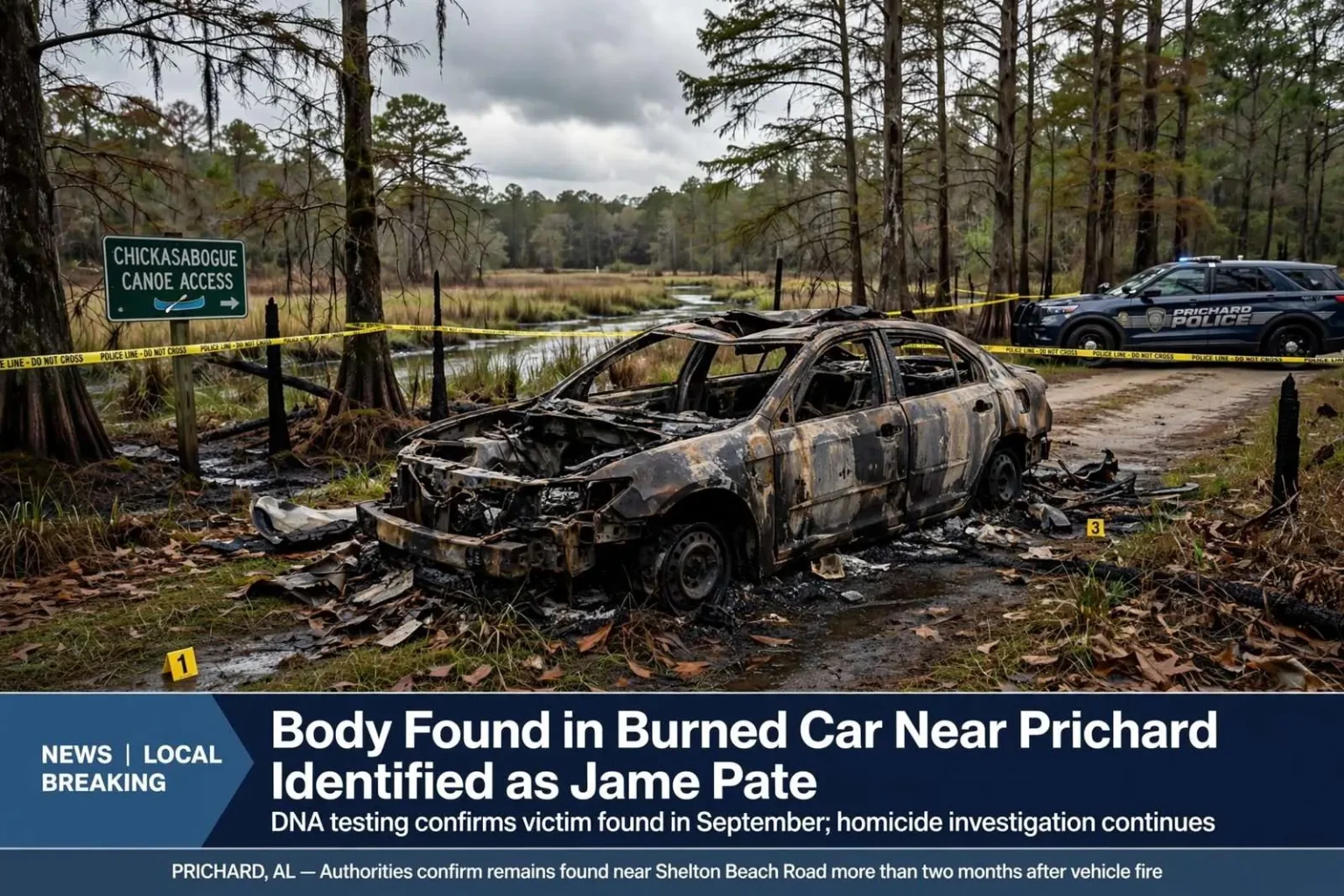
More than two months after a burned vehicle was discovered near the Chickasabogue canoe access point, Prichard police have identified the person found inside. Investigators said the Alabama Department of Forensic Sciences confirmed through DNA testing that the remains belonged to Jame Pate, closing one chapter of a case that has been treated as a homicide since the beginning.
The car was found in September off Shelton Beach Road, in a secluded stretch of western Prichard where the Chickasabogue corridor’s wooded lowlands meet a handful of rural roads. A burned vehicle in a location like that draws an immediate forensic response: fire destroys not only the evidence of what happened inside the car but often the most basic facts of who was in it and how they died.
Police said the severity of the burning initially prevented them from identifying the victim or determining how he died. From the outset, however, investigators have treated the death as a homicide — a decision shaped by the circumstances of the discovery itself. A body inside a burned vehicle, abandoned off a lightly traveled road far from any residence, is not the pattern of an accident, and detectives built their file accordingly from the first hours.
The identification now allows detectives to move forward with the next phase of the investigation. Until DNA results came back, every investigative step was shadowed by the central unknown of who the victim was. With a name, investigators can reconstruct Pate’s final days — who he was with, where he had been, who might have known he was missing — and begin building toward the answers the case has lacked since September.
How remains are identified after a fire
The work that produced Pate’s name belongs to the Alabama Department of Forensic Sciences, the state agency that handles death investigations for law enforcement agencies across Alabama. Its Mobile laboratory serves the Gulf Coast region, and its forensic pathologists and scientists handle exactly this kind of case — remains too damaged for visual identification, processed through a sequence of scientific methods that can take weeks or months.
DNA identification typically works in one of two ways. Scientists may compare DNA recovered from the remains against samples from the victim’s relatives, whose genetic profiles can be matched to establish identity. Or they may compare it against records from earlier events in the victim’s life — medical procedures, prior identifications, or entries in databases maintained for missing persons. Either route requires time, careful lab work and often coordination with family members who are themselves waiting for answers.
The two-month wait between the discovery of the vehicle and the identification announcement is not unusual in cases of this severity. Investigators deliberately keep the details of the science out of public view while it proceeds, both to protect the integrity of the process and to spare families the burden of speculation. For Prichard detectives, the period has meant continuing the investigation on parallel tracks — canvassing, collecting records, and following leads — while the lab work moved toward a name.
The place where the car was found
The Chickasabogue canoe access point sits along a waterway that threads through the wilder western edge of the Mobile metro area. The creek and its surrounding parkland draw paddlers and anglers in daylight hours, but the roads around it — including Shelton Beach Road — see little traffic after dark, and the wooded tracts between them screen the view from the highway. It is the kind of landscape where something abandoned can go unnoticed for days.
That seclusion is precisely why investigators read the location as evidence. Someone chose that spot — far from homes, cameras and passersby — and the choice tells detectives something about planning and familiarity with the area. In homicide investigations across Mobile County, locations like this one shape the earliest theories of a case: who would know this road, who would come out here at night, and who would assume no one would look?
The discovery in September set off a response that combined Prichard police, fire investigators and forensic teams. Burned vehicles require specialized examination — accelerant detection, analysis of the chassis for damage patterns, and careful excavation of anything the fire left behind. Every element of that examination feeds the homicide file that detectives are now free to develop with the victim’s identity in hand.
Why the homicide classification matters
Calling the case a homicide from the outset was more than a label — it determined the resources, the procedures and the urgency applied to everything since September. Homicide investigations bring dedicated detectives, forensic specialists and a level of documentation designed to eventually support a prosecution. Death investigations that begin as accidents or undetermined deaths can be reclassified, but the evidence-gathering in those early days cannot be redone, which is why Prichard investigators chose to treat the scene as a crime scene from the start.
The classification also shapes what families hear. From the beginning, police have had to balance the reality that a killing likely occurred against the fact that they could not yet tell the family with certainty who had died. The DNA confirmation resolves that limbo, and it also formalizes the case’s status: a named victim, a violent death, and an open investigation that now moves into its most productive phase.
Homicide cases in the Mobile area are cleared at rates that frustrate both police and communities, and investigators consistently identify the same missing ingredient: witnesses. The hours and days after a killing are when someone saw something — a car, an argument, a stranger on a road where strangers do not belong. Cases that go unreported for months lose those details, which is why police are pairing the identification announcement with a renewed call for information.
The next phase of the investigation
With a name in the file, detectives can run the victim’s life backward. The first questions are the simplest: Where did Pate live? Who was he close to? When was he last seen, and by whom? The answers come from family, from phone records, from employment records, from the ordinary paper trail a person leaves behind. Each contact point in his final days becomes a lead, and each lead either narrows the circle of people who knew where he was or expands the timeline of his movements.
Investigators will also revisit the vehicle itself with new context. Knowing who owned or regularly used the car can establish where it should have been, which routes it habitually traveled, and whether anything found in or near it — a gas receipt, a key, a personal item — takes on new meaning. Physical evidence recovered from the burned car in September sits in storage, and the identification gives it a frame to be interpreted in.
The final phase, whenever it comes, is the one that matters to both the family and the community: an arrest, or at least a public accounting of what happened. Cases like this one — a body, a fire, a secluded road — are solved most often because someone in the victim’s circle could not stay quiet. Detectives will be counting on that again.
How to contact Prichard police
Anyone with information about Pate’s death is urged to contact Prichard police. Investigators stress that no detail is too small — a vehicle seen on Shelton Beach Road in September, a person who mentioned the burned car before police announced the discovery, a change in someone’s behavior after the fire. Tips can be delivered anonymously, and people who hesitate to come forward are reminded that they can speak without giving their names.
Anonymous tips have closed homicide cases across Mobile County for decades, and the mechanisms for submitting them — phone lines and online forms — are designed to protect the people who use them. For residents of Prichard and the communities around the Chickasabogue corridor, the announcement of Pate’s name is the moment to search their memories of September and call.
Two months of waiting have ended with a name, and an investigation built on the assumption of murder now has the victim at its center. What remains is the work of finding who put him there — work that Prichard police say they are ready to continue, and for which they are asking the public’s help.
Prichard and its unsolved cases
The case lands in a city that knows the weight of unsolved deaths. Prichard, one of Mobile County’s older communities, has spent years working through a backlog of homicides and suspicious deaths with a police department far smaller than those of its neighbors. Each unidentified victim has represented a family left in limbo — a missing person no one could account for, a death no one could claim.
The identification of remains through DNA has resolved dozens of such limbo cases across Alabama over the past two decades, as forensic techniques improved and the state’s database of missing persons grew. For the Pate family, the confirmation brings the hardest kind of closure — certainty about the worst possible news. For detectives, it converts a mystery into a mission with a name attached.
Community members in the Chickasabogue and Shelton Beach Road area have followed the case since the vehicle was found, and many have asked what they can do. The answer police have given remains the same: think back to September, write down what you remember, and call. Homicide files are built from exactly those recollections, and they remain open long enough for courage to catch up with memory.
Prichard police have not announced any arrests or named any suspects in connection with Pate’s death. The investigation is ongoing, and anyone with information is urged to contact the Prichard Police Department.