Body Found in Burned Pickup Likely That of Missing Grove Hill Man, Clarke County Sheriff Says
Clarke County Sheriff DeWayne Smith says a body found in a burned pickup near Lower Peach Tree is likely a missing Grove Hill man, in a Wilcox County case.
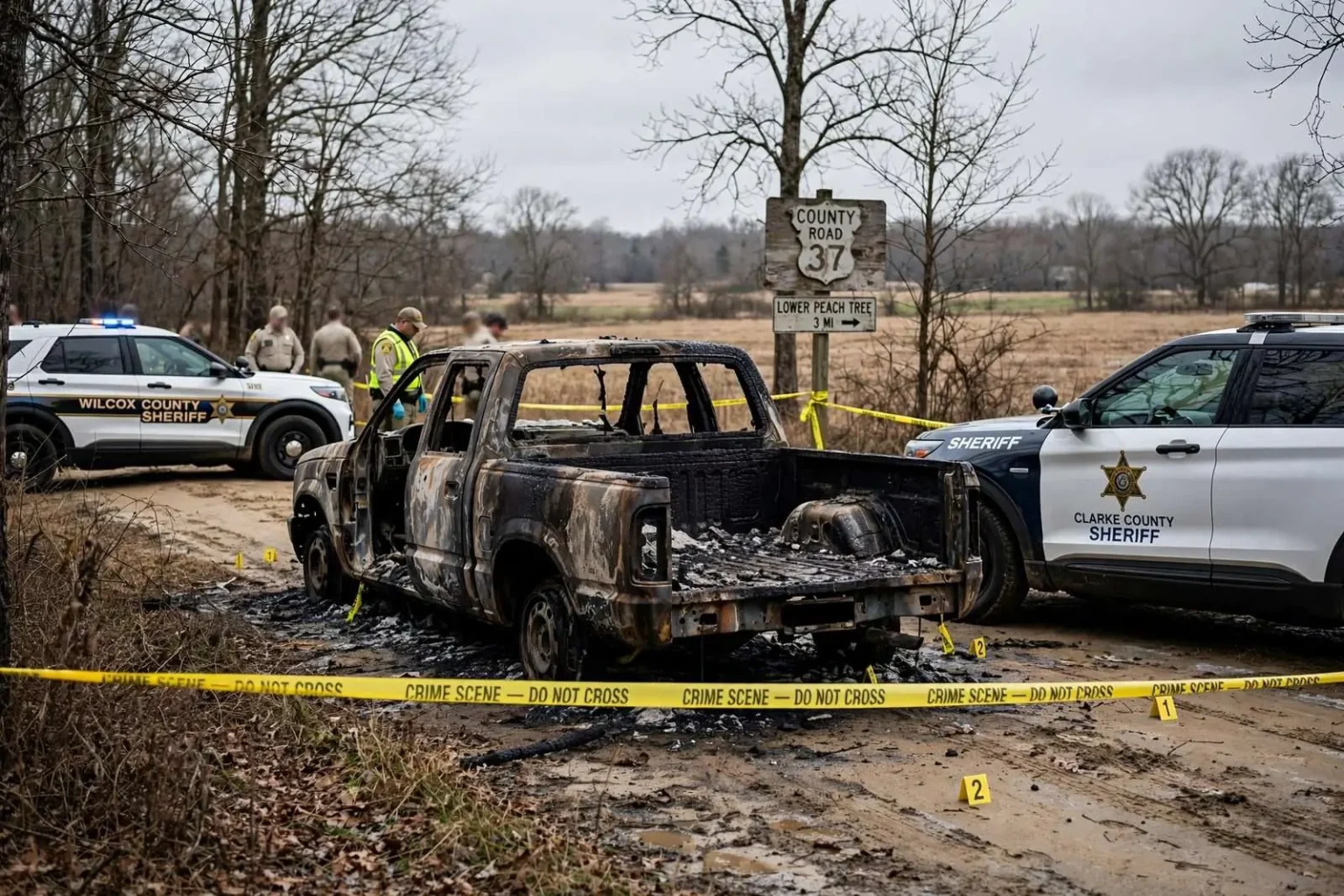
Investigators believe a body recovered from a burned pickup truck on a rural dirt road is most likely that of a Grove Hill man who was reported missing the same day, according to Clarke County Sheriff DeWayne Smith. Smith said his office is assisting the Wilcox County Sheriff’s Office with a homicide investigation stemming from the discovery, which was made on Thursday, Jan. 5. The Wilcox County Sheriff’s Office is the lead agency on the case.
According to Smith, the truck was found on a small dirt road west of Lower Peach Tree, and Clarke County deputies also responded to the scene. The man had been reported missing earlier that same day, a timing that quickly connected the two counties’ investigations and set the case on a path toward formal identification and, eventually, a search for whoever was responsible.
The area where the truck was discovered is remote even by the standards of Alabama’s Black Belt. Lower Peach Tree sits in the southern reaches of Wilcox County near the Alabama River, a community of scattered homes, farmland and winding county roads where a vehicle on an unnamed dirt road would draw little attention until something went wrong. Terrain like that complicates investigative work in specific ways: few witnesses, sparse surveillance coverage and long distances between the spots where evidence might be found.
News of the discovery spread quickly in both counties. In small Alabama communities, a missing person report and a fatal fire on the same day are the kind of events that travel by word of mouth before any official statement, and local residents followed the case closely as sheriff’s offices from two counties converged on the scene and began coordinating their work.
Identification not yet confirmed
Smith said the body is believed to be that of Richard Stephen Gilpin, but cautioned that the identification has not been confirmed with certainty at this stage. The pickup truck itself belonged to Gilpin, according to the sheriff, and the connection between the vehicle and the missing person report was the basis for officials’ early assessment.
Formal identification in cases involving fire damage typically requires forensic examination rather than visual confirmation, which can extend the timeline before authorities release a definitive determination. Remains recovered from vehicle fires are generally examined by a forensic pathologist, with identification methods that can include dental records, medical records, fingerprints or DNA comparison, depending on what condition the remains are in and what reference samples are available from family members.
The pace of that work varies. If dental or fingerprint records can be matched quickly, identification may be completed within days; DNA comparison takes longer, and results from a state laboratory can take weeks in busy periods. Until that process concludes, investigators continue building the rest of the case in parallel, canvassing the area, processing the vehicle and tracing the movements of the person believed to have died there.
A burned vehicle on an isolated road presents a demanding scene for investigators. Fire destroys much of the physical evidence that would otherwise tell the story of what happened, from fingerprints to DNA to the arrangement of the vehicle’s interior. Forensic teams therefore work methodically, photographing and collecting whatever survives, and the fire itself becomes evidence: accelerant patterns, the direction of burning and the condition of the chassis can all speak to whether the fire was accidental or set deliberately.
The involvement of two counties reflects the case’s geography. Gilpin was reported missing from Grove Hill, the Clarke County seat, while the truck turned up across the county line in Wilcox County, meaning the investigation had to account for a distance of many miles between the last place he was known to be and the scene where the vehicle was found. Establishing that route, and who he may have encountered along it, became a central line of inquiry.
Neither agency indicated whether anyone had been detained in connection with the investigation, and no suspect information, cause of death or additional case details had been released. Officials also declined to speculate publicly about how the fire started or when Gilpin may have died, holding those determinations for the forensic work still ahead.
Multi-agency homicides are common in rural Alabama, where sheriff’s offices operate with small staffs and lean budgets. A county with a handful of investigators may request assistance from neighboring sheriffs, the Alabama Law Enforcement Agency or the FBI when a case demands more personnel or specialized expertise, such as fire investigation, forensic analysis or digital records. In this case, Clarke County deputies responded to the scene alongside Wilcox County investigators, and both offices continued sharing resources as the examination of the scene proceeded.
For Grove Hill, a town of a few thousand residents that serves as the commercial center of Clarke County, a missing persons case that ends across a county line in a criminal investigation is a jarring development. Residents reported the loss hitting close to home, and authorities urged anyone with information, however small, to come forward while the investigation was still fresh. In communities of that size, investigators said, the kind of tips that break cases often come from people who knew the victim or noticed an unfamiliar vehicle in the days before the discovery.
The scene near Lower Peach Tree remained an active investigation area in the days after the discovery, with deputies controlling access to the dirt road while forensic teams worked. Rural scenes pose their own preservation challenges, since weather, animals and passing traffic can degrade evidence quickly, and investigators try to complete their work at the scene before releasing it, knowing that returning later is rarely as productive.
As of the sheriff’s latest statements, the case remained in its early stages: a body believed to be Richard Stephen Gilpin, pending forensic confirmation, a burned pickup that belonged to him, and two counties working a homicide with no suspects named and no answers released. Officials said more information would come as the forensic examination concludes and investigators develop leads, and residents of both counties were left waiting for the details that would explain how a man reported missing in Grove Hill ended up dead on a dirt road near Lower Peach Tree.
The early hours after a missing person report are critical, and investigators in such cases move through a standard sequence: confirming when and where the person was last seen, checking hospitals and jails, interviewing family and friends, and examining phone records for the final days of activity. When a vehicle connected to the missing person surfaces with a fatal fire, the case changes character immediately, and the missing person investigation becomes a death investigation while the original canvass continues on a parallel track.
Homicides without an immediately identified suspect are solved slowly in rural counties, often through relationships rather than technology. Investigators map the victim’s contacts, work habits and financial activity, looking for the last people who saw him and the reason he may have traveled toward the Alabama River communities south of the county line. Records from businesses along the route, cameras at stores and intersections, and conversations with residents along the way all feed a picture that emerges over weeks rather than days.
The Alabama Law Enforcement Agency’s State Bureau of Investigation is a common support partner for cases like this, providing agents, crime scene services and laboratory analysis that small sheriff’s offices cannot maintain on their own. District attorneys in the region also coordinate early with investigators to shape how evidence is gathered, since charging decisions in rural homicide cases often hinge on circumstantial evidence assembled before any arrest is made.
Gilpin’s family, meanwhile, faces the hardest part of the process: waiting. Missing person cases that become death investigations leave families in a prolonged state of uncertainty, first about identification and then about how their loved one died and who was responsible. Victim advocates in rural counties often help families navigate that period, from dealing with media attention to understanding the steps of an investigation that may take months to produce answers.
The coroner’s role in Alabama cases adds another layer to the process. County coroners have legal authority over the remains, work with forensic pathologists to determine the manner of death and issue the official documentation families need. Their coordination with sheriff’s investigators is essential in cases involving fire, where the determination of whether a death was a homicide may itself await the full autopsy and laboratory results.
Investigators reiterated their request for information from the public, noting that even details that seem insignificant, a truck seen on a back road, a person asking about Gilpin, or anything unusual in the days around Jan. 5, could help establish the timeline. Tips in both counties can be directed to the sheriff’s offices, and authorities have not said whether a reward might be offered as the investigation develops. Until the forensic identification is confirmed and the autopsy findings are in, both agencies are saying little, consistent with the caution investigators apply in the opening days of a rural homicide case.