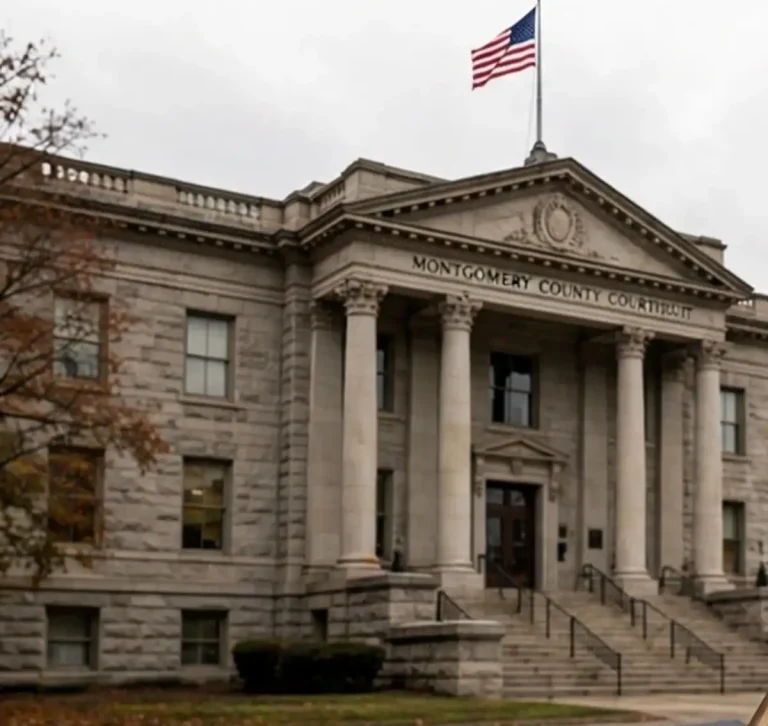
Bond Denied for Teen Charged in Fatal Moffett Road Head-On Crash in Semmes
A judge denied bond for a 17-year-old charged with homicide by vehicle in a fatal head-on crash on Moffett Road in Semmes.
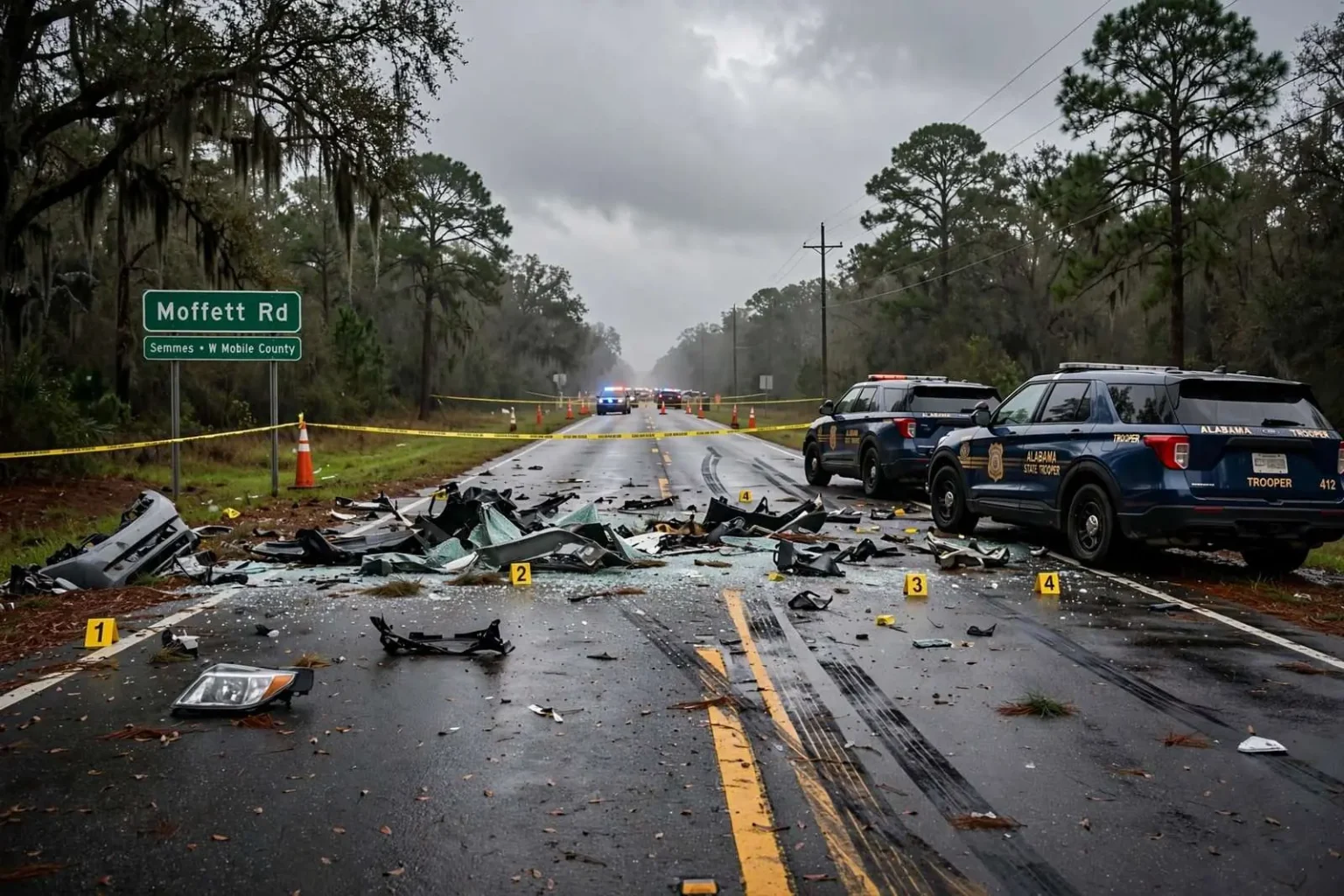
A judge denied bond for a 17-year-old charged in a head-on crash on Moffett Road in Semmes that killed a Mobile County woman, sending the case to a grand jury. Domingo Marcos Diego faces charges of homicide by vehicle and leaving the scene of an accident with injuries in the death of Sonya Jones. The bond denial came after a preliminary hearing in which testimony from the investigating trooper stood in sharp contrast to the defense’s account of how the crash happened.
Marcos Diego appeared in court on crutches Monday for the preliminary hearing before Judge George Hardesty, still recovering from injuries of his own sustained in the collision. A preliminary hearing is not a trial, and the standard of proof is low: prosecutors need only show that a crime was probably committed and that the defendant probably committed it. Judge Hardesty’s decisions — denying bond and sending the case to a grand jury — signal that the state cleared that threshold. The grand jury will now decide whether to issue formal indictments, which is the step required before a felony case proceeds to circuit court in Alabama.
Testimony Contradicts Defense Theory
Alabama State Trooper Timothy Freeman testified that Marcos Diego crossed into the opposite lane and struck Jones’ vehicle head-on, and said the teen attempted to flee the scene multiple times afterward. The allegation of repeated attempts to leave the scene became a central point in the hearing, bearing directly on the leaving-the-scene charge and on the question of whether the defendant’s actions showed a disregard for the consequences of the crash.
Defense attorney Michael Kaoui argued the charges were not appropriate, contending his client was forced into Jones’ lane by another vehicle and that the collision was an accident rather than a knowing or deliberate act. The distinction matters in Alabama law, because homicide by vehicle can turn on whether a driver’s conduct rose beyond simple carelessness, and the defense’s account of a third vehicle forcing the teen’s car across the centerline would, if accepted, change the character of the charges entirely.
Assistant District Attorney Keith Blackwood countered that video evidence and testimony about the crash data retrieval system were inconsistent with that theory, saying Marcos Diego was speeding and crossed directly into Jones’ lane of travel. Crash data retrieval — often described as the vehicle’s version of a flight data recorder — captures speed, braking, and steering inputs in the seconds before impact, and it has become one of the most important tools prosecutors and troopers use to reconstruct serious collisions. When that data lines up with video from the scene, defense theories built on unseen third vehicles face a steep climb.
The charges themselves carry significant weight. Homicide by vehicle in Alabama is a felony that applies when a driver causes a death through a violation of traffic law under circumstances showing disregard for the safety of others, and leaving the scene of an accident with injuries is separately charged because of the duty every driver has to stop, render aid, and remain until authorities arrive. Prosecutors will have to prove each element, but the combination of a fatal head-on impact and an attempted flight from the scene is what drove the case to the grand jury with bond denied.
The defendant’s appearance in court on crutches was a visible reminder that the crash injured both drivers before one of them died. Recovery from his own injuries did not spare Marcos Diego from the judge’s decision, and he was ordered held pending the grand jury’s action.
For Jones’ family, the hearing offered the first public accounting of the evidence — the video, the crash data, the trooper’s reconstruction — but also a reminder of how long the road ahead is. Preliminary hearings determine only whether a case moves forward, not guilt or innocence, and the full adjudication of the charges will come much later in circuit court if the grand jury indicts.
The crash also underscores the role of modern evidence in fatal collision cases. Crash data retrieval systems, now standard equipment in most vehicles sold in the past decade, record the final seconds before airbag deployment — vehicle speed, throttle position, brake application, and steering angle. Combined with video from nearby cameras and physical evidence such as skid marks and vehicle damage, that data allows investigators to reconstruct a crash with a precision that simply did not exist a generation ago. Defense theories that once turned on conflicting witness accounts now run squarely into recorded vehicle data, which is precisely what prosecutors said happened here when they argued the record contradicted the claim of a third vehicle forcing the crossover.
The testimony left Judge Hardesty weighing two irreconcilable versions of the same crash. If the state’s evidence holds — a speeding vehicle crossing the centerline deliberately into oncoming traffic, followed by attempts to leave the scene — the charges fit. If the defense’s account of being forced over by another vehicle were corroborated, the case would look very different. With the data retrieval evidence and video on the record, the judge sided with the prosecution’s version at this early stage, denying bond and forwarding the case for grand jury review.
The Crash on Moffett Road
Moffett Road is one of the busiest corridors in west Mobile County, running from the city limits of Mobile through Semmes toward the Mississippi state line as U.S. Highway 98. The stretch through Semmes carries commuter traffic, school traffic, and heavy commercial vehicles along a road that mixes busy intersections with long, fast straightaways. Head-on collisions on roads like it are among the most deadly crashes troopers work, because the combined speed of two vehicles meeting head-on multiplies the forces involved, and centerline crossings at highway speed leave little time for either driver to react.
The loss of Sonya Jones rippled well beyond the crash scene. Family members described a woman whose focus in recent months had been fixed on the future — specifically, on seeing her daughter begin college — making her death all the harder for those who loved her to absorb.
Family Honors Jones’ Wishes
Jones’ family said her focus had been on sending her 17-year-old daughter, Amberly, to college, and they set up a fundraising campaign to help make that goal possible. The campaign is intended to carry forward the plan Jones was working toward herself, turning support from the community into tuition and college expenses for a young woman now facing that milestone without her mother.
Jones’ husband, Harold, said their daughter was struggling with the loss of her mother, whom she described as her best friend. The description captured what friends and family say was the closeness of the mother-daughter relationship — the kind of bond built over years of everyday life, school events, and plans for the future that the crash has now left unfinished. The family has asked for privacy as they grieve while the case moves forward.
What Comes Next in the Case
With the case headed to a grand jury, the next milestone is the grand jury’s decision on indictment. Grand jurors hear the state’s evidence in private and vote on whether there is probable cause to formally charge the defendant on each count. If indictments are returned, the case will move to arraignment in circuit court, where the defendant enters a plea and pretrial proceedings begin in earnest — motion practice, evidence disputes, and eventually either a plea agreement or a trial.
The denial of bond means Marcos Diego will remain in custody while that process unfolds. Bond decisions at the preliminary stage weigh the seriousness of the charges, the evidence against the defendant, and any risk of flight, and judges have wide discretion. In cases involving a death and evidence of attempted flight from the scene, prosecutors typically argue that release would put the community at risk, and Monday’s ruling reflected that calculation.
A Dangerous Corridor
Semmes, the fast-growing city where the crash occurred, has seen substantial residential growth in recent years, and roads like Moffett Road have absorbed the increase in traffic. Growth brings more intersections, more turning movements, and more opportunities for the kind of violent conflicts that occur when a vehicle crosses the centerline at speed. Law enforcement agencies in Mobile County regularly emphasize the basics — staying in your lane, moderating speed, and never driving impaired — because head-on crashes on high-speed roads so often prove fatal for someone.
For the family of Sonya Jones, none of that changes the outcome. The criminal case will take months to resolve, the grand jury will decide the formal charges, and a trial, if it comes, will be further down the road. In the meantime, the fundraising campaign stands as the family’s answer to the loss: a mother’s priority, her daughter’s college education, carried forward by a community that has rallied around them.