
Bond Set at $160,000 for Mobile Man Accused of Shooting Grandson on Thanksgiving
David Timmons faces attempted murder charges after police said he shot his grandson during a Thanksgiving argument at Pecan Cove Apartments.
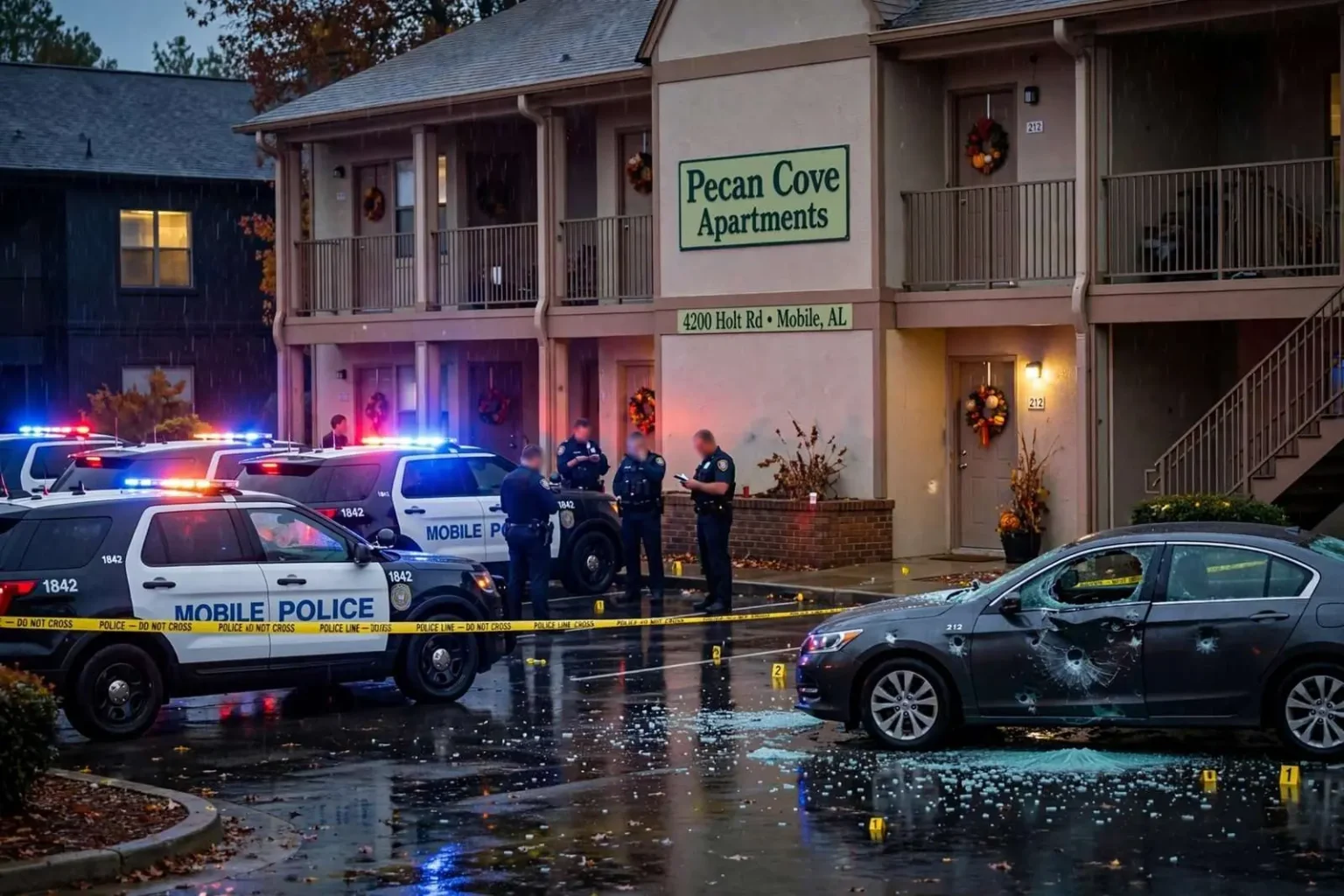
MOBILE, Ala. — A judge has set bond at $160,000 for a Mobile man accused of shooting his grandson on Thanksgiving night, a holiday that ended in gunfire at a west Mobile apartment complex instead of family celebration. David Timmons, 58, is charged with attempted murder and shooting into an occupied vehicle in connection with the shooting, which police said left his 25-year-old grandson with life-threatening injuries.
According to investigators, the shooting stemmed from an argument between the two men at the Pecan Cove Apartments on Holt Road. What began as a family dispute on an evening normally reserved for gatherings around the table escalated, police said, until shots were fired and a young man was wounded several times. The allegations — that a grandfather turned a weapon on his own grandson during an argument — lent the case a gravity that even seasoned officers described as tragic, all the more so for the holiday it stained.
The Charges and What They Carry
Attempted murder is among the most serious charges in Alabama’s criminal code, accusing a defendant of taking a substantial step toward killing another person with intent. A conviction carries decades in prison, and prosecutors treat the charge as reserved for the gravest cases of interpersonal violence. The companion charge of shooting into an occupied vehicle reflects the circumstances police described: gunfire directed at a car with someone inside, an act Alabama law punishes separately because of the extreme danger it poses not only to the intended target but to anyone in or near the vehicle.
The $160,000 bond set by the judge serves the dual functions that bail is designed for — ensuring the defendant’s appearance at future court proceedings and accounting for public safety while the case is pending. In Alabama, bond amounts in attempted murder cases routinely reach into the six figures, and judges weigh the severity of the allegations, the defendant’s ties to the community, and any history of violence before fixing a figure. Whether the bond is ultimately posted, and under what conditions, will shape the early course of the case as it moves through the court system.
The Night of the Shooting
Thanksgiving night calls draw police into situations no one anticipates when the holiday begins. At the Pecan Cove Apartments on Holt Road, officers responding to reports of shots fired encountered the aftermath of an argument between family members that had turned violent. Police said the 25-year-old grandson had been shot several times, and his injuries were described as life-threatening — a classification that sets in motion the most urgent tier of trauma response, with paramedics working to stabilize the victim for transport while officers secured the scene.
Thanksgiving statistically sees its share of family disputes that escalate, and law enforcement agencies across the country plan for the spike in domestic-related calls that accompanies major holidays. Extended families gather under one roof, alcohol often flows, old grievances resurface, and the holiday’s emotional weight can turn a quarrel into a confrontation. Mobile police, like departments nationwide, staff holiday weekends with that reality in mind, though no amount of planning removes the shock when a family celebration ends in a shooting.
The scene at an apartment complex after a shooting is a complex one for responding officers. They must secure the area, identify witnesses among residents who heard the argument or the gunfire, preserve evidence in and around any vehicles involved, and coordinate with paramedics who are treating the wounded. Detectives take over the scene once it is safe, reconstructing the sequence of events through interviews and physical evidence. Statements from family members carry particular weight in cases like this one, where the relationship between the parties is itself central to what happened and why.
Mobile’s emergency medical network is built for precisely this kind of trauma. Patients with life-threatening injuries from gunshot wounds are transported to the region’s trauma-capable emergency departments, where surgical teams stand ready for the race against blood loss and organ damage that such injuries impose. The word “several” in the account of the victim’s wounds matters clinically as well as legally: multiple gunshot wounds multiply the medical challenges and worsen the prognosis, which is why police described his condition as life-threatening rather than serious or stable.
From Arrest to Court
With bond set, the case moves into the early procedural stages of Alabama’s criminal courts. An initial appearance precedes any preliminary hearing, where a judge determines whether sufficient evidence exists to bind the case over to a grand jury. Prosecutors with the Mobile County District Attorney’s Office will review the police investigation — witness statements, physical evidence, and forensic results — before presenting the case to the grand jury for an indictment decision. Each step takes place on a timeline measured in weeks and months, not days.
For the victim’s family, the legal process unfolds in parallel with the medical one. A 25-year-old facing life-threatening injuries faces a hospitalization measured first in critical days and then, if he survives, in a rehabilitation whose length and outcome no one can yet predict. Family members who gathered for Thanksgiving now keep vigil at a hospital instead, and the criminal case will proceed whether or not they are emotionally ready to follow it.
Guns and Family Arguments
Advocates across Alabama use cases like this one to remind families that conflict resolution resources exist, from crisis hotlines to counseling services, before a dispute reaches the point of violence. Domestic violence service providers in Mobile County maintain hotlines, shelters, and intervention programs, and their message during the holidays is consistent: when a family argument begins to feel dangerous, the safest course is separation — leaving the room, leaving the house, calling someone — rather than escalation. No holiday obligation outweighs a life.
The case illustrates a pattern that domestic violence researchers have documented for decades: when firearms are present, family arguments carry a dramatically higher risk of death or serious injury. An argument that might otherwise end in harsh words or a broken door can become lethal when a gun is within reach, and the holidays — with their concentration of family gatherings — see that risk rise. Researchers studying holiday violence have found the Thanksgiving-to-New-Year stretch produces elevated rates of family-related assaults in communities across the country, a pattern that holds regardless of region or city size.
Mobile County’s courts process thousands of felony cases a year, but the ones that stay in public memory are those like this: a family event, a familiar holiday, and a gunshot that turned a celebration into a crime scene. The charges against David Timmons — attempted murder and shooting into an occupied vehicle — are accusations, and every defendant is presumed innocent until proven guilty in a court of law. What is not in dispute is the outcome described by police: a 25-year-old man, shot several times by his own grandfather, fighting for his life on the night the family was supposed to give thanks together.
What Happens at Bond and Beyond
A bond setting is the first formal checkpoint in a felony case, and the judge’s $160,000 figure in this case reflects the seriousness of the charges as alleged. If the bond is posted, the defendant’s release would typically come with conditions — no contact with the victim, no possession of firearms, and surrender of any weapons — designed to protect the alleged victim and the community while the case is pending. Violating those conditions can result in the bond being revoked and the defendant being returned to jail ahead of trial.
The attempted murder charge alone, if it results in a conviction, carries a potential sentence measured in decades under Alabama law, and the shooting-into-an-occupied-vehicle count adds further exposure. Prosecutors will ultimately decide how to proceed: presenting the case for indictment, negotiating a resolution, or taking it to trial. Defense counsel, meanwhile, will examine every element of the police case, from the initial response at Pecan Cove Apartments to the evidence linking the defendant to the shots fired.
For the neighborhood around Holt Road, the incident was a jarring end to a holiday. Apartment complexes are places where families live their daily lives — children playing, neighbors coming home from work — and a Thanksgiving night shooting penetrates that sense of ordinary safety in a way that ordinary crime news does not. The court process will now determine accountability, and the victim’s recovery will determine much of the human story’s final shape. Both will take time, beginning with the weeks after a holiday meant for gratitude, when a Mobile family instead found itself divided between a hospital waiting room and a courtroom, and a west Mobile community was left to absorb the shock of what an argument between family members had become.


