Bond Set at $540,000 for Teen Charged in Ladd-Peebles Stadium Football Game Shooting
A judge set $540,000 total bond for Deangelo Parnell, charged with nine counts of attempted murder in the Ladd-Peebles Stadium shooting.
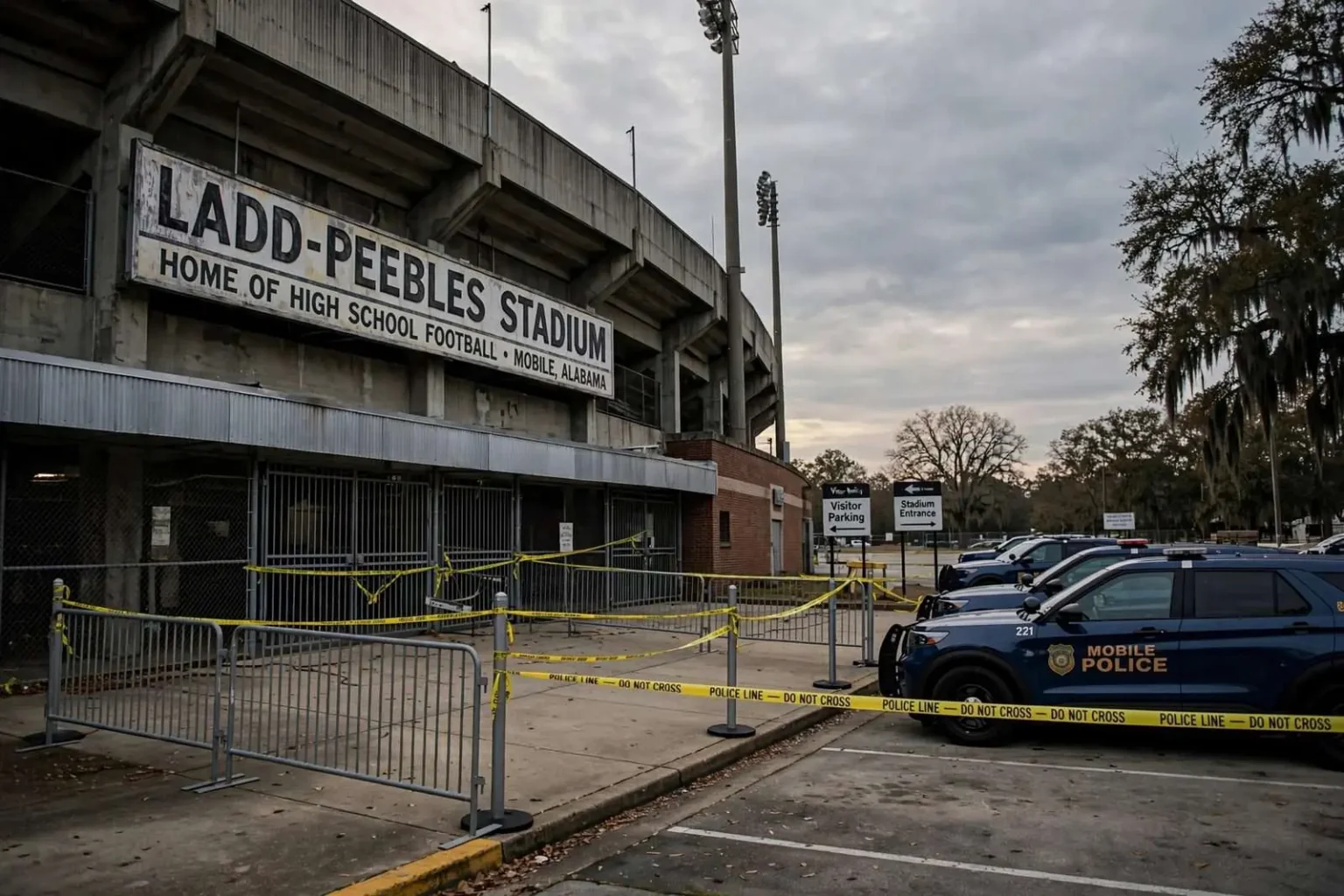
MOBILE, Ala. — The case against the teenager charged in the Ladd-Peebles Stadium shooting moved forward at a preliminary hearing in November 2019, where a judge ruled there was enough evidence to send the charges to a grand jury. Deangelo Parnell, who was 17 at the time of the August 30, 2019 shooting following the LeFlore-Williamson game, faced the hearing on nine counts of attempted murder — one for each of the people injured when gunfire erupted in the stadium concourse.
A Mobile police detective testified that one of the victims identified Parnell as a shooter and that surveillance video showed him firing shots. Ballistics evidence indicated two guns were fired from two separate locations during the attack, and the second shooter had not been found. Parnell’s attorney argued police could not prove his client shot any of the victims; the detective testified that ballistics results were still pending to match victims to weapons.
The hearing also took up the question of bond, which the judge subsequently set at $405,000 — down from the $540,000 total originally imposed. If released, Parnell would remain under electronic monitoring, would be barred from possessing any weapon, and would be prohibited from contacting any of the victims.
What Happened at Ladd-Peebles
The shooting unfolded on August 30, 2019, following the LeFlore-Williamson high school football game at Ladd-Peebles Stadium, one of Mobile’s most storied sports venues. Nine people were injured in the concourse shooting, which police said stemmed from a fight between groups attending the game. The victims, most of them teenagers, were among the crowds still inside the stadium grounds when the altercation turned into gunfire — an eruption of violence in a place generations of Mobile families associate with Friday night football.
Ladd-Peebles Stadium has anchored major sporting events in Mobile for decades, from high school championships to college all-star games, and games there draw thousands of fans from across the city. LeFlore and Williamson are both Mobile public high schools, and their matchup brought the kind of crowd that fills the stadium’s concourses and parking areas. That context made the shooting all the more shocking: a dispute between groups at a high school game ending with nine people shot and a city searching for answers.
Police quickly identified Parnell, then 17, and charged him with nine counts of attempted murder. The arrest was only the beginning of a case that would test the city’s schools, its stadium operations, and its courts — and which, as the November hearing showed, still contained unanswered questions about the second set of gunshots.
The arrest was only the beginning of a case that would test the city’s schools, its stadium operations, and its courts — and which, as the November hearing showed, still contained unanswered questions about the second set of gunshots. The nine separate counts of attempted murder meant the potential consequences were compounded nine times over, and the pending investigation into the second shooter hung over every stage that followed.
The City’s Response
The shooting prompted immediate reaction across Mobile, from school officials to stadium operators to the families who fill the stands every Friday night. Games between public high schools are community events as much as athletic contests, drawing parents, students, alumni, and neighborhood residents to the stadium in numbers that make security planning a constant concern. An incident that wounds nine people at such a gathering inevitably raises hard questions about how weapons entered the grounds and what measures could keep them out in the future.
For the young victims and their families, the weeks between the August shooting and the November hearing meant hospital stays, recoveries, and the slow work of returning to routines. The police investigation, meanwhile, continued to develop — building the surveillance timeline, pursuing the second shooter, and preparing the ballistics evidence that would become a centerpiece of the court proceedings.
Inside the Preliminary Hearing
A preliminary hearing serves a narrow but important function in Alabama’s court system: it is not a trial, and no guilt is determined, but a judge must decide whether probable cause exists to send the charges forward to a grand jury. At the November hearing, Mobile police detective testimony supplied that foundation. The detective told the court that one of the nine shooting victims identified Parnell as a shooter, and that surveillance video from the stadium showed him firing shots during the attack.
Nine counts of attempted murder is a consequential charging decision. Each count represents one of the people injured, and the counts are tried separately in the sense that the state must attempt to prove the charge for each victim. The breadth of the indictment also reflects how prosecutors viewed the concourse shooting: not as a single shot fired in a scuffle, but as a sustained act of gunfire in a crowded space that injured nine people regardless of who was the intended target.
The defense pushed back on the strength of that evidence. Parnell’s attorney argued police could not prove his client shot any of the victims — a distinction that matters because attempted murder charges require proving an attempt to kill, not merely the presence of gunfire. The detective acknowledged under questioning that ballistics results were still pending to match victims to weapons, meaning the physical evidence had not yet tied specific wounds to a specific gun.
The ballistics testimony also surfaced the case’s central complication: two guns were fired from two separate locations during the attack, and the second shooter had not been found. That fact looms over the proceedings. While the surveillance video and the victim’s identification point to Parnell, the identity of the second shooter — and the location and role of the second weapon — remained open as the case moved toward the grand jury.
Bond Reduced With Strict Conditions
Beyond the evidence, the hearing addressed Parnell’s custody. His lawyer asked the judge to reconsider the bond originally imposed in the case, and the judge subsequently set bond at $405,000 — down from the $540,000 total originally imposed across the nine counts.
The reduction came with conditions that will govern Parnell’s conduct if he is released before trial. He would remain under electronic monitoring, wearing a device that tracks his location continuously. He would be barred from possessing any weapon, a condition with direct relevance given the charges. And he would be prohibited from contacting any of the victims, an order designed to protect the nine people injured in the shooting from any further contact with the defendant.
Such conditions are standard in serious violent felony cases, but their weight is considerable. Electronic monitoring means any violation of location restrictions is recorded in real time; a weapon possession charge on top of pending attempted murder counts would be devastating to any defense; and contact with victims carries its own separate consequences. For a defendant facing nine attempted murder charges, the conditions function as a cage as much as the bond amount itself.
The Grand Jury Stage Ahead
The case’s timeline matters for context as well. The shooting occurred on the last day of August, the arrest followed within days, and the preliminary hearing arrived in November — a pace typical for serious felony cases moving through the local court system. The grand jury stage that follows operates on its own calendar, and any eventual trial would come months after that. For a defendant who was 17 at the time of the shooting and is now being prosecuted on adult charges, each of those stages carries consequences that will follow him for years.
The judge’s ruling sends the case to a Mobile County grand jury, the panel that will hear the evidence in closed session and decide whether to indict. Grand juries in Alabama almost always hear directly from investigators, and in this case the presentation will include the detective’s testimony, the surveillance video, and — by then, presumably — the ballistics results that were still pending at the time of the hearing. An indictment would clear the way for arraignment and, eventually, trial; a refusal to indict would end the case as charged.
The ballistics work remains the thread to watch. If testing matches victims’ wounds to one of the two weapons fired, it will sharpen the picture of who shot whom in the concourse that August night. If the results are inconclusive or point to the still-unidentified second shooter, the defense’s argument that police cannot prove Parnell shot any of the victims gains force. Either outcome will shape how the nine attempted murder counts proceed.
For the families of the nine people injured, the hearing was one more stage in a case that began with gunfire at a high school football game — and one more reminder that the questions left open in its wake, including the identity of a second shooter, are still being answered one court proceeding at a time.