
Bond Set for Five Charged in Wealthy Street Murder of Mobile Man
Bond has been set for five people charged with murdering Joseph Carter, found dead on Wealthy Street in Mobile in April 2020.
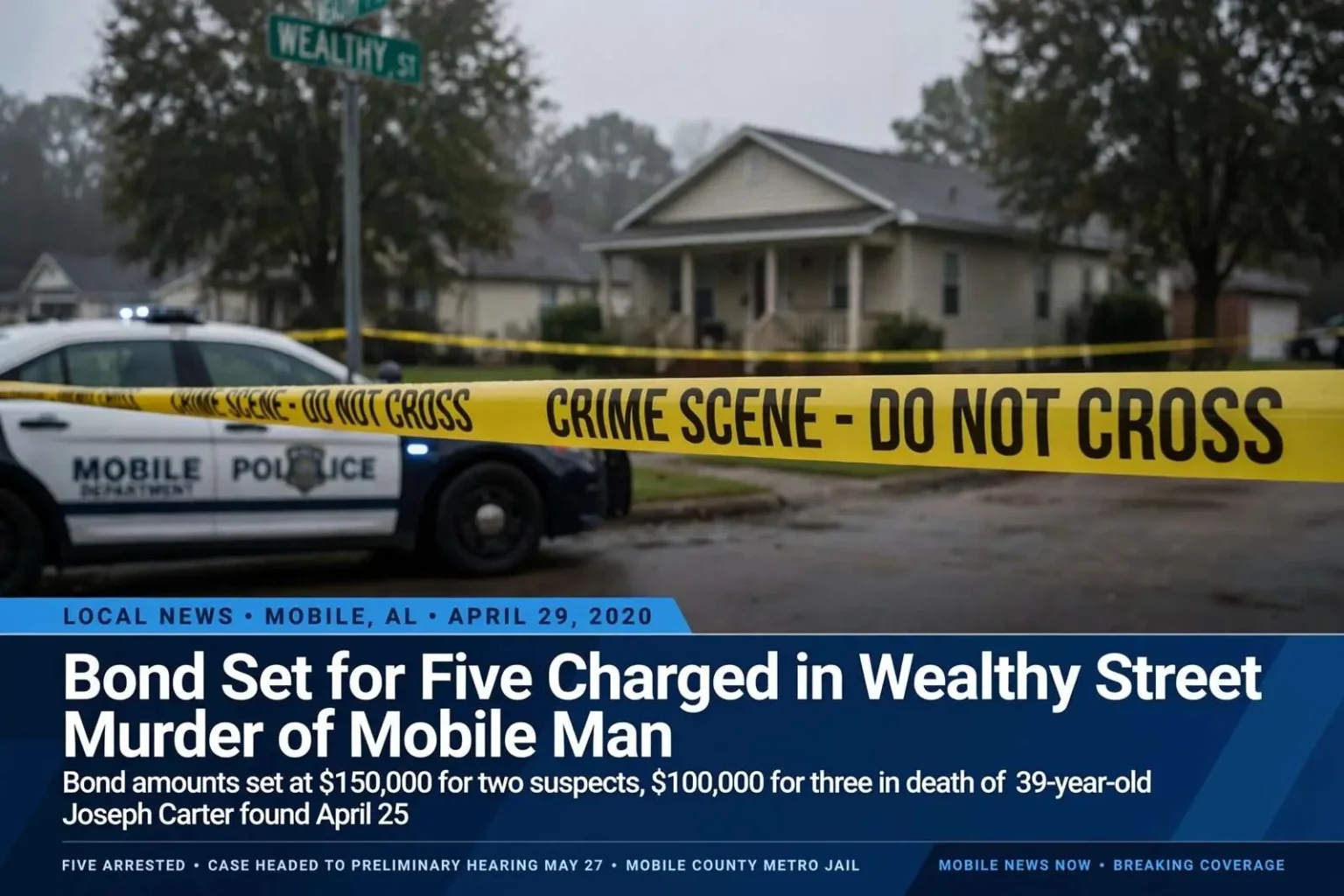
Bond has been set for the five people charged in the death of a Mobile man whose body was found on Wealthy Street in late April 2020. Mobile police officers discovered 39-year-old Joseph Carter dead outside a home on Wealthy Street just before 7 a.m. on Saturday, April 25, 2020. Investigators treated the case as a homicide from the outset, and police said they believed Carter may have been beaten to death.
The discovery set off one of the Mobile Police Department’s pandemic-era homicide investigations, conducted under the extraordinary constraints of April 2020 — a city weeks into emergency restrictions, with detectives balancing traditional canvassing against the new realities of interviewing witnesses in a socially distanced world. Wealthy Street sits in a residential section of the city where a body found outside a home at daybreak draws immediate attention, and the early-morning timing meant the scene was secured while most of the neighborhood was just waking.
Police have not released a detailed account of what led to Carter’s death, and with arrests made and the case headed toward the courts, much of what investigators assembled will come out in preliminary hearings and trial rather than in press releases. What is publicly established is the sequence: a man found dead outside a residence, a homicide classification, a belief that the death involved a beating, and within days, five suspects in custody.
Five arrested and charged
Days after the discovery, Mobile police announced that five people had been arrested and charged with murder in connection with Carter’s death: Martha Hickbottom, Marlasha Hickbottom, Lacey Hickbottom, Lawrence Buford, and Jeremiah Wright. Police have not said whether any of the five are related to one another, despite the shared surname among three of the defendants. All were booked into the Mobile County Metro Jail to await trial.
Five murder arrests in a single case is an unusual count for Mobile, and it signals prosecutors’ view that the events outside the Wealthy Street home involved multiple participants acting together. Alabama’s murder statute covers deaths caused during the commission of certain assaults, and Alabama law also recognizes accomplice liability — a person who aids or encourages a killing can be charged with murder even if they did not deliver the fatal act themselves. The charging decisions in multi-defendant cases typically reflect how investigators divided responsibility among those present.
The Mobile County Metro Jail, where all five were booked, processes thousands of arrests a year for the county’s law enforcement agencies, and murder suspects arrested there await the two steps that follow any felony arrest in Alabama: a bond determination and a preliminary hearing where a judge reviews whether probable cause supports the charge.
Bond amounts and what they mean
According to bond hearings held April 29, bond was set at $150,000 each for Martha Hickbottom and Lawrence Buford, and $100,000 each for Marlasha Hickbottom, Lacey Hickbottom, and Jeremiah Wright. The differing amounts suggest the court weighed individual circumstances — alleged roles, criminal histories, community ties — in setting each figure, even where the charge itself was identical.
Bond in Alabama serves a specific legal purpose: it allows a presumptively innocent defendant to remain out of custody before trial while giving the court financial assurance that the defendant will appear. In a $150,000 bond, a defendant who uses a bail bond company typically pays a non-refundable premium of roughly 10 to 15 percent — $15,000 to $22,500 — to secure release, with the full amount owed if they fail to appear. For defendants who cannot post even that, the bond amount determines how long they wait in jail before trial.
Judges in Mobile County’s District and Circuit Courts set bonds at initial appearances within days of arrest, often with standard ranges for offense classes that are adjusted for individual factors. Murder carries the possibility of life imprisonment or, in some circumstances, the death penalty in Alabama, which places these defendants’ bonds at the higher end of the scale even when judges see no flight risk or danger that would justify denying bail outright.
The next steps in court
Preliminary hearings for the defendants were scheduled for May 27, 2020. The preliminary hearing is where the state must show a judge enough evidence to establish probable cause that each defendant committed the crime charged. It is not a trial — no verdict is rendered, and the evidentiary standard is far lower than proof beyond a reasonable doubt — but it is the first public airing of the state’s case, and often the first time the basic outline of what investigators believe happened becomes part of the court record.
Defense attorneys use preliminary hearings to lock in testimony, probe the strength of the state’s evidence and preserve issues for later motions. Prosecutors, for their part, sometimes waive the hearing and take the case directly to a grand jury, which in Alabama formally issues the indictment that moves a felony case to Circuit Court. Either way, the May 27 date marked the point where the case would leave the police phase and become, primarily, a courtroom matter.
The timeline also reflects the constraints of spring 2020. Alabama’s courts, like the state’s other institutions, were operating under emergency orders during the coronavirus pandemic, with many proceedings delayed or rescheduled as courthouses limited access. A hearing set a month out from arrest was, in that environment, a relatively quick turnaround, and the pandemic’s slowdowns would continue to shape the case’s path through the system in the months that followed.
Homicide work in Mobile
The case sits within a broader picture of violent crime response in Mobile. The Mobile Police Department’s homicide unit investigates the city’s killings with support from patrol officers, forensics and the District Attorney’s office, and the department has historically cleared a substantial share of its homicide cases through arrests — a measure that depends heavily on witnesses coming forward in the crucial first days after a death. Five arrests within roughly a week of a body being found represents the kind of pace detectives aim for, and it suggests witnesses or evidence pointed investigators toward the suspects quickly.
Multi-defendant homicide cases also test the capacity of the court system. Five defendants means five defense attorneys, coordinated scheduling, and a trial — if the cases reach trial rather than resolution by plea — that can consume weeks of court time. Prosecutors frequently sever multi-defendant cases or resolve some defendants through plea agreements to manage the logistics, and each defendant’s path to resolution can diverge sharply depending on the evidence of their individual role.
For the family of Joseph Carter, the arrests and bond hearings mark a transition from unanswered questions to a legal process measured in years. Murder cases in Alabama commonly take a year or more to reach trial once indicted, and appeals can extend the timeline well beyond that. The May 27 preliminary hearings were the first scheduled milestone in that long calendar — the moment when the case moved from the Wealthy Street scene and the police annex to the courthouse where its outcome will eventually be decided.
Mobile Countys criminal justice institutions will carry the case from here. The District Attorneys office decides the charging path after preliminary hearings; the Circuit Court judges of the 13th Judicial Circuit handle the trials; and the jail on Sheriff Johnson Road houses defendants who remain in custody. Each stage has its own calendar, its own rules and its own delays, which is why even the most straightforward homicide case is typically resolved over a span of years. For a case that began with a 7 a.m. discovery on Wealthy Street, the systems machinery has only begun to turn.
The Wealthy Street case also illustrates how homicide investigations begin, because the first hours matter most. When patrol officers found Carter just before 7 a.m. on a Saturday, the scene outside the home became the cases foundation: measurements, photographs, evidence collection and the first interviews with neighbors, all conducted while the trail was freshest. Detectives then work backward — phone records, surveillance footage from nearby homes and businesses, and interviews that establish who was present and when. The speed of the arrests suggests that work converged quickly on the five people who were eventually charged.
Community involvement remains a decisive factor in cases like this one. Mobile police regularly ask residents with information about any homicide to come forward, through direct contact with investigators or through the departments tip channels, and anonymous tips can qualify for rewards through regional crime-stoppers programs. In multi-defendant killings, details that seem minor to a witness — a vehicle seen leaving the street, an argument heard earlier in the evening — often prove to be the pieces that clarify each participants role and support the charges the state ultimately files.


