
Bond Set for Johnny Vail After RV Taylor Barricade Standoff With Mobile Police
Bond was set at $45,000 for Johnny Vail after an RV Taylor barricade standoff in which suspects allegedly fired at Mobile police. No officers were hurt.
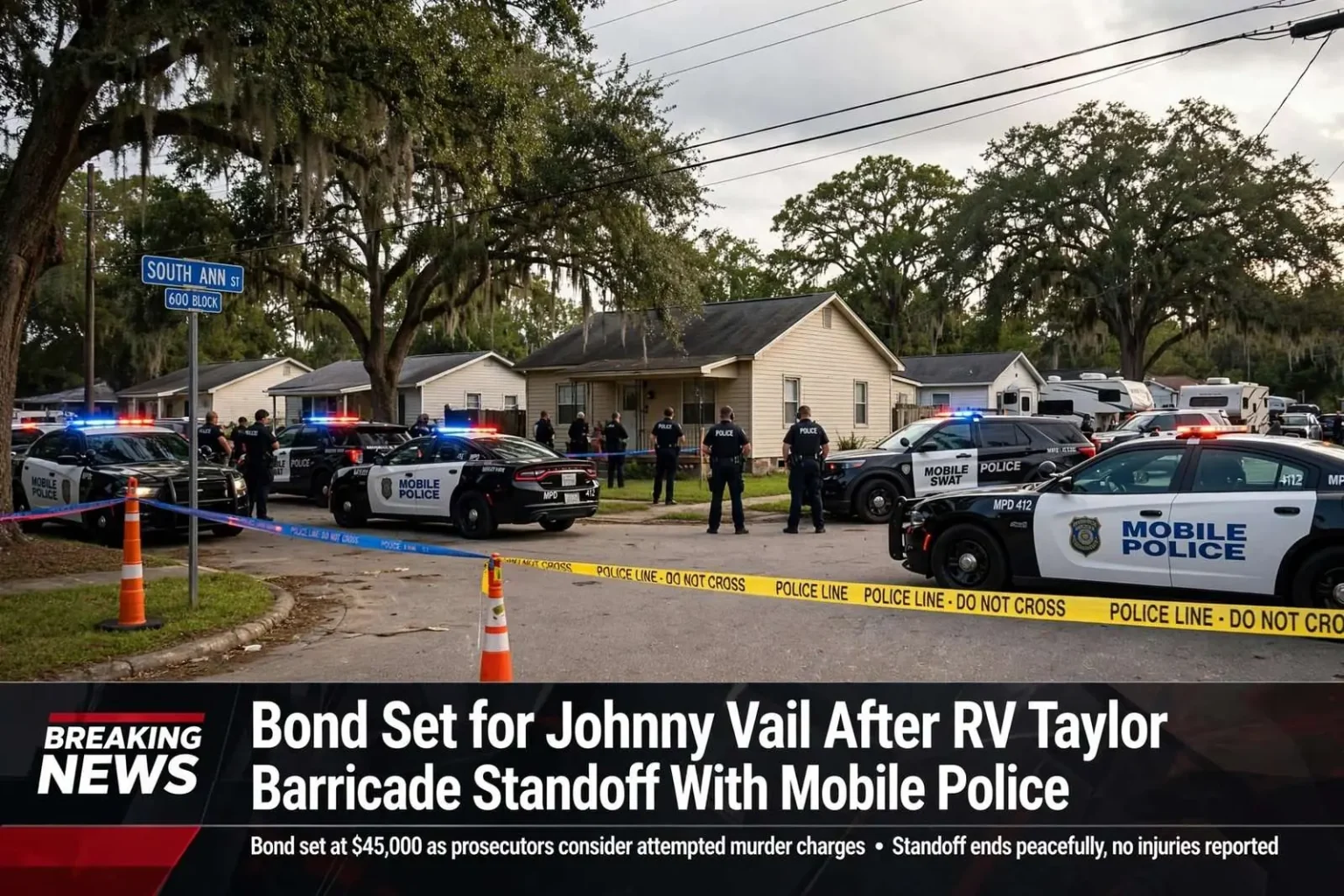
Bond was set at $45,000 for one of two suspects accused of firing at Mobile police during a barricade standoff in the RV Taylor community, with prosecutors warning that attempted murder charges could still be added as the investigation continues.
The standoff unfolded on South Ann Street, where officers surrounded a home in a cul-de-sac after narcotics officers attempted a drug stop nearby. According to Public Safety Director James Barber, the suspects fired at police and an officer returned fire before the situation was resolved peacefully — an ending that officers and neighbors alike described as the best possible outcome given how the afternoon began.
No one was hurt once the suspect barricaded himself inside the home, Barber said, and no officers were injured in the incident. Police credited patient work by negotiators and intermediaries for bringing the ordeal to a close without further gunfire.
How the Standoff Began
The sequence started when narcotics officers with the Mobile Police Department attempted a drug stop in the RV Taylor area, a neighborhood in the city’s Maysville corridor where the department has run focused enforcement operations. The attempt spiraled into a broader confrontation when the suspects fired at pursuing officers, prompting a massive police response to the South Ann Street home.
Officers established a perimeter around the residence, a single-family home at the end of the cul-de-sac, and began working to establish contact with whoever was inside. Because the neighborhood is densely built and home to many families, officers moved quickly to clear nearby residents from the line of fire as the situation developed.
Rather than force the issue, officers first reached out to the barricaded suspect’s close friends to help communicate with him — a de-escalation tactic that law enforcement officials say often succeeds where loudspeaker commands fail. Familiar voices, they note, can persuade a frightened or desperate person to surrender when they might otherwise hold out against strangers.
Barber’s Account of the Response
Barber, who leads public safety operations for the city and has overseen the police and fire departments’ coordinated responses to critical incidents, said no shots were fired once the suspect barricaded himself inside the home. That detail matters both for the safety review that follows any police shooting and for the way the case will proceed through the courts.
An officer did return fire during the initial exchange when the suspects fired at police, according to Barber’s account, making the incident one of the relatively few in the city each year in which shots are exchanged between officers and suspects.
Two handguns were recovered from the scene, though it was not known whether they were stolen. Ballistics and ownership checks typically follow such recoveries as investigators piece together where the weapons came from and whether additional charges related to the firearms themselves are warranted.
The Suspects and Their Injuries
Police identified the barricaded suspect as Johnny Vail, a name familiar to Mobile County law enforcement. Authorities said Vail was also involved in the 2015 Christmas shooting at the Wynnsong Theater on Schillinger Road, a terrifying holiday-day incident at the west Mobile movie theater that drew wide attention when gunfire erupted at the crowded cinema.
A second suspect, 20-year-old Andrew Lee Mitchell, was shot during the initial exchange and taken to University Hospital, the region’s major trauma center and the destination for the most seriously injured patients in south Alabama. Both suspects were expected to recover from their injuries.
University Hospital — now part of the USA Health system affiliated with the University of South Alabama — routinely handles gunshot victims from across Mobile County, and its trauma teams are the first line of care in incidents like the South Ann Street shooting.
The Charges So Far
Vail was booked into Mobile Metro Jail on charges including receiving stolen property, certain persons forbidden from carrying a pistol, and 14 counts of possession of a forged instrument. The forgery counts — fourteen of them — suggest investigators believe Vail was in possession of a batch of fraudulent documents, a category of charge that covers instruments ranging from counterfeit checks to falsified identification.
The charge of being a certain person forbidden from carrying a pistol applies to individuals legally barred from possessing firearms, typically because of prior felony convictions. Combined with the alleged exchange of gunfire with officers, that charge positions prosecutors to seek far more serious counts as the case develops.
Police said additional attempted murder charges were possible, a signal that the district attorney’s office is awaiting the results of the shooting investigation — including ballistics, witness statements, and the officer-involved shooting review — before deciding how to present the case to a grand jury.
The RV Taylor Neighborhood and South Ann Street
The RV Taylor community takes its name from the public housing development and surrounding neighborhood south of downtown Mobile, an area that has long been the focus of community policing efforts and investment programs aimed at reducing violent crime. Streets like South Ann Street, with their compact blocks and cul-de-sacs, can complicate police operations — few approaches, limited escape routes, and nearby homes packed close together.
A barricade situation in such a setting requires police to balance two competing priorities: containing the suspect while protecting the residents whose homes surround the scene. The decision to call in friends of the suspect rather than immediately storm the residence reflected that balance, officials indicated, as did the methodical pace of the negotiations.
Standoffs involving barricaded suspects are among the most resource-intensive incidents a police department handles, often drawing on patrol officers, negotiators, SWAT personnel, and command staff for hours at a time. The Mobile Police Department’s protocol calls for patience in cases where no hostage is involved and no one is in immediate danger — a policy that paid off on South Ann Street.
The 2015 Wynnsong Theater Shooting Connection
Vail’s alleged connection to the 2015 Christmas shooting at the Wynnsong Theater on Schillinger Road adds a layer of history to the case. The Christmas Day incident at the west Mobile multiplex shocked the city, unfolding at a crowded theater on one of the busiest moviegoing days of the year and prompting a large police response to the Schillinger Road cinema.
The theater sits amid the busy retail corridors of west Mobile, an area of shopping centers, restaurants, and neighborhoods stretching toward the Mississippi line. Incidents there draw immediate attention because of the crowds such venues attract, particularly on holidays.
Authorities did not detail the nature of Vail’s alleged involvement in the theater case, but the reference underscored what officers believed they were dealing with during the barricade — a suspect with a documented history of violent incidents.
What Comes Next in the Case
With bond set at $45,000 on the current charges, the immediate question is whether prosecutors will add attempted murder counts tied to the exchange of gunfire. In Alabama, firing at a police officer can support attempted murder charges, which carry far steeper potential sentences than the weapons and forgery counts Vail currently faces.
The officer who returned fire will also be part of the administrative review that follows any officer-involved shooting, a standard process in Mobile that examines whether departmental policies on the use of force were followed. Barber’s public account — that suspects fired first and the officer responded — will be tested against the physical evidence gathered from the scene.
A Peaceful End to a Dangerous Afternoon
For the residents of the RV Taylor community, the most important fact of the day was the simplest one: the standoff ended peacefully. Nobody inside the home was seriously hurt, no officers were injured, and the neighborhood was spared the kind of violent conclusion that barricade incidents sometimes produce.
Mobile police leadership has repeatedly emphasized the role of negotiation-first tactics in cases like this one, pointing to the use of personal intermediaries — friends, family members, pastors — as a practice that has defused numerous barricade situations across the city over the years. The South Ann Street case fit that pattern, with the suspect surrendering after hours of patient communication.
The recovery of two handguns from the scene, and the pending question of whether they were stolen, will also feed into the broader enforcement picture. Stolen firearms circulating in Mobile’s neighborhoods remain a central concern of the department’s narcotics and violent crime units, and tracing recovered weapons is a routine part of building cases against suspects and their suppliers.
The Bigger Picture on Violent Crime
The incident illustrates the chain of escalation that narcotics enforcement can produce — a routine drug stop that turned into gunfire, an officer-involved shooting, and a neighborhood-wide police response. Departments across the Gulf Coast have struggled with that dynamic as they attempt to disrupt drug activity in residential areas while minimizing risk to officers and residents.
It also highlighted the role of the Mobile Metro Jail and the county’s court system in processing the aftermath. Booking on multiple counts, bond hearings, and the possibility of additional charges mean the legal story of the South Ann Street standoff will continue long after the police lights are gone.
For now, the case stands as an example of both the dangers Mobile officers face during routine enforcement and the de-escalation practices the department has invested in. A standoff that could have ended in tragedy instead ended with a suspect in custody, a wounded suspect expected to recover, and a neighborhood intact — the outcome police training is designed to produce.