
Boys & Girls Clubs of South Alabama Names Robert Kennedy as New CEO
Robert Kennedy Jr. takes over as CEO of Boys & Girls Clubs of South Alabama, succeeding Tim Wills after six years leading the Mobile nonprofit.
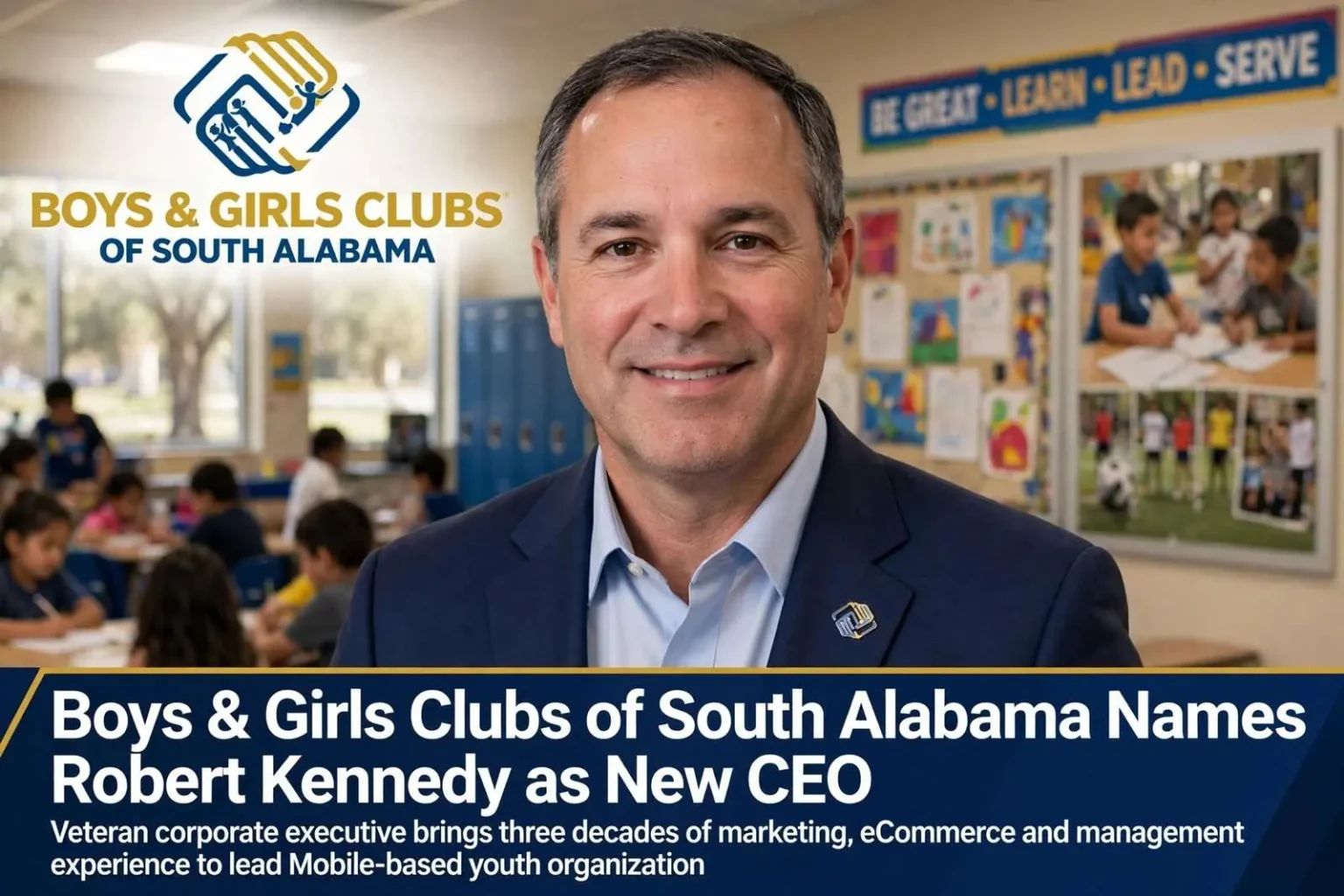
The Boys & Girls Clubs of South Alabama has a new leader at the top: Robert Kennedy has been named Chief Executive Officer of the Mobile-based youth organization, succeeding Tim Wills, who stepped down after six years in the role. The transition places a veteran corporate executive with a background spanning marketing, eCommerce, and general management at the head of an agency that serves young people across Mobile County year-round.
The change comes at a meaningful moment for the organization, which operates clubhouses and programming that reach hundreds of school-age children, and which depends on a mix of donors, community partners, and volunteers to keep its services free or affordable for the families who rely on them. Board members who led the search said the goal was to find someone who could strengthen the club’s public profile while managing the operational demands of a multi-site nonprofit.
A Marketing and Operations Background
According to the organization’s announcement, the board set out to find a successor with deep experience in marketing, general management, and human resources. Kennedy brings three decades of team leadership and budget management to the job, along with a résumé that stretches from the military to some of the country’s best-known retail brands.
His education reflects that path. Kennedy holds a bachelor’s degree in political science from the United States Naval Academy and a master’s degree in leadership and human resource development from the Naval Postgraduate School. The combination of a service academy background and graduate training in organizational leadership shaped a career spent managing large teams and complex budgets.
Most recently, Kennedy served as chief marketing officer for Brett/Robinson, the Gulf Shores vacation rental company — a correction from earlier reports that had described him as that firm’s chief executive. In that role he was responsible for how one of the Alabama Gulf Coast’s largest vacation rental operations presents itself to travelers in a fiercely competitive beach market.
His résumé also includes a stint as general manager of global eCommerce for Bio-Rad Laboratories, a life sciences company, and executive roles at Sears Holdings, Toys “R” Us, and Harrah’s Entertainment. Those positions placed him inside organizations wrestling with the shift of American retail and entertainment onto digital platforms, experience the club’s board believes will translate into sharper outreach and fundraising for the nonprofit.
‘A Deep History of Serving Youth’
In a statement accompanying the announcement, Kennedy said he was humbled by the selection and honored to join an organization with a long record of serving young people across the community. He added that he looked forward to working with the board, club leaders, and volunteers on a unified vision for the future.
Outgoing CEO Tim Wills led the organization for six years, a period that included the challenges of operating youth programs through a pandemic and the ongoing work of sustaining donations and partnerships in a competitive charitable landscape. Leadership transitions at nonprofits of this size carry significant weight, because the CEO is simultaneously the organization’s chief fundraiser, public face, and operational manager.
What the Organization Does
The Boys & Girls Clubs of South Alabama runs year-round youth development programs across Mobile County focused on character and leadership, education and career readiness, health and life skills, the arts, and fitness. The local clubs are part of the national Boys & Girls Clubs movement, which has operated for more than a century and is known for providing safe, structured after-school and summer environments for young people, particularly in communities where families have limited access to enrichment programs.
On a typical weekday, club programs blend homework help and tutoring with organized athletics, art and music activities, and lessons aimed at building practical skills for adulthood. Teen members often encounter college and career programming that introduces them to scholarship opportunities, job readiness training, and mentors from the local business community — the same community Kennedy spent his corporate career working within.
Why the Hire Matters for Mobile
For a nonprofit whose reach extends across Mobile County, the chief executive’s background in marketing and general management has practical consequences. Fundraising for youth organizations is increasingly competitive, and donors — from individual families to Gulf Coast foundations and corporations — tend to support organizations that communicate their impact clearly and manage their budgets transparently. A CEO who has spent decades building brands and running operations is being counted on to do exactly that for the clubs.
The emphasis on human resources experience in the search also reflects the realities of nonprofit leadership. Organizations like the Boys & Girls Clubs depend on a workforce that blends full-time youth development professionals, part-time staff, and a large volunteer corps. Recruiting, training, and retaining that mix of people is one of the hardest parts of the job, particularly for programs that run after school, on weekends, and through the summer.
Mobile’s clubs also operate in a regional context that makes their mission especially visible. The Gulf Coast economy leans heavily on industries — tourism, hospitality, healthcare, aerospace, and the Port of Mobile — that increasingly expect trained, work-ready employees, and youth development organizations are widely viewed as the first rung on that ladder. Board members and community partners frequently describe support for the clubs as an investment in the area’s future workforce rather than simple charity.
The National Context
The Boys & Girls Clubs movement serves millions of young people across the country through thousands of local organizations, each governed by its own board and responsible for its own fundraising. That structure means local CEOs carry chief-executive duties similar to those of a small company: overseeing facilities, safety, staffing, programs, finances, and brand, all while answering to a volunteer board of directors drawn from the local business and civic community.
National research on out-of-school time consistently points to the value of structured after-school programming for academic performance, graduation rates, and long-term earnings, particularly for students from lower-income households. Organizations like the Boys & Girls Clubs of South Alabama occupy a central place in that landscape along the Gulf Coast, making the selection of steady, experienced leadership a decision with consequences well beyond one organization’s headquarters.
Looking Ahead
With Kennedy now at the helm, attention turns to how the organization builds on the foundation laid during Wills’ six-year tenure. The priorities outlined in the search — stronger marketing, disciplined management, and human resources depth — suggest a focus on growth in visibility and sustainability rather than a dramatic change in mission.
For the families who depend on the clubs, the day-to-day programs remain the constant: safe spaces, caring adults, and structured activities designed to help young people finish school with a plan for the future. The organization’s leadership says the goal of the transition is to ensure those services not only continue but expand their reach across South Alabama in the years ahead.
Community members interested in supporting the mission — whether through donations, volunteering, or partnership inquiries — are encouraged to contact the organization directly, as clubs throughout the region rely on local involvement to sustain the programming that defines them.
What a Club Membership Looks Like
For parents across Mobile County, the practical value of the clubs shows up in the hours after the final school bell. Children and teenagers who attend are checked into supervised facilities where trained staff lead them through a rotating schedule: time set aside for homework, structured games in the gymnasium, art and music sessions, and small-group discussions aimed at building confidence and good decision-making. Membership fees are kept low or eliminated entirely, with fundraising covering the difference, so that a family’s income is not the deciding factor in whether a child can take part.
The organization’s program model mirrors the national Boys & Girls Clubs framework, which organizes activities around five core areas: character and leadership development, education and career readiness, health and life skills, the arts, and sports, fitness, and recreation. Local clubs adapt that framework to their own neighborhoods, partnering with schools, churches, and civic groups to meet young people where they are.
Teen programming deserves particular attention in a market like Mobile, where employers in shipbuilding, healthcare, aviation, and logistics have voiced ongoing concerns about finding qualified young workers. Career-readiness tracks — resume workshops, interview practice, job shadowing, and scholarship guidance — aim to connect club members with those opportunities before they leave high school, turning the clubs into an early bridge between the county’s classrooms and its economy.
A Community Investment
Boards searching for a new CEO at youth nonprofits typically weigh two questions: can the candidate keep programs running smoothly, and can they raise the money the mission requires? The selection of Kennedy answers both with a single profile. His career has been built on managing teams and budgets inside demanding corporate environments, and the organizations he has served — from the military’s leadership pipeline to national retail chains to a Gulf Coast tourism brand — all rewarded leaders who understood both numbers and people.
For donors and volunteers across South Alabama, the appointment signals continuity with an added emphasis on professional management. The clubs’ work continues as it always has, with staff and volunteers showing up each day for the county’s young people, while the organization’s new leadership works to ensure the funding, partnerships, and public awareness are there to sustain that work deep into the future.


