Brad Pitt Rumors Swirled Around Fairhope Film Festival in 2008
Archived WKRG coverage documented unconfirmed rumors that Brad Pitt was visiting Fairhope during its first film festival in 2008.
Historical community feature, published from archived local news coverage.
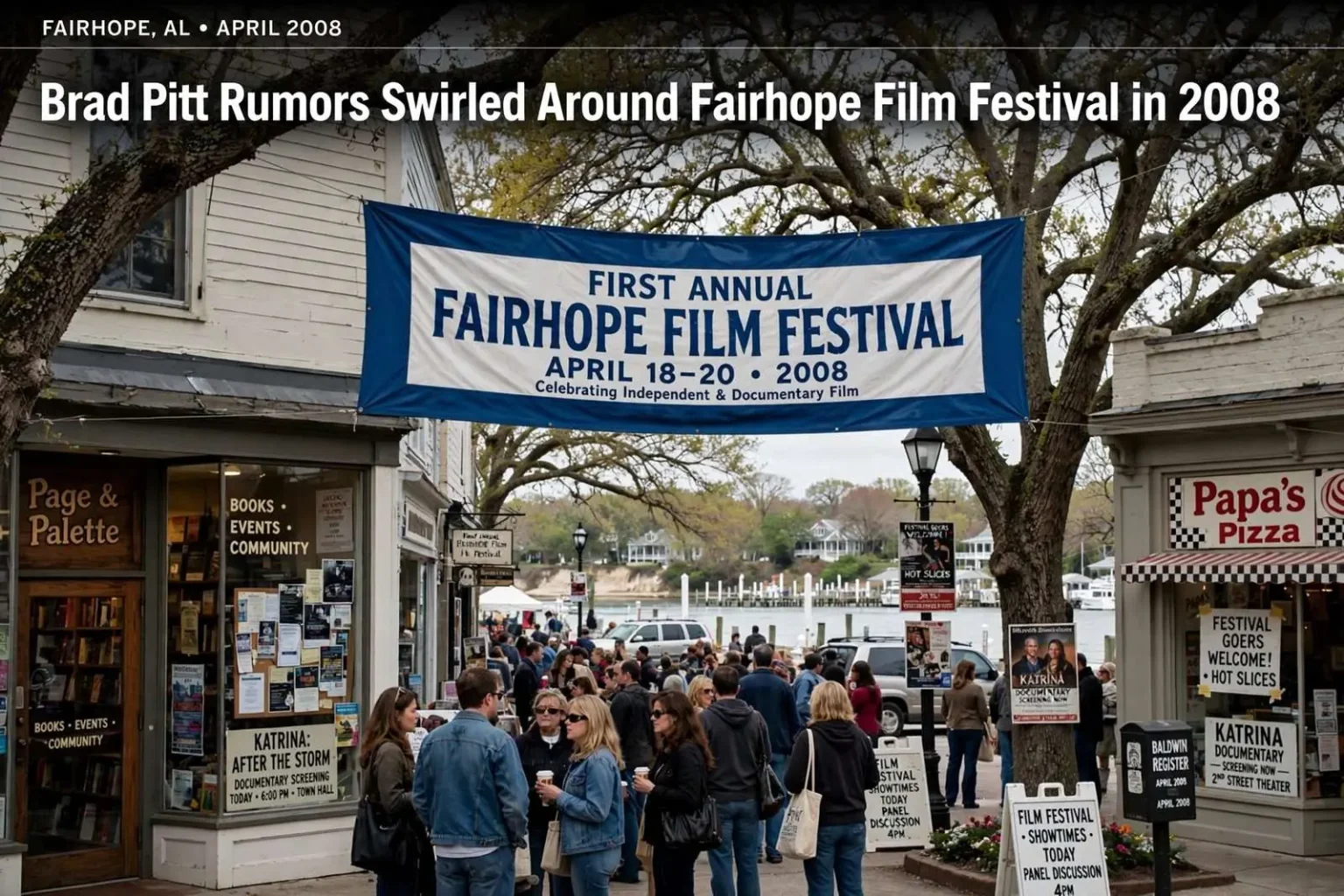
Rumors that actor Brad Pitt was visiting Fairhope spread around town during the first Fairhope Film Festival in April 2008, according to an archived local news feature — a burst of speculation that swept through the Baldwin County arts town faster than any film on the schedule. For a few festival days, the question on Running Streets and sidewalk patios was not which documentary to see, but whether one of the world’s most famous movie stars was walking among the crowds.
The station reported that the speculation had a plausible connection, which is precisely why it spread so readily. Pitt had been involved in Hurricane Katrina relief efforts in the years after the 2005 storm devastated the Gulf Coast and New Orleans, and a Katrina documentary was screening at the festival. A festival film about the storm, a star with a public stake in the recovery, and a bayside town a few hours from the affected region — the ingredients made the rumor feel believable enough to repeat.
The station did what a newsroom is supposed to do with a rumor: it checked. Reporters contacted the festival director, the documentary’s producer, the screening room, Papa’s Pizza and Page and Palette — the independent bookstore that serves as one of Fairhope’s cultural landmarks — but found no confirmation that Pitt was actually there. Every check came back the same way: no sighting, no appearance, no reservation, no confirmation.
People nevertheless called local businesses and attended the festival hoping for a sighting. Phones rang at restaurants and shops; crowds scanned festival venues for a familiar face behind sunglasses. The hope itself became part of the festival’s first-year story — a small-town festival suddenly playing host to a celebrity manhunt conducted entirely on speculation.
The station’s conclusion was clear: there was still no confirmation that Pitt had been in Fairhope. This historical article reports the rumors as rumors, not as a verified visit — and that distinction is the point of the story that Fairhope remembers.
Fairhope in festival season
The setting explains the rumor’s persistence. Fairhope, perched on the bluffs above Mobile Bay, had spent decades cultivating an identity as an artists’ and writers’ colony — a town of galleries, independent bookshops and sidewalk cafes that draws visitors from Mobile, Pensacola and across Baldwin County. Its downtown, anchored by the flower-filled streets around the pier and the fountain park, is exactly the kind of place people imagine a movie star slipping away to: walkable, low-key, and far from the paparazzi circuits of Los Angeles.
The first Fairhope Film Festival, launched in April 2008, added a new attraction to that identity: a curated lineup of independent and documentary films screened across the town’s venues. First-year festivals run on volunteer energy and community goodwill, and the arrival of an event promising art-house cinema in a town of a few thousand residents drew exactly the engaged, curious crowd a festival hopes for. It also drew, as it turned out, a rumor worthy of the big leagues.
The Katrina documentary screening gave the festival a topical centerpiece. Documentary films about the 2005 hurricane — its devastation, the flooding of New Orleans, the slow recovery of the Gulf Coast — circulated widely in the years after the storm, and a screening in a Gulf Coast town carried particular weight. Audiences in Fairhope had watched Katrina’s aftermath firsthand: Baldwin County took a direct hit from the storm’s eastern side, sheltered tens of thousands of evacuees, and spent years in the region’s long recovery.
Pitt’s public role in that recovery made the connection feel natural. In the years after Katrina, the actor became one of the most visible national figures associated with rebuilding New Orleans, championing efforts to construct sustainable, storm-resistant housing in the city’s damaged neighborhoods. His frequent presence in the Gulf region was well documented, and the rumor mill in Fairhope needed only the slender bridge of a Katrina documentary screening to imagine him crossing the bay.
The geography helped the story along, too. Fairhope sits barely an hour’s drive from New Orleans by interstate — close enough that a spur-of-the-moment trip is an easy errand — and Mobile Bay communities have long hosted New Orleans families who keep second homes or weekend retreats on the eastern shore. A star with ongoing Gulf Coast commitments showing up incognito in a quiet bayside town was, for the rumor’s tellers, not a stretch at all. It was the kind of thing that could plausibly happen, which is precisely what makes such rumors so durable: the story asks only for a possibility, not a fact.
How the rumor worked — and why it mattered
The mechanics of the rumor were classic small-town celebrity watching. Someone heard something, told someone at a screening, and by the next morning the story had grown a life of its own. Calls went out to Papa’s Pizza, the local pizza institution, and to Page and Palette, the bookstore that functions as Fairhope’s living room — hosts, book clubs and author events have long made it a community hub. Had Pitt stopped in for a slice or browsed the shelves? The businesses had nothing to report, but the calls themselves showed how quickly hope travels in a town where everyone knows everyone.
The festival’s organizers found themselves managing a celebrity sighting they could neither confirm nor deny. The festival director had no announcement to make; the documentary’s producer had no star to bring on stage. Yet the rumor arguably did the festival a favor — it packed venues, put the first-year event on tongues across Baldwin County, and gave the inaugural festival a legend to tell in later years: the spring a movie star might have been among us.
For the station’s newsroom, the episode was a small case study in rumor discipline. The temptation in local news is to let a good story run on the strength of “people are saying” — but the checks at the festival office, the production company, the screening venue, the pizza parlor and the bookstore all came back empty, and the report said so plainly. The published conclusion — no confirmation that Pitt had been in Fairhope — preserved the fun of the story while refusing to convert a rumor into a fact.
It is worth pausing on how many places the station actually called before writing the story. The festival director would know about any planned appearance. The documentary’s producer would know about any travel connected to the film. The screening room staff would know about any visit to a venue. Papa’s Pizza and Page and Palette were the town’s likeliest stops for an incognito celebrity — the restaurant everyone ends up at and the bookstore no visitor skips. Five checks across every layer of the rumor’s supposed origin, and all five came back without a sighting. That is what separates a reported story from a repeated one: the calls were made, the answers were the same, and the answer went into print.
That discipline matters more than it might seem. Celebrity-sighting rumors follow a predictable arc in small communities: they are harmless while they remain speculation, but they harden into false local history the moment they are published without sourcing. Years later, a reader might reasonably ask whether Pitt really visited Fairhope in 2008 — and the honest answer, preserved by the archived coverage, is that the town hoped he had, checked everywhere it could, and never confirmed that he did.
The festival’s afterlife
The first Fairhope Film Festival went on to become a fixture of the town’s cultural calendar, and the 2008 rumor became part of its founding lore. Festivals trade on exactly this kind of story — the legend of the near-sighting, the year anything seemed possible — and Fairhope’s version has the virtue of being true to what actually happened: a plausible connection, an enthusiastic town, a diligent newsroom, and a star who may or may not have ever come near the bay.
What the episode captured, in the end, was Fairhope itself: a town that loves its films, its bookstores and its pizza joint, gets swept up easily in a good story, and — thanks to the reporters who made the calls — keeps the record straight. Brad Pitt’s presence in Fairhope during the first festival remains, to this day, a rumor. The town checked. No one confirmed it. And that is how the story is told.
This article is republished from archived local news coverage as a historical community feature. It reports the 2008 rumors as rumors and records the station’s finding: there was still no confirmation that Brad Pitt had been in Fairhope.