
Breast Cancer Survivor Brings Private, Personalized Medical Wigs to Mobile Women
Tracey Morgan of Sugar Me Lace offers custom cranial prostheses covered by insurance, giving Mobile women privacy and confidence during hair loss.
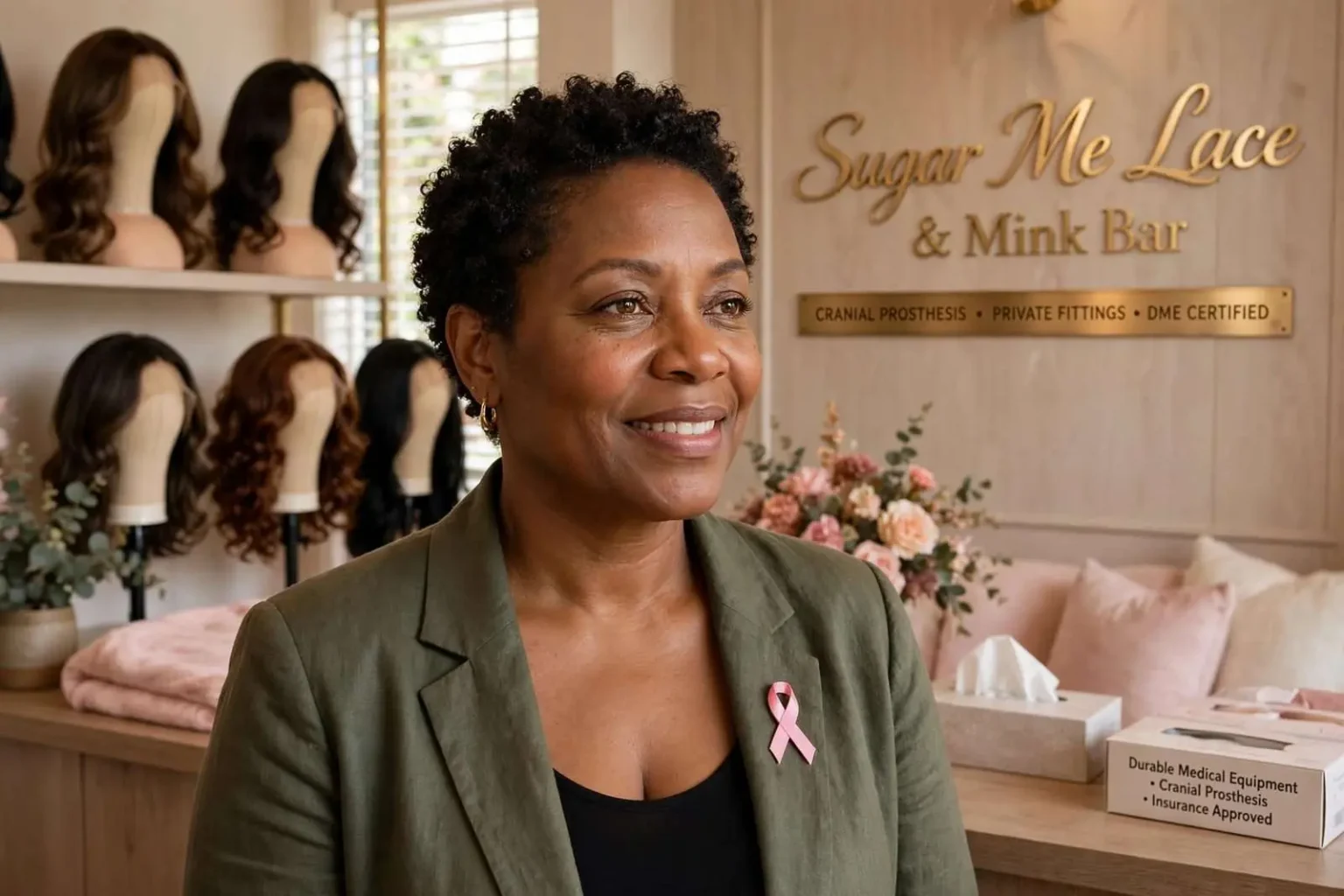
A Mobile business owner who lost her own hair to chemotherapy is helping other women navigate hair loss with custom medical wigs — and a private space to talk about it. Tracey Morgan, CEO and founder of Sugar Me Lace & Mink Bar, built the business around an experience she knows from the inside, and the difference shows in how appointments work: no open floor, no audience, no strangers watching a woman take her hair off.
From Diagnosis to a New Calling
Morgan was diagnosed with breast cancer in 1998 while pregnant with her son. Her mother and sister were also diagnosed, and all three lost their hair during chemotherapy treatment. That shared experience — three women in one family navigating the same loss at the same time — pushed her, years later, to create what she describes as a safe space for women searching for a new hairstyle after medical hair loss.
Hair loss is one of the most feared and most visible side effects of chemotherapy, and it arrives on top of everything else a diagnosis brings. For many women, the moment of losing their hair is when an illness that has been medical becomes public — coworkers, children and strangers can all see something has changed. A wig that looks and moves like the wearer’s own hair does not erase the illness, but it lets a woman decide who learns what and when, which is a form of control that patients consistently describe as mattering.
Sugar Me Lace offers custom, human-hair cranial prostheses — medical wigs designed to help women regain confidence after illness. The wigs can be styled any way the wearer prefers, and protective caps shield the scalp from scratches. The distinction between a cranial prosthesis and an ordinary fashion wig is more than vocabulary: a medical-grade prosthesis is constructed for a scalp undergoing or recovering from treatment, with attention to sensitivity, fit and the realities of skin that has changed during therapy.
Why Privacy Matters
Morgan said the idea grew out of an uncomfortable visit to a conventional hair store, where she had to remove her wig or scarf in front of a room full of strangers. “I visited a hair store and there was not an intimate setting there, you had to sit out in the open in front of everyone,” Morgan said. “I thought about women that had to come in to remove their wigs or scarves from their head and you have an audience standing behind you.”
That memory became the design principle for her own shop. Fittings for a medical wig require a woman to be bare-headed in front of someone — there is no way around it — and the question is who that someone is, and who else is in the room. Sugar Me Lace’s answer is a private setting where the fitting, the conversation and the decision all happen behind closed doors rather than across a public counter.
“Women can come in here and we can laugh, cry, get lunch, whatever helps them feel comfortable,” Morgan added. The formulation describes something closer to a salon-as-support-group than a retail transaction, and it reflects the client base: women in active treatment, survivors rebuilding after it, and family members trying to help someone through the worst stretch of a long year.
The Insurance Difference
Beyond comfort, there is a practical benefit that sets the business apart: Morgan is a certified Durable Medical Equipment provider, which means Sugar Me Lace accepts medical insurance for cranial prostheses. The certification matters financially for clients. A custom human-hair medical wig represents a significant expense, and when it is prescribed and billed as durable medical equipment rather than sold as a cosmetic item, insurance can cover a meaningful share of the cost for women whose policies include the benefit.
The DME pathway also changes the conversation at the doctor’s office. Physicians and oncology teams can refer patients for a cranial prosthesis the way they refer for other supportive equipment during treatment, folding hair loss into the medical care plan rather than leaving it as a private problem to be solved off the books. For women already carrying the costs of treatment, the difference between a covered prosthesis and an out-of-pocket purchase is not a small one.
Breast cancer touches an enormous number of Mobile families — it is among the most common diagnoses American women face, and the Gulf Coast’s network of oncology practices, screening programs and survivor groups means the client base for this kind of service is wide and permanent. A business that grew from one family’s experience in 1998 serves a need that, statistically, is not going away.
A Family’s Story Behind the Business
Morgan’s diagnosis while pregnant with her son marked the beginning of the family’s long experience with the disease, and the parallel diagnoses of her mother and sister made hair loss a shared family event rather than a private one. Women who have been through that experience together often describe the wigs and scarves of a treatment year as emotional territory — the wig on the stand, the scarf collection, the first time going out with a new style. Turning that territory into a profession was, in her telling, a way of making the hard part useful.
The business model reflects that origin. Sugar Me Lace serves women searching for a new hairstyle after medical hair loss — the phrase Morgan uses for a moment that is really about identity, not fashion. The custom construction means each prosthesis is built for one wearer, styled to her preferences, and fitted to a scalp that needs protecting; the protective caps that shield the scalp from scratches are part of that same attention to what treatment leaves behind.
What a Private Fitting Looks Like
A visit to the shop follows the arc Morgan wished she had found in 1998: a private appointment, time to talk, and a fitting that never requires a woman to sit exposed in front of strangers. Clients can bring family members they choose, not audiences they didn’t. The conversation ranges from cap construction and styling to whatever the day calls for — which is why Morgan describes the space as a place where women can laugh, cry, get lunch or simply feel comfortable.
The softer model does not come at the cost of the technical work. The certification that lets Sugar Me Lace bill insurance also means the fittings follow medical-equipment standards, with documentation of the client’s condition and needs. It is a hybrid that is still rare on the Gulf Coast: part salon, part medical supplier, and part support space, run by a woman who has sat on the client’s side of the wig stand.
For Mobile women beginning treatment or recovering from it, the shop offers a shortcut through a hard season — the assurance that hair loss will not have to be managed in public, and that the replacement will be made for them individually, by someone who lost hers in the same way.
Medical Wigs and How They Differ From the Rack
The term “cranial prosthesis” describes a category of wig constructed and documented for medical use, and the differences run deeper than marketing. A prosthesis is typically prescribed when hair loss results from chemotherapy, radiation, alopecia or other medical conditions, and it is built to accommodate a scalp that may be sensitive, tender or newly bare. Construction details matter: breathable caps that don’t irritate, monofilament tops that imitate natural growth, and human hair that can be cut, colored and styled like the wearer’s own.
For women in treatment, those details translate into daily life. A prosthesis can be slept in, exercised in and styled at home; it can match the hair a woman had before diagnosis or give her the chance to try something new; and it stays put through the routines of work and family that treatment interrupts but does not excuse. The protective caps Morgan’s shop provides shield the scalp from scratches during fitting and wear — a small accommodation that clients with sensitive skin notice immediately.
The custom route takes longer and costs more than an off-the-shelf wig, which is exactly why the insurance pathway matters. Human-hair prostheses are among the most expensive options in the category, and the women most likely to need one are also the women most likely to be facing treatment bills from every direction. Coverage turns the choice from a financial question into a fitting question, which is where it belongs.
The Gulf Coast’s Support Network for Survivors
Sugar Me Lace operates inside a regional support network that has grown steadily over the decades. Mobile’s hospitals and oncology practices connect patients to screening programs, nurse navigators and survivor support groups; area nonprofits run wig banks, mastectomy boutiques and financial assistance programs; and churches and civic groups across the city organize around the families that breast cancer touches. A woman diagnosed in Mobile today moves through a network of services that simply did not exist a generation ago — and a certified DME provider who understands the fitting from the inside is one of the stops on that path.
The private-appointment model also aligns with what survivor networks emphasize: that the emotional side of cancer treatment is medical business, not just personal business. Depression and anxiety during treatment are common and treatable, and small humiliations — like being bare-headed in a public shop — compound in ways that clinicians take seriously. A fitting that feels like an afternoon with a friend rather than an errand performed in public is part of the care.
A Business Built From a Hard Year
Entrepreneurs who build businesses out of personal hardship often describe the work as a way of repurposing it, and Morgan’s path fits the pattern. The 1998 diagnosis — while she was pregnant with her son — and the simultaneous diagnoses in her family placed her at the intersection of the experiences her clients now bring through her door: the fear, the treatment, the hair loss and the moment of looking for a new hairstyle and finding no comfortable place to look.
Two decades later, the shop she built answers that moment directly. It offers custom, human-hair cranial prostheses, styled any way the wearer prefers, in a room where the door closes and the conversation belongs to the client. It accepts medical insurance through Morgan’s DME certification, putting the cost within reach for women whose budgets are already stretched. And it keeps the private fitting — the feature she could not find in 1998 — at the center of the experience.
For women in Mobile beginning the same journey Morgan’s family began together, the shop offers something rare: expertise from someone who has been there, and a private room in which to begin again.


