Brewton Hurricane Isaias Cleanup Grows as FEMA Assesses Escambia County Damage
Debris piles keep growing in Brewton after Hurricane Isaias as FEMA, state and county teams assess damage to decide whether Escambia County qualifies for federal disaster aid.
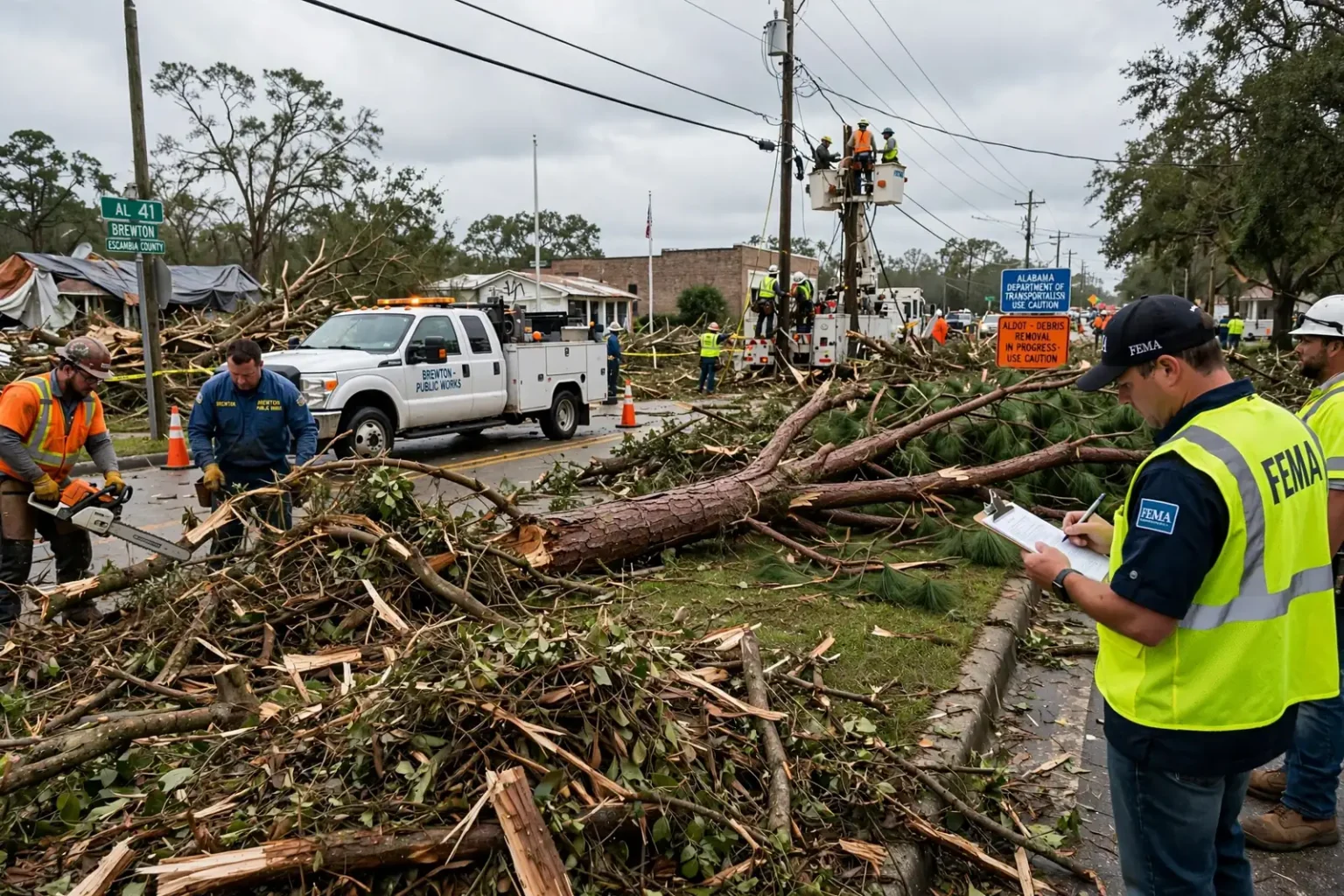
BREWTON, Ala. — The Brewton Hurricane Isaias cleanup began almost as soon as the winds died down, and the debris piles lining city streets keep growing as residents and crews clear downed trees and damaged property. Now, city and county leaders are waiting to learn whether the damage in Escambia County is severe enough to qualify for federal disaster assistance.
Brewton Mayor Frank Nalty said representatives of the Federal Emergency Management Agency were in the county and the city on Monday, Oct. 19, assessing conditions. He cautioned that federal help is not automatic and that the process follows a set timeline.
“There is a time line that has to be followed when it comes to FEMA disaster designation. Everyone involved has submitted the paperwork to ask for that designation. Until the assessments are complete, we are on our own. There is no guarantee that FEMA assistance will come.” — Brewton Mayor Frank Nalty
Officials with Escambia County, the City of Brewton and the City of East Brewton are in contact with state representatives to make sure the information needed to support a declaration has been submitted for consideration.
Debris removal coming to state highways
Some relief is on the way for the debris lining major routes through the area. Nalty said the Alabama Department of Transportation has contracted with Crowder Gulf, a Mobile company, to remove storm debris from state roads in the area over the next few days.
“They will be removing debris from along the roadways of AL 41, 31 and 29 with some of that path in the city limits,” Nalty said Monday. “That will be a blessing to the city when it comes to getting debris picked up.”
Because portions of those state routes pass through Brewton, the contracted crews will help reduce the volume of material that city workers would otherwise have to handle themselves. State-maintained highways are generally the responsibility of ALDOT, while city streets and county roads fall to local governments, which is why the cleanup is being divided among different agencies and contractors.
Nalty urged motorists to use caution until cleanup is complete. Debris piles near the roadway can narrow travel lanes, block sight lines at intersections and driveways, and hide hazards. Drivers should slow down around work crews and heavy equipment and watch for trucks entering and leaving the roadway.
More than 600 linemen restored power
Before debris could be hauled away, the first priorities were restoring electricity and clearing streets. Nalty described the effort as remarkable.
“It was nothing short of amazing,” he said. “We had more than 600 linemen working in the city on Saturday and into Sunday to bring all of our residents back on line. With all the damage to power poles, lines and trees everywhere, it was a daunting task. We can’t say thank you enough for their work and help in getting our community back closer to normal.”
The mayor said work began immediately after the storm and will continue until order is restored. He also praised city employees who have been on the job since the storm passed.
“Our city street and utilities workers have been blowing and going since the winds died down,” Nalty said. “They are tired, but they continue to work to get our city back to normal as much and as quickly as possible.”
Parks among the hardest-hit areas
City crews are still cleaning up several public spaces where trees came down during the storm. Areas named by city officials include:
- Jennings Park
- The Industrial Park
- Dogwood Hills Park
- The Fischer Center
- E.O. Wilson Nature Adventure Park, which experienced severe damage
The E.O. Wilson Nature Adventure Park is named for the late Edward O. Wilson, the renowned Harvard biologist and Pulitzer Prize-winning author who spent part of his childhood in Brewton. The heavy tree damage there and at other parks means residents may find some public spaces partly closed or limited while cleanup continues.
How the FEMA declaration process works
In a world where many things happen instantly, a federal disaster declaration is not one of them. Josh Johnson of the Alabama Emergency Management Agency said the declaration process has five steps. The first two are complete, and the third is in the “happening now” phase.
In a statement released Monday, Johnson explained that FEMA assessment teams have joined county and state experts for a joint Preliminary Damage Assessment in Alabama. That assessment is designed to determine whether storm damage in the state reaches the thresholds required for federal assistance.
If the teams find that the damage meets those thresholds, Johnson said, the governor would then be able to request a Major Disaster Declaration from the president through FEMA. If that request is made and approved, multiple forms of federal assistance could become available.
Major disaster declarations are issued under the federal Stafford Act. Generally, a Preliminary Damage Assessment brings together local, state and federal officials to document the type and extent of damage, including how many homes were affected and how much public infrastructure was damaged. The findings help the state determine whether a request is justified and help federal officials evaluate it. Only the president can approve a major disaster declaration, and approval can cover specific counties and specific types of assistance.
The Alabama Emergency Management Agency is the state office that coordinates disaster preparedness, response and recovery, working alongside county emergency management agencies and federal partners. During a damage assessment, its staff help gather and verify the information that will ultimately be used in any request for federal help. Brewton, the county seat of Escambia County, and its neighbor East Brewton are both part of that review, along with unincorporated areas of the county.
Types of federal help that could follow
Johnson’s statement outlined the main types of aid that could become possible if a declaration is approved:
- Individual Assistance: Direct financial assistance from FEMA to individuals for losses that were uninsured or underinsured.
- Public Assistance: Despite its name, this program is not aid “for” individual members of the public. It is money that goes from FEMA to help rebuild public infrastructure damaged by the storm, such as roads and bridges.
- Small Business Administration loans: A major disaster declaration could also open the door to SBA loan programs that apply in disaster situations.
Under the Public Assistance program, local governments can typically seek reimbursement for a share of eligible costs such as debris removal, emergency protective measures and repairs to public facilities. That is one reason local officials keep detailed records of storm-related work. SBA disaster loans, when available, are generally offered at low interest to homeowners, renters, businesses and nonprofit organizations to repair or replace damaged property.
None of these programs is guaranteed. Whether any of them becomes available to Escambia County residents depends on the outcome of the damage assessment, a request from the governor and approval from the president.
Help is available now through 2-1-1
Johnson stressed that residents who need help do not have to wait for the federal process to play out.
“You do not need to wait on this federal process to unfold. Dial 2-1-1 or text your ZIP code to 898-211 to be connected with help today.” — Josh Johnson, Alabama Emergency Management Agency
The 2-1-1 service is a free, confidential information and referral line that connects callers with local resources. After a storm, those resources can include help with food, shelter, clothing, utility assistance and other basic needs.
What residents should do now
City and county officials are urging citizens who sustained damage from Hurricane Isaias to continue reporting it to city and county officials. Accurate damage reports help emergency managers build a complete picture of the storm’s impact, which feeds directly into the assessment that will decide whether federal aid thresholds are met.
Residents working through storm damage may also want to keep in mind some widely recommended steps:
- Take photos or video of damage before making repairs or hauling material to the curb.
- Keep receipts for repairs, temporary housing, debris removal and other storm-related expenses.
- Contact your insurance company as soon as possible to start a claim.
- Place debris at the curb without blocking the roadway, storm drains, fire hydrants or utility equipment, and keep piles away from power lines.
- Follow any debris-sorting instructions from your city or county, such as separating vegetation from construction materials and appliances.
- Be cautious around downed trees and lines, and treat any downed power line as live.
For now, the cleanup in Brewton and East Brewton continues, debris piles keep growing along the roadside, and local leaders say they will keep pressing state and federal partners while the assessment moves forward. As Nalty put it, until that process is complete, the community is relying on its own crews, its neighbors and the help that is already available through the state.