University of South Alabama Brewton
Brewton Teen Charged in House Fire That Injured Relative
A 17-year-old Brewton resident faces attempted murder and arson charges after a mobile home fire in the Appleton community injured a family member.
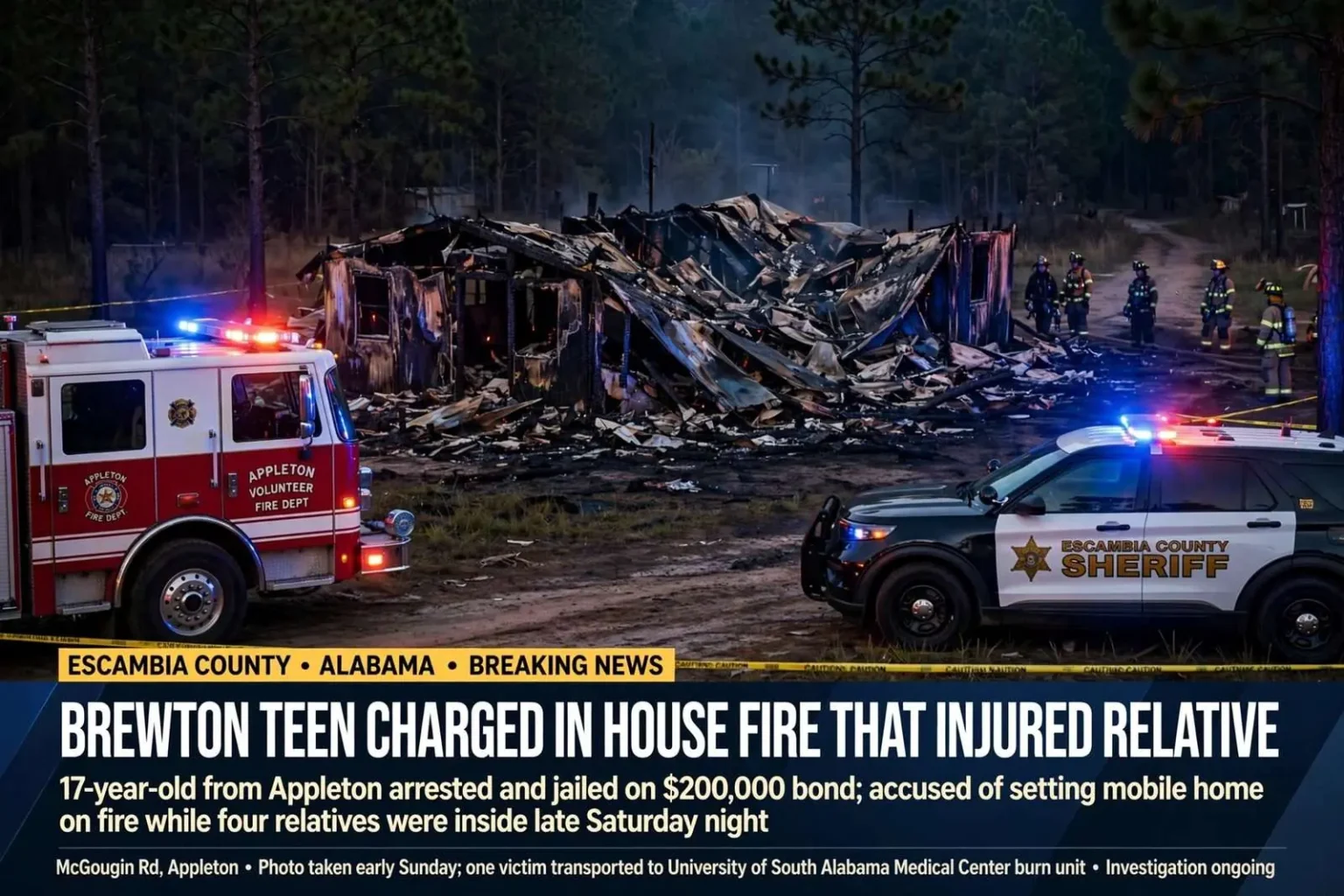
A 17-year-old Brewton resident remained jailed this week on a $200,000 bond after Escambia County sheriff’s deputies accused her of setting fire to her family’s mobile home while four relatives were inside. The allegations stunned residents of the Appleton community, a quiet rural stretch of northern Escambia County where families often live along the same country roads for generations and where a house fire is the kind of news that travels by word of mouth long before it appears anywhere in print.
Deputies charged Love Freedom Rutledge with four counts of attempted murder and one count of first-degree arson following the fire, which broke out late Saturday night in the Appleton community of Escambia County. Because of the severity of the allegations, Rutledge is being charged as an adult, said Chief Deputy Mike Lambert of the Escambia County Sheriff’s Office. Under Alabama law, defendants who are 16 or 17 years old may face charges in adult court when the accusations involve acts of serious violence, and prosecutors treat such cases through the ordinary criminal process rather than the juvenile system.
Investigators believe Rutledge set the fire to the family’s mobile home on McGougin Road before fleeing into a nearby wooded area. The road runs through the sparsely populated countryside outside Brewton, the Escambia County seat, where homes sit far enough apart that a blaze at one residence is unlikely to spread to the next but help can still be minutes away.
Around 1 a.m. Sunday, sheriff’s deputies, medics and firefighters with the Appleton Volunteer Fire Department responded to a 911 call reporting a fully involved structure fire. By the time crews arrived, the mobile home had been destroyed. In rural Escambia County, as across much of south Alabama, first response depends on volunteer departments staffed by neighbors who leave their own homes in the middle of the night, and a structure fire reported after midnight typically means crews arrive to find the building already consumed or nearly so.
One family member suffered severe burns in the fire and was transported first to a local hospital before being flown to the burn unit at the University of South Alabama Medical Center. The Mobile facility serves as the regional destination for burn patients across south Alabama and the Florida panhandle, and air transport is standard when a patient’s injuries require the specialized care that smaller community hospitals cannot provide. Authorities had not released an update on that person’s condition as of Wednesday. The home’s three other occupants were not seriously hurt.
Deputies said that when they arrived on scene, they realized only four of the home’s five residents could be accounted for. That discovery shifted the response from a fire scene to a search. A K-9 unit was called in to search the area, and Rutledge was eventually located in a wooded area a short distance from the burned home. Tracking dogs are a routine tool for rural sheriff’s offices, whose deputies often search large tracts of timber, underbrush and cleared fields where a person on foot can disappear quickly after dark.
The Escambia County Sheriff’s Office, along with the Alabama State Fire Marshal’s Office and local fire departments, is continuing to investigate the case. Authorities have declined to release additional details, citing the ongoing nature of the investigation, including what may have led to the alleged attack and whether there had been any prior warning signs within the household.
A Close-Knit Corner of Escambia County
Appleton sits along the U.S. 29 corridor between Brewton and the Conecuh County line, one of several small unincorporated communities that dot the piney woods of north Escambia County. The area is defined by family plots, modest manufactured and site-built homes, and a landscape of pine plantations and hardwood bottoms. Law enforcement coverage across the county rests largely with the Escambia County Sheriff’s Office, which patrols a wide rural territory with a relatively small complement of deputies, supplemented by municipal police departments in Brewton, East Brewton and Atmore and by volunteer fire companies scattered across the county.
Volunteer fire departments like the one in Appleton depend heavily on community support and district fire fees to keep trucks fueled, gear replaced and stations maintained. When a call comes in after midnight, members respond from their own beds and driveways, and neighboring departments are frequently summoned for mutual aid. A fully involved structure fire in such a setting leaves little to salvage; the priority shifts immediately to confirming that everyone got out and to treating anyone who was inside.
The Charges and What They Carry
The charging decisions in the case reflect the gravity of what investigators allege. First-degree arson under Alabama law involves setting a fire to an occupied building and is classified as a Class A felony, the most serious tier in the state’s criminal code, punishable upon conviction by a sentence that can run to life imprisonment. Attempted murder is likewise a Class A felony, and filing one count for each of the four relatives inside the home means the total potential exposure if the case proceeded to conviction is exceptionally severe.
Because Rutledge is 17, her case sits at the boundary between the juvenile and adult systems. Alabama generally handles offenders under 18 in juvenile court, but teenagers accused of the most serious violent acts can be prosecuted as adults, a decision made in light of the nature of the alleged offense. Once in adult court, the case will move through the standard process: bond conditions, preliminary proceedings, review by the district attorney’s office, and ultimately either a plea agreement or a trial before a jury. The $200,000 bond set in the case keeps her in custody at the county jail while that process unfolds, and any request to reduce it would have to be argued before a judge.
The State Fire Marshal’s Role
The involvement of the Alabama State Fire Marshal’s Office is standard in cases where a fire is believed to have been deliberately set. The agency, part of the Alabama Law Enforcement Agency, fields trained fire investigators who work alongside sheriff’s investigators and local fire departments to determine a fire’s origin and cause. Their work typically involves examining burn patterns within the structure, collecting physical evidence from the scene, interviewing occupants and neighbors, and reconstructing the sequence of events in the hours before the blaze was reported. Findings from that investigation become the backbone of the state’s case, because prosecutors must be able to establish not only that a fire was set but who set it and what the person knew about who was inside.
In rural counties, that level of investigative specialization is not always available locally, which is why state fire investigators and, when necessary, other state agencies are brought in early. Scenes involving manufactured housing present particular challenges for investigators, since lightweight construction burns quickly and can collapse, complicating the job of documenting evidence in place. Investigators in such cases commonly work the scene for days, and the formal findings can take weeks to be finalized.
Recovering From Burn Injuries
The most seriously injured victim’s transfer to the University of South Alabama Medical Center underscores how specialized burn treatment has become. Burn care involves not only the initial treatment of the wounds themselves but management of infection risk, fluid balance, pain control and, in serious cases, multiple surgical procedures and long-term rehabilitation. Patients transported from rural south Alabama to the Mobile burn unit often face weeks of hospitalization followed by outpatient care, and families frequently shoulder the burden of travel between their home communities and the hospital for the duration of recovery.
For the three other occupants who escaped without serious injury, the loss of the home itself creates its own crisis. Rural families displaced by fire often rely on relatives and neighbors for immediate shelter, and volunteer organizations and local churches typically mobilize to collect clothing, furniture and household goods. Rebuilding on a rural lot, or replacing a destroyed mobile home, can take months, particularly when insurance coverage is limited.
What Remains Unknown
Sheriff’s officials have been deliberate about what they will say publicly, and for good reason. Statements made while an investigation is active can complicate prosecution, and details about the household dynamic that may have preceded the fire are exactly the kind of information that both investigators and prosecutors will guard closely until the case reaches court. What authorities have acknowledged is that they are examining whether there were warning signs before the fire, a question that touches on how families, schools and social service agencies recognize and respond to escalating conflict inside a home.
The case remains open, and additional charges or amendments to the existing charges are possible as the investigation concludes. Anyone with information relevant to the case can contact the Escambia County Sheriff’s Office. For now, the community is left to reckon with the reality that a family fire on a quiet country road was, according to the charges, no accident at all, and that four of the people who lived there now face a long road of recovery while the fifth answers for it in an adult courtroom.
Across Alabama, fires set inside occupied homes are among the most serious cases local agencies handle, because they combine the unpredictability of fire with the vulnerability of sleeping occupants. Investigators note that the difference between a fire from which everyone escapes and one that produces catastrophic injuries often comes down to minutes: whether smoke alarms sounded, whether occupants woke in time, and whether exits remained passable once flames and smoke spread through lightweight interior walls.
Fire Safety in Rural Manufactured Homes
The destruction of the McGougin Road home also highlights a safety reality that fire officials in south Alabama raise repeatedly. Manufactured housing remains common across the region’s rural counties because it is affordable, but older units in particular can ignite and be fully involved within minutes. Fire officials urge rural residents to keep working smoke alarms in sleeping areas and hallways, to agree on a meeting place outside so everyone can be quickly accounted for, and to make sure that fire departments can find the address in the dark. In communities where hydrants are scarce, tanker shuttle operations are the norm, and every minute saved in reporting a fire matters to the outcome.
Volunteer departments across Escambia and neighboring Conecuh, Monroe and Covington counties continually recruit new members, and departments that lose structures to fully involved fires often point to the value of early detection and rapid reporting. State-level grants and local fire fee districts help fund equipment, but the human element — neighbors willing to train, respond and serve — remains the backbone of rural fire protection.
Support for Families After a Fire and an Arrest
When a house fire turns into a criminal case, the aftermath is complicated for everyone connected to the household. Victims of violent crime in Alabama, including family members of those injured, may access support through victim services officers attached to the prosecutor’s office and through state compensation programs that can help with medical bills, counseling and funeral-related costs when they apply. Prosecutors’ offices in the region routinely assign victim services staff to serious felony cases so that injured parties and their families are kept informed as the case moves through hearings.
For the Appleton community, the case will now play out through a schedule of court appearances in the months ahead. The investigation continues, and officials have asked anyone with information to come forward. The sheriff’s office has not indicated when additional details might be released, saying only that the inquiry remains active and that the focus for now is on the recovery of the injured family member and the careful preparation of the case.