Brewton’s Donations-Only Restaurant Drexel & Honeybee’s Feeds Anyone Who Walks In
In Brewton, Ala., Lisa Thomas-McMillan's donations-only restaurant Drexel & Honeybee's feeds anyone who walks in — named nicest place in Alabama.
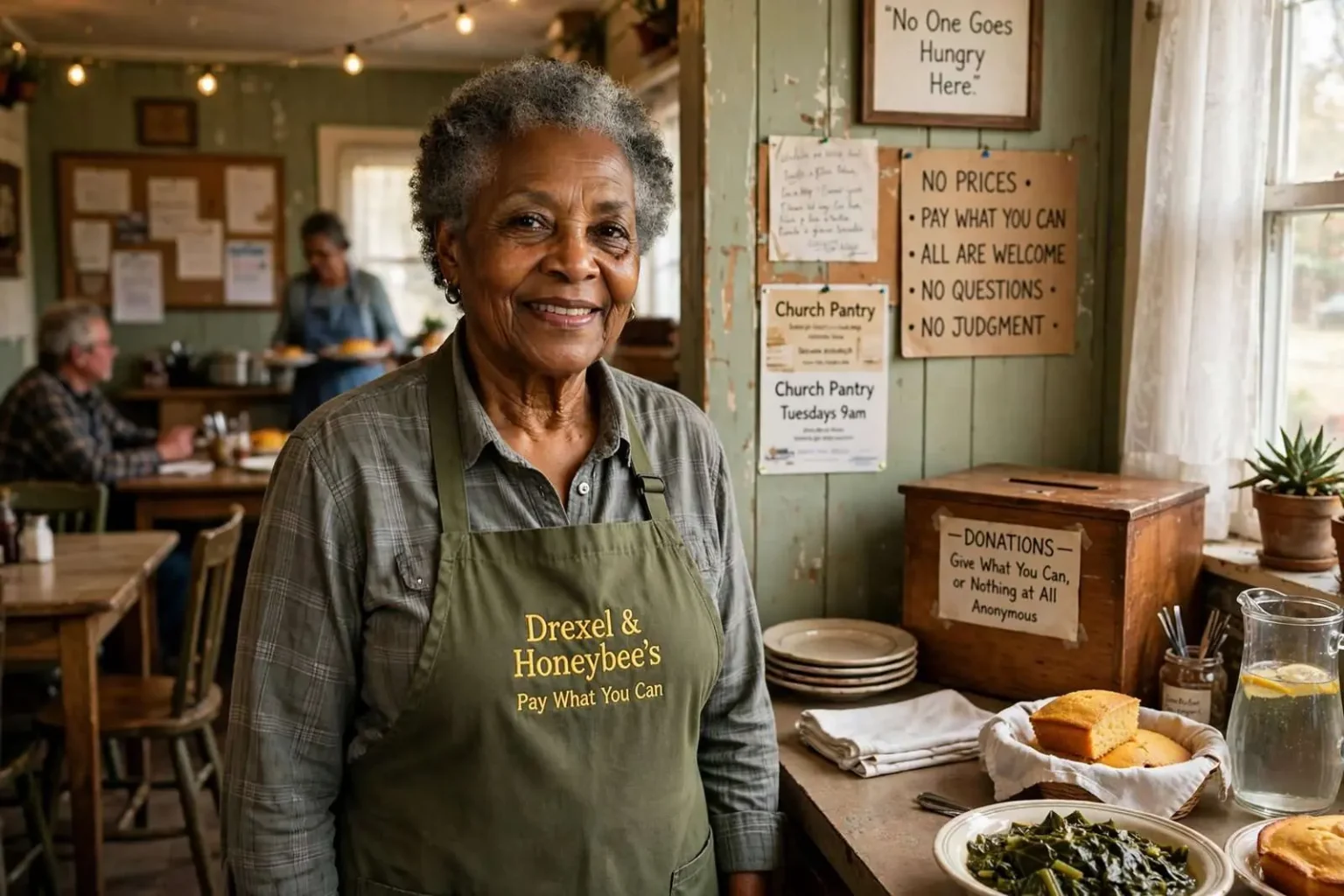
In Brewton, a small dining room runs on an unusual business model: there are no prices. At Drexel & Honeybee’s, customers pay whatever they want — or nothing at all — and no one in the dining room ever knows who gave what. The arrangement is deliberate down to its mechanics: donations go into a box, plates go out to every comer, and the person at the next table is indistinguishable from any other guest. In a small Escambia County town, where reputations travel fast and pride can keep people away from a charity line, that anonymity is the design principle on which the whole restaurant rests.
The restaurant is the life’s work of Eleze “Lisa” Thomas-McMillan, whose fight against hunger stretches back decades. In the early 1990s she started a food pantry at her church that continues serving families who cannot afford groceries. In 2005, she walked from Alabama to Washington, D.C., to draw attention to hunger in America — a months-long, on-foot pilgrimage that turned a local concern into a public statement made one step at a time. Two years before this profile, she and her husband Freddie opened the donations-only restaurant in her hometown, dipping into their retirement savings — most of it his, earned during his career as a Marine — to make it happen.
The name carries the couple with it: “Drexel” and “Honeybee” are the affectionate handles by which the two are known around Brewton, and the dining room feels less like an enterprise than an extension of their kitchen. There is no menu board with numbers, no register confrontation, no ledger of who owes what. A meal costs exactly what the person eating it can offer, which on any given day may be a full donation, a few dollars, or simply a thank-you.
From Church Pantry to Walk to Washington
The restaurant is the visible end of a long pipeline of hunger work. The church pantry Thomas-McMillan founded in the early 1990s still operates, and it taught her the limits of the form: shelves and distribution hours help, but they don’t feed people dignity, and they don’t feed people daily. A person who cannot afford groceries can visit a pantry; a person who is hungry at noon still needs somewhere to sit down and eat. The restaurant answers that need without a waiting list, an application or a budget inquiry — anyone who walks in eats.
The walk to Washington in 2005 belongs to the same conviction. Walking across multiple states to the nation’s capital to draw attention to hunger in America is the kind of gesture that gets remembered locally for decades, and in Brewton it cemented Thomas-McMillan’s identity as the area’s conscience on food insecurity. The restaurant, opened years later with retirement money rather than grants or campaigns, is that same witness translated into a storefront: less a protest than a proof of concept, run on the bet that a community will feed itself if given the chance.
A Table Where Everyone Is Equal
People from all walks of life line up for the hot, home-cooked meals prepared by Thomas-McMillan and a staff of volunteers. A retired pastor made the trip from Wagarville just to eat lunch and pray for the people inside. College students say the meals are the difference between eating twice a day and three times a day. Guests never learn who paid for their plate or who simply left a thank-you note in the box — the anonymity holds in both directions, protecting the donors from recognition and the recipients from judgment.
“The point is, you have no more than the other person coming in here,” Thomas-McMillan has said, explaining that the restaurant deliberately keeps donors and recipients anonymous because it doesn’t know — or care — what anyone has. The line is the restaurant’s whole philosophy compressed into a sentence: whatever separates people outside the door — income, age, circumstance — is suspended inside it. The dining room treats scarcity as a shared condition rather than a personal failing, and the food arrives without a moral attached.
National Recognition for a Small-Town Dining Room
The little restaurant has drawn outsized attention: Reader’s Digest named Drexel & Honeybee’s the “nicest place in Alabama,” and The Washington Post has featured its story. For a dining room in a town of a few thousand people in south Alabama’s rural wiregrass country, the recognition rippled outward — visitors began arriving from out of town and out of state, some to eat, some to see whether a restaurant with no prices could really exist. It could, and it does, sustained by a community that took over the operating costs of its own generosity.
Carolyn Hart, who volunteers as a server, says Thomas-McMillan’s drive comes from experience — she knew what it was like not to have enough to eat in college and never forgot it. The memory explains the model. A person who has been hungry understands that hunger is not abstract, and that the humiliation of asking is often worse than the emptiness itself. Everything about Drexel & Honeybee’s — the no-questions policy, the donor anonymity, the uniform plates — is engineered to remove that humiliation from the transaction.
Thomas-McMillan shares her philosophy in her book, “Living Fulfilled, The Infectious Joy of Serving Others,” and believes other communities could do something similar. “What good would it be for me to have a ton of money and my neighbors are suffering down the street?” she has said. The book frames the restaurant not as charity but as a way of life — service as the source of a person’s own fullness rather than a sacrifice of it — and its title could stand as the dining room’s mission statement.
Hunger in Alabama’s Small Towns
The restaurant’s work happens against a backdrop of persistent food insecurity in rural Alabama. In communities like Brewton — the county seat of Escambia County, an hour’s drive from the nearest metropolitan grocery options in Mobile or Pensacola — access to food is shaped by distance, income and transportation together. Families at the lower end of the income scale face the compounded arithmetic of rural life: fewer jobs, longer drives, thinner retail, and social service infrastructure stretched across wide geography. Food pantries and school meal programs carry much of the load, and the gaps between them — evenings, weekends, the stretch at the end of the month — are where adults quietly go without.
A daily hot meal, available to anyone who walks in, fits into those gaps in a way that institutional programs cannot. It requires no paperwork, no schedule and no eligibility determination, and it puts the meal in a social setting rather than a distribution line. For the college students who describe it as the difference between two meals a day and three, and for the older residents and working people who form the regular lunch crowd, the dining room functions as a piece of informal infrastructure that the town would otherwise lack.
A Model Other Towns Could Copy
Donations-only restaurants have appeared elsewhere in the country, but they remain rare, and the reasons are practical: food costs money, and the model works only where a community’s voluntary donations — money, labor and food — cover what its hungry residents consume. Brewton’s version works because Thomas-McMillan and her volunteers run a tight operation, because local supporters treat the donation box as a civic duty, and because the founder’s own savings underwrote the start. The restaurant’s continued operation, meal after meal, is itself the argument she makes to other communities: that the model is replicable wherever enough people decide their neighbors’ hunger is their own business.
That is the quiet claim of “Living Fulfilled” and of every plate served in the dining room — that generosity is not a resource that runs out when it is spent, but a habit that grows with use. In Brewton, the proof sits on the plate: a hot, home-cooked meal, available to anyone, priced at exactly what the person eating it chooses to give, in a town where no one at the table knows who gave what.
The volunteer corps that keeps the kitchen running has become one of the town’s quiet institutions. Servers like Carolyn Hart work the dining room alongside other regulars who schedule their weeks around the lunch service, and the work has a social gravity that draws people back: this is where Brewton’s concern for its own becomes visible, one shift at a time. Students, retirees and working people all pass through as volunteers, and several began as guests. In a donations-only house, labor is a donation too, and the dining room’s ledger balances in hours as often as in dollars.
The national attention, meanwhile, changed little about the daily rhythm — which is the point. Reader’s Digest and The Washington Post described to a national audience what Brewton already knew, and the visitors who arrive because of those stories eat under the same rules as everyone else. The restaurant has no interest in being a destination so long as it remains a lunchroom; its fame is useful mainly because Thomas-McMillan can use it, book in hand, to argue that what works on a side street in Brewton would work on a side street anywhere.