British Soccer Players at University of Mobile Reflect on Queen Elizabeth II’s Death
Three English players on the University of Mobile soccer roster shared childhood memories and reflections after Queen Elizabeth II died at age 96.
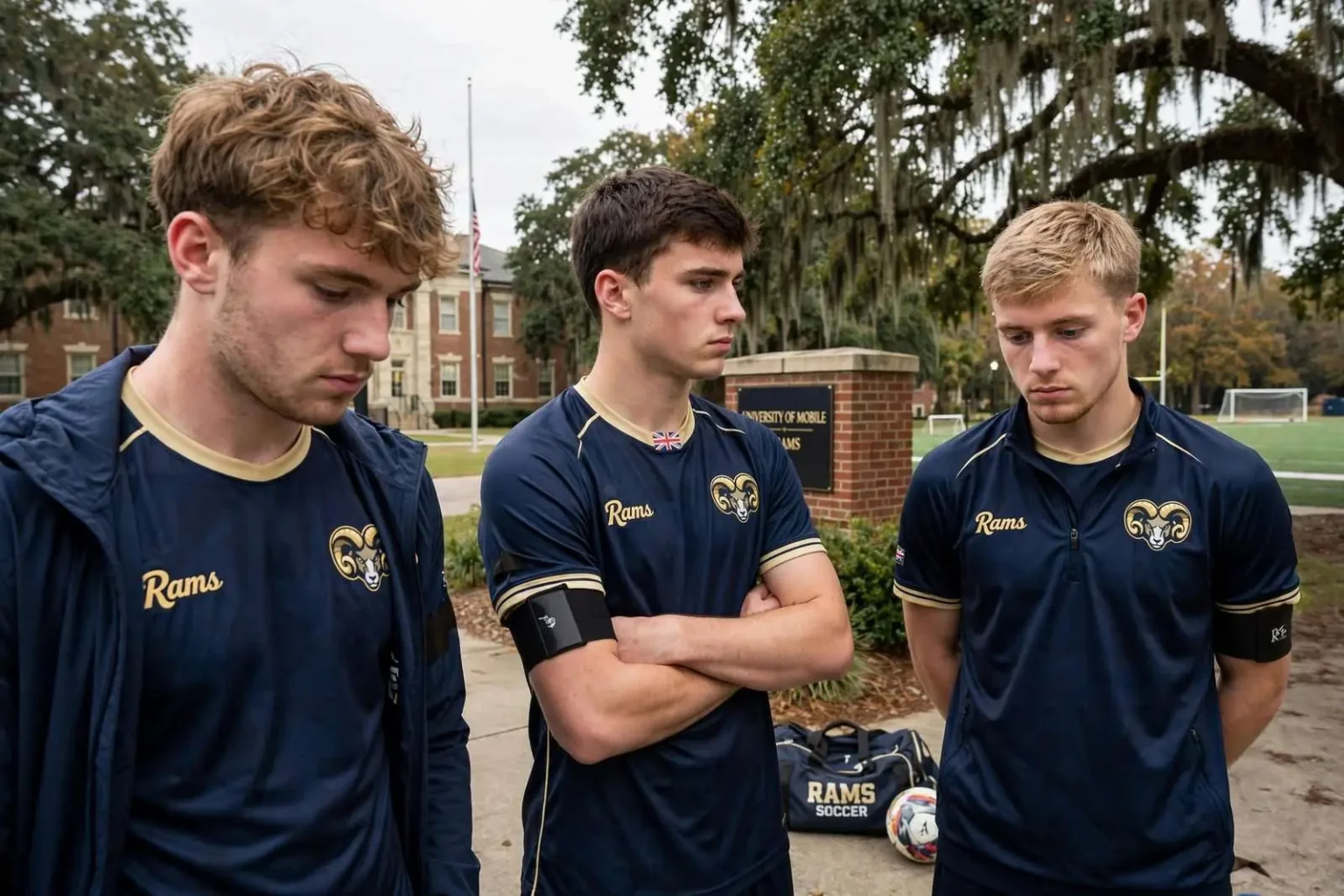
The death of Queen Elizabeth II rippled across the globe Thursday, and for a handful of British soccer players on the University of Mobile’s roster, news of their monarch’s passing arrived thousands of miles from home. The queen, who died at her Balmoral estate in Scotland at the age of 96 after more than 70 years on the throne, had been a constant presence in the lives of the young athletes now studying and playing on the Alabama Gulf Coast — most of whom had never known another British head of state.
Word of her death reached the players the way it reached millions of others: through phones, group chats and rolling television coverage. But for the British natives on the Rams’ roster, the moment carried a weight few of their American teammates could fully share. The monarch whose image hangs in public buildings and whose silhouette anchors every coin and stamp was, to them, a fixture of childhood itself, and the news landed with a strangeness that mixed grief and disbelief.
Memories of a Queen Who Was Always There
Freshman Tom Durand, who grew up near Windsor Castle in London, said some of his earliest memories involve the long-reigning queen.
“Growing up, so I live quite close to Windsor Castle, and so like we used to drive past as a family all the time and they have the different flag posts whether she’s in or not,” Durand said. “And just as a kid, I remember driving past to see ‘oh, is the queen in?'”
Windsor Castle has served as a working royal residence for nearly a thousand years, and for the people who live in the town that grew up around its walls, the comings and goings of the royal household are simply part of everyday life. Durand’s childhood ritual — checking the flag flying above the castle to learn whether the queen was in residence — is one familiar to generations of locals, and it is precisely the kind of small, personal connection that ended with her passing. For the young midfielder, the landmark he drove past with his family is now inseparable from the moment the country lost its sovereign.
That sense of a personal history running alongside the monarchy is common among Britons of every age, but it is especially acute for the generation now in college. Elizabeth II ascended the throne in 1952 and was crowned the following year, meaning her reign encompassed the decolonization of Africa and the Caribbean, the Troubles in Northern Ireland, the end of the Cold War, the advent of the internet age and Britain’s withdrawal from the European Union. Through all of it, she remained the one fixed point of British public life.
A Symbol of Patriotism
Sophomore Sam Hughes, from Birmingham, England, described the monarchy as the focal point of British national identity.
“In terms of like America, how you guys are all quite patriotic about like the American flag, we’re the same with the queen,” Hughes said.
The comparison captures a difference in how the two countries express national pride. In the United States, reverence is directed at the flag, the Constitution and the founding documents; in Britain, the crown has historically served as the unifying symbol around which ceremonies, oaths and national occasions are organized. Passports are issued in the monarch’s name, new citizens swear allegiance to the crown, and the national anthem is a prayer for the sovereign personally rather than an ode to a flag or a nation.
For Hughes and his teammates, that means the queen’s death is not an abstraction happening to a distant institution. It is the loss of the person who anchored the version of patriotism they grew up performing — at school assemblies, at sporting events, at moments of national celebration and mourning alike. The shift now underway in Britain has no real American equivalent: the country is adjusting to a new anthem, new coinage, new official language, all at once.
A Generational Turning Point
Sophomore Will Harris, from Essex, said her death marks a generational turning point: “Their whole life has been with her as the queen. So obviously it’s going to be tough. But yeah, I think it will be one of those moments where you will remember where you were.”
The observation speaks to a demographic reality that became a quiet talking point across Britain this week. The overwhelming majority of the United Kingdom’s population — roughly four in five Britons — was born after Elizabeth took the throne, which means most living subjects have never sung anything but “God Save the Queen” or seen a different monarch on their currency. For older generations, memories reach back to her father, King George VI, and to the wartime years when the young princess lived through the Blitz alongside her countrymen. For everyone younger, the queen was simply the permanent backdrop of national existence.
Historians and grief counselors often note that the deaths of long-reigning public figures produce a form of collective mourning that operates differently from private grief. People who never met the queen nonetheless feel the loss personally, because she appeared at the center of the ceremonies that structured their lives — the Christmas broadcast each December, the Platinum Jubilee celebrations, the weddings and funerals that stopped the country. Psychologists describe these events as moments when individual memory binds itself to shared history, which is exactly the phenomenon Harris described: a moment where “you will remember where you were.”
For the players, processing that moment from an American campus adds its own layer of distance. The rituals unfolding on television — the accession council, the lying in state, the state funeral — are happening in a country that is, for now, an ocean away from their daily routine of classes, training sessions and matches in Mobile. Their American teammates are watching the same coverage, but from the outside.
An International Roster Far From Home
The moment has also highlighted how far college soccer programs like the University of Mobile’s reach in assembling their rosters. The Rams, who compete in the NAIA and the Southern States Athletic Conference, draw players from across the United States and from overseas, and English players in particular have long been part of the college soccer pipeline. For young British players, American universities offer the chance to continue playing competitively while earning a degree, an option that the British academy and non-league system does not always provide.
The tradeoff is that major moments at home now arrive while the players are abroad. Some of the British players on the roster will have watched the queen’s funeral proceedings on American television, half a world from the crowds lining the streets of London and Windsor. Teammates from the Deep South, for whom the British royal family is a distant fascination, have suddenly found themselves seated next to people for whom it is a lived inheritance.
College athletics departments across the country quietly made space for that grief in the days after the announcement, and the soccer community — an international one at nearly every level of the American game — has been among the groups most directly touched. British professionals playing in MLS and the lower divisions spoke publicly about the news, and at the amateur and collegiate levels, players found themselves fielding questions from teammates about everything from the line of succession to the meaning of the word “abdicant.”
‘God Save the King’
The players noted that even routine traditions will now change — including the anthem they’ll sing at upcoming matches.
“Especially with the World Cup coming up, singing the national anthem — that song will have to be different,” Durand said. “That will be probably quite a surreal moment.”
“Yeah, God save the King,” Harris added. “Instead of God save the Queen. For the first time in everyone’s life,” Durand finished.
The anthem change is among the most immediate and visible markers of the new reign. Upon the queen’s death, the accession of her son meant the anthem automatically became “God Save the King,” the form it last held during the reign of her father, George VI, who died in 1952. The words themselves require only a single alteration — “Queen” for “King” — but the adjustment is profound for a population that has sung the feminine form for seven decades. Even seasoned British athletes and public figures stumbled over the unfamiliar words in the days after the transition, and choirs and broadcasters have been relearning verses that most people had never needed to practice.
For the University of Mobile players, the change will arrive in a practical setting. British players representing their country — or simply singing along during international fixtures watched with teammates — will do so for the first time under a king. The World Cup adds a specific deadline to the adjustment: when England’s squad lines up for its opening match, the anthem played in the stadium will be the new one, and millions of viewers will hear a tradition that is simultaneously centuries old and days old.
What Carries Forward
Despite the strangeness of the transition, the players’ reflections kept returning to continuity. The institutions that shaped their childhoods — the castle flag posts, the anthem, the sense of national identity Hughes described — are changing their form, not disappearing. The new king, Charles III, spent more than seven decades as heir apparent, the longest wait in British history, and takes the throne with the institutions of the monarchy already in place around him.
For Durand, Hughes and Harris, the months ahead will mix the ordinary business of a college soccer season with a personal history lesson unfolding in real time. They will train, travel and play matches across Alabama and the region while the country of their birth relearns its own ceremonies. And when the anthem plays before matches — or when England takes the field at the World Cup — they will sing words that, for the first time in their lives, everyone back home is learning together.
“For the first time in everyone’s life,” as Durand put it. The reminder of how rare the moment is also serves as a measure of how constant the queen was: the last time Britain changed monarchs, none of the three sophomores and freshmen now playing in Mobile had been born, and few of their parents had been either. That a single reign could span from the aftermath of World War II to the smartphone era is the fact that gives the players’ memories — flag posts and all — their weight.