Broad Street closes at Congress for utility work as Mobile’s federal grant project rolls on
Mobile closed Broad Street at Congress Street for utility relocation as the federally funded Broad Street rehabilitation continued.
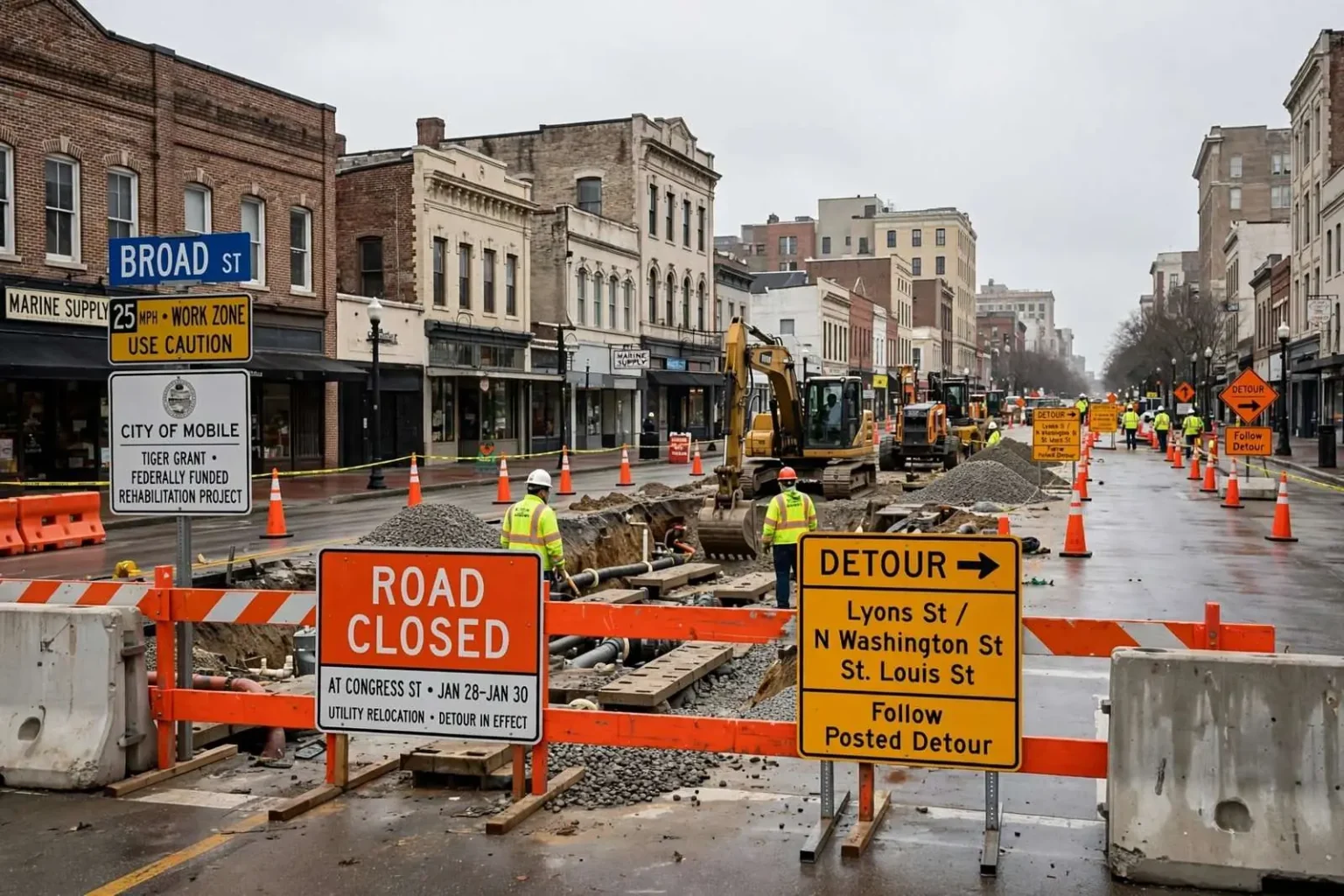
Drivers who use Broad Street in Mobile faced another round of closures as the city pressed ahead with the federally funded rehabilitation of the corridor. The city announced that Broad Street would be closed at Congress Street beginning Tuesday, Jan. 28, with the roadway scheduled to reopen Thursday, Jan. 30. Crews needed the closure to relocate utilities along that section of the project, the latest in a series of scheduled disruptions that will continue as the rebuild advances.
The two-day window reflects the city’s effort to balance progress on the project against the daily reality of a street that carries substantial traffic. Closing a block of a major corridor for even forty-eight hours forces commuters and freight haulers to adjust, and the city has worked to schedule each segment so that drivers can plan around the work rather than discovering it on the way to work.
A marked detour was set up using Lyons Street, North Washington Street and St. Louis Street to route traffic around the closed block. The posted route steers vehicles through the grid of streets that parallels Broad Street just west of downtown, keeping drivers on pavement built to handle the diverted volume while crews work on the closed block itself.
The city cautioned that all work was weather-dependent and could be delayed or rescheduled if conditions turned bad. Winter weather on the Gulf Coast can be unpredictable — rain arrives in heavy bursts, and wet ground complicates excavation around buried utilities — so drivers were told to expect changes and to check for updates before committing to routes through the area.
Officials reminded drivers to observe the 25-mph speed limit through the corridor and to use extra caution in the work zone, particularly after dark. Motorists were asked to watch for construction workers and for equipment entering and exiting the roadway. Work zones present hazards that ordinary streets do not: lane shifts, uneven pavement, workers on foot, and trucks and machinery crossing the travel lanes at access points that drivers may not expect.
About the Broad Street project
The work is part of a rehabilitation of Broad Street funded through a Transportation Investment Generating Economic Recovery grant, a competitive federal program that awards money directly to local governments for surface transportation projects. The program, administered by the U.S. Department of Transportation, has funded projects across the country through applications that cities and regions submit against one another, with award decisions weighing project readiness, economic impact and long-term benefit.
Winning such a grant is itself a milestone for a city. Because the money is competitive rather than formula-based, a TIGER award signals that federal reviewers judged Mobile’s corridor project among the strongest proposals in its funding round, and it brought federal dollars to a street that carries some of the heaviest mixed traffic in the downtown area.
The city said closures would continue as the project advanced. Each phase moves the work along the corridor in segments, with the schedule announced in advance so that residents, businesses and commuters can plan for the disruptions. The block-by-block approach trades speed for access, keeping the street usable while the rehabilitation proceeds underneath and along it.
Broad Street runs along the western edge of downtown Mobile and functions as a major connector between the interstate system, downtown and the neighborhoods to the north and west. For thousands of drivers each day, it is the road that carries them between home and work, linking the residential districts north of the central business district with the offices, hospitals, port facilities and government buildings downtown.
The corridor also serves as a freight route. Trucks moving between the interstate system and destinations in and near downtown use Broad Street because it offers a direct path, and that commercial traffic shares the pavement with commuter cars, buses and local deliveries. A street that must serve both roles takes a beating, and the rehabilitation is intended to address the wear that decades of heavy use have left behind.
Because the corridor carries both commuter traffic and freight movement, the city staged the work in short segments rather than shutting the street down for an extended stretch, relocating utilities block by block ahead of surface reconstruction. The approach spreads the inconvenience across many weeks rather than concentrating it into one long closure that would push all of the corridor’s traffic onto parallel streets at once.
Utility relocation is typically among the earliest and least visible phases of a street rebuild, since water, sewer, gas and communication lines beneath the pavement have to be moved clear of the new roadbed before paving can begin. The work that matters most to the project’s outcome happens below grade, out of sight, which is why closures announced for utility relocation often look like little is happening to drivers passing the site.
Getting those lines moved before reconstruction is essential. If utilities were left where they sit, every future repair would require cutting into a brand-new street surface, undoing the investment the rehabilitation represents. Relocating them now — adjusting their depth, position and access points — means the rebuilt road can be maintained for decades without repeated excavation.
The coordination involved is considerable. Utility relocation on a project like this one requires the city’s contractors to work alongside the water and sewer system operators, the gas utility and the communications companies whose lines share the right of way, scheduling each crew so the work proceeds without one utility’s relocation undoing another’s.
What it means for drivers and residents
For drivers who rely on Broad Street, the project means months of planning around closures, detours and lane restrictions. The city’s announcements give advance notice of each segment, and the two-day pattern of closure and reopening that began at Congress Street is expected to repeat as the work moves along the corridor.
Residents and businesses along the street experience the project differently from pass-through drivers. Access to homes and businesses is generally maintained during utility relocations, but construction brings noise, dust, heavy equipment and temporary changes to parking and entrances. Local businesses in particular depend on customers being able to reach them during construction, and clear signage marking open entrances is a standard part of staging work in a commercial corridor.
The neighborhoods along and near Broad Street have watched the corridor’s condition for years. Streets that carry heavy commuter and freight traffic tend to deteriorate faster than residential streets, and the rehabilitation addresses both the surface damage and the underlying infrastructure that dates from earlier eras of the city’s growth. When the project is complete, the rebuilt pavement is expected to serve the corridor for decades, provided the utilities beneath it are positioned where they can be serviced without disturbing the new road.
Corridor rehabilitation projects of this kind also carry longer-term implications for how a street functions. Modern rebuilds often incorporate updated drainage, improved markings and signals, and design decisions that reflect how the street is used today rather than how it was used when it was last reconstructed. The federal grant funding that supports the work is awarded on the strength of a project’s expected economic benefit, which for a connector like Broad Street includes the reliability of the route for freight and commuters alike.
The competitive grant program that funds the work has channeled federal money to projects that local governments could not easily finance on their own. Cities apply with detailed engineering and benefit analyses, and the awards have funded street reconstructions, bridge replacements, transit improvements and port access projects across the country. For Mobile, the award shifted the cost of a major corridor rebuild substantially toward the federal side, easing the burden on the city’s capital budget.
Drivers navigating the closures have several habits worth adopting. Checking the city’s announcements before travel, allowing extra time, using the posted detour rather than improvising through side streets, and slowing through the work zone all reduce the risk of collisions and keep the project on schedule. Work zone crashes delay projects as surely as weather does, and a collision in an active work zone endangers the crews working within feet of moving traffic.
The 25-mph speed limit through the corridor deserves particular attention. The reduced limit reflects workers on foot, equipment crossing the roadway and the narrowed clearances of an active work zone, and violations in work zones carry heightened penalties under state law. Drivers who treat the limit as advisory put themselves and the crews at risk.
After dark, the risks increase. Construction zones at night present lighting gaps, confusing patterns and equipment that may be parked or moving without full visibility, which is why officials emphasized extra caution for evening and overnight travel through the corridor.
As the project advances block by block, the repeated pattern of announcement, closure and reopening will continue along Broad Street. Each segment completed moves the corridor closer to the finished product: a rebuilt street with modernized utilities beneath it, able to carry the commuter and freight traffic that depends on it without the deterioration that prompted the rehabilitation. For now, drivers should expect the work to continue, plan their routes accordingly, and treat the work zone with the caution the city has asked for since the project began.