Budweiser Clydesdales Returned to Mobile Mardi Gras in 2018
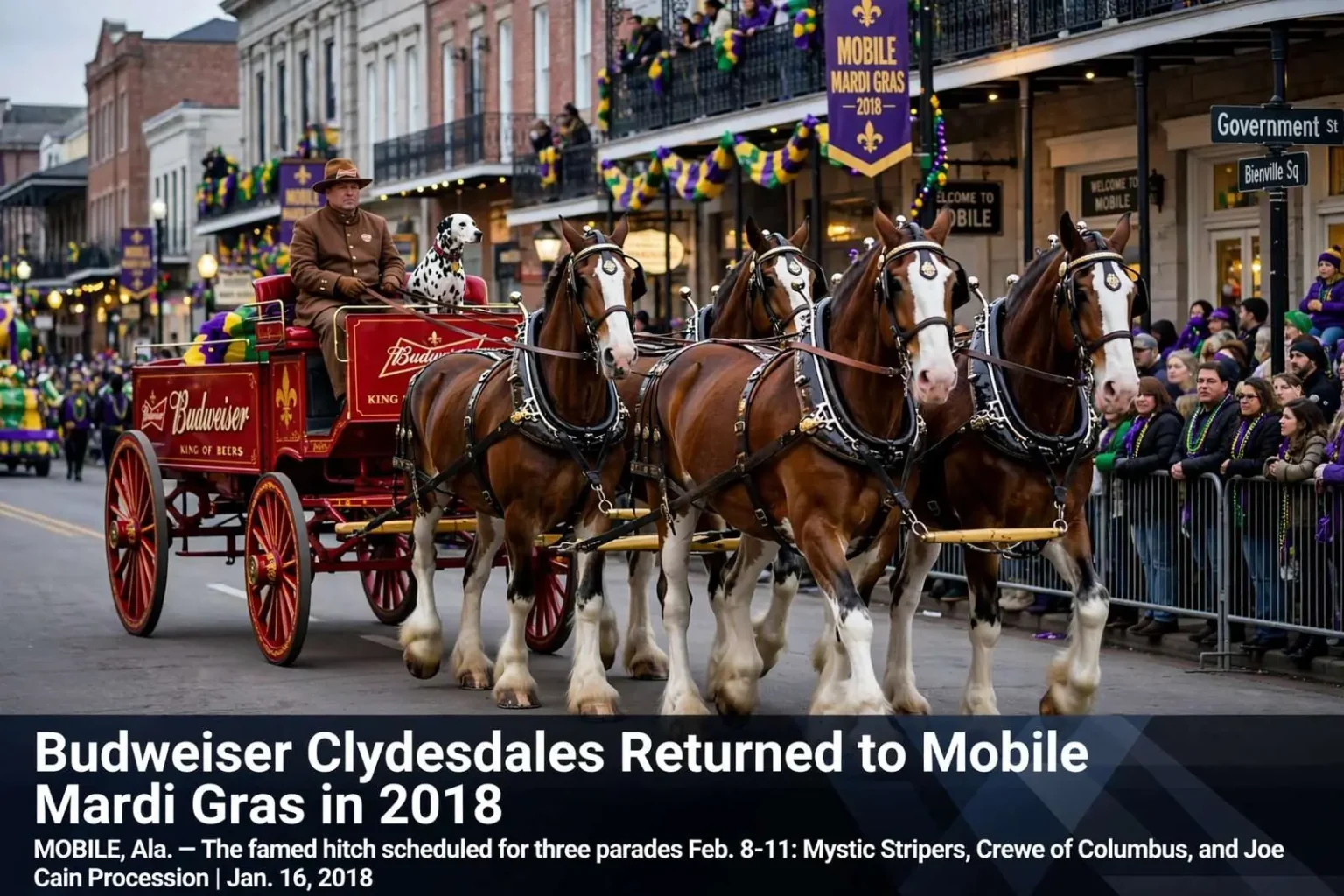
The Budweiser Clydesdales were scheduled to appear in three Mobile Mardi Gras parades in February 2018, according to WKRG.
Originally reported January 16, 2018. This article preserves a 2018 parade announcement and does not describe current appearances or schedules.
MOBILE, Ala. — The Budweiser Clydesdales were scheduled to return to Mobile for three Mardi Gras parades in February 2018, according to a local news report, putting the world-famous draft horse team back on the streets of the city that claims America’s original Carnival celebration. The horses were set to appear in the Mystic Stripers parade on Feb. 8, the Crewe of Columbus parade on Feb. 9 and the Joe Cain Procession on Feb. 11, giving parade crowds three separate chances to see the towering hitch in action during the height of the 2018 season.
The announcement was welcome news for Mardi Gras regulars, who regard the Clydesdales as one of the most recognizable non-mystic attractions to roll in Mobile’s parades. Each appearance required the Budweiser team to transport, stable, and exercise the horses in the days surrounding the parades, and their presence along the traditional downtown route historically drew extra crowds to the sidewalks well before the first float appeared.
The Clydesdales and their long history
The Budweiser Clydesdales have been the public face of the Anheuser-Busch brewing company since 1933, when August Anheuser Busch Jr. presented a team of the horses to his father in celebration of the repeal of Prohibition. The gift marked the resumption of legal beer sales in the United States, and the horses — a breed originating in the Clydesdale region of Scotland, known for their size, feathered lower legs, and high-stepping gait — became an enduring symbol of the company. The famous hitch has since appeared at parades, fairs, and Super Bowls across the country for decades.
The standard traveling hitch consists of eight horses pulling a red, white, and gold beer wagon, driven by a handler in period attire and accompanied by a Dalmatian riding alongside — a tradition that dates to the era when the spotted dogs guarded wagons and stables. The horses themselves are selected for strict criteria, standing roughly 18 hands at the shoulder and weighing around 2,000 pounds each, with bay coats, four white stocking legs, and a white blaze on the face.
For Mobile audiences in 2018, the chance to see the full hitch three times in four days was unusual. The team’s appearances typically require weeks of logistical planning, from arranging stabling near the parade route to coordinating the ground crews who handle harnessing, hitching, and the meticulous grooming the animals receive before each outing.
Three Mobile parades, three Carnival traditions
The Mystic Stripers Society, founded in 1939, was one of the defining organizations of Mobile’s Carnival season for generations, known for its signature stripes and its place in the downtown parade calendar. The society’s parades traditionally rolled on the Thursday night of the final week before Fat Tuesday, drawing large family crowds to the route. The Crewe of Columbus, established in 1910, brought its own long history to the following night, with the organization’s parades a fixture of Mobile Mardi Gras across more than a century.
The Joe Cain Procession, set for Sunday, Feb. 11, honored Joseph Stillwell Cain, the Mobile man credited with reviving Mardi Gras after the Civil War. In 1866, Cain — costumed as a fictional Chickasaw chief — paraded through the ruined city with a wagon of friends, lifting spirits in the process and restarting a celebration that continues to this day. The procession held in his memory, which began in 1966 on the 100th anniversary of his ride, has grown into one of the most beloved and irreverent events of the Mobile season, held each year on Joe Cain Day, the Sunday before Ash Wednesday.
Placing the Clydesdales ahead of or within those three parades put the horses in front of some of the season’s largest audiences. Weekend crowds for the Joe Cain Procession in particular historically swell the downtown route beyond what weeknight parades draw, with spectators arriving hours early to claim their spots along Government Street and the surrounding blocks.
The Mardi Gras route and its rhythms
Mobile’s Mardi Gras predates New Orleans by years — the city’s first Carnival celebration dates to 1703, when French settlers observed the holiday at Twenty-Seven Mile Bluff up the Mobile River, and the city’s first mystic society, the Cowbellion de Rakin Society, formed in 1830. That deep history is a point of civic pride, and locals are quick to note that Mobile, not New Orleans, is America’s original home of Mardi Gras. The season spans weeks rather than days, with family parades, moon pie throws, and society masque balls filling the calendar from January through Fat Tuesday.
For spectators planning to catch the hitch in 2018, timing mattered. Arriving early was essential for a clear view of the wagon, since the Clydesdales drew spectators well beyond their spot in the parade order and often passed by in only a minute or two. Veterans of the route recommended positioning near the beginning of the parade line or at points where floats slowed for turns, and keeping children a safe distance from the roadway as the large animals passed. Crowds around the horse unit traditionally lingered after the parade moved on, taking photos as the team waited near the staging area.
The downtown parade route in 2018 followed the traditional loop through the heart of the city, with floats, marching bands, and marching units lining up near the civic center area and rolling along Government Street before turning through the streets of the historic district. Spectators stake out territory along the route with ladders, coolers, and chairs — a Mobile tradition in its own right — and the throws that fly from the floats include the MoonPies that have become the city’s signature Mardi Gras souvenir.
What the 2018 season meant locally
For downtown businesses, an appearance as distinctive as the Clydesdales historically functioned as a draw in its own right. Restaurants and shops along Dauphin Street, Royal Street, and Bienville Square see their heaviest foot traffic of the year during parade season, and attractions that bring spectators to the route early tend to lengthen the time — and the spending — that visitors devote to the evening. Hotels in the downtown core fill weeks in advance for the final parades of the season, and the 2018 calendar, with its Thursday-through-Sunday stretch of major parades, ranked among the busier visitor periods of the year.
The horses’ presence also carried a practical dimension for the parade societies. Large animal units require coordination with police escorts, traffic control, and cleanup crews, and the sight lines along the route matter — drivers and handlers need space to maneuver a wagon team through the turns of the parade loop. That coordination happens quietly, but it is part of why a hitch like the Clydesdales appears only in select parades each season rather than rolling every night.
Animal welfare was a consideration as well. The Budweiser team maintains strict standards for the care of the hitch, limiting the horses’ working time, monitoring weather conditions, and providing veterinary oversight at appearances. The horses travel in custom trailers and rest between events, and appearances are scheduled with gaps for recovery — one reason a three-appearance weekend like the 2018 Mobile schedule represented a substantial commitment of the team’s time.
Remembering the 2018 announcement
The 2018 appearance remains a documented moment in the long relationship between the Clydesdales and Mobile’s Carnival. The horses have visited the city periodically across the decades, and each visit tends to generate the same response: crowds packed shoulder to shoulder near the wagon, phones raised for photographs, and children hoisted onto shoulders for a clear view of the feather-footed giants.
Schools in the Mobile area also work the season into their calendars, with Mardi Gras holidays built into the academic schedule around Fat Tuesday — a local distinction that reflects how central Carnival remains to daily life in the city. For many families, the stretch of parades that includes the Mystic Stripers, Crewe of Columbus, and Joe Cain Procession dates is the heart of the season, when weeknight parade-going turns into a four-day celebration running from Thursday through Sunday.
Parade schedules change from year to year, mystic societies evolve, and attractions come and go — which is why this article preserves the 2018 announcement as it was originally reported on January 16, 2018, without suggesting that the same schedule applies today. Anyone seeking current parade dates or appearance information for any given season is advised to consult the official Mobile Mardi Gras schedules published each year by the city and the parade societies themselves.
What the 2018 announcement captured was a moment of anticipation in one of the South’s oldest continuing traditions: three February nights and afternoons when the most famous draft horses in America would join the floats, bands, and marching units of Mobile Mardi Gras, in the city where the American Carnival celebration began more than three centuries ago.