
Burger King franchisee to fill 1,700 jobs at September job fair
GPS Hospitality, a Burger King franchisee in the Mobile area, is hiring 1,700 managers and crew members at a Sept. 19 job fair. Apply online or in person.
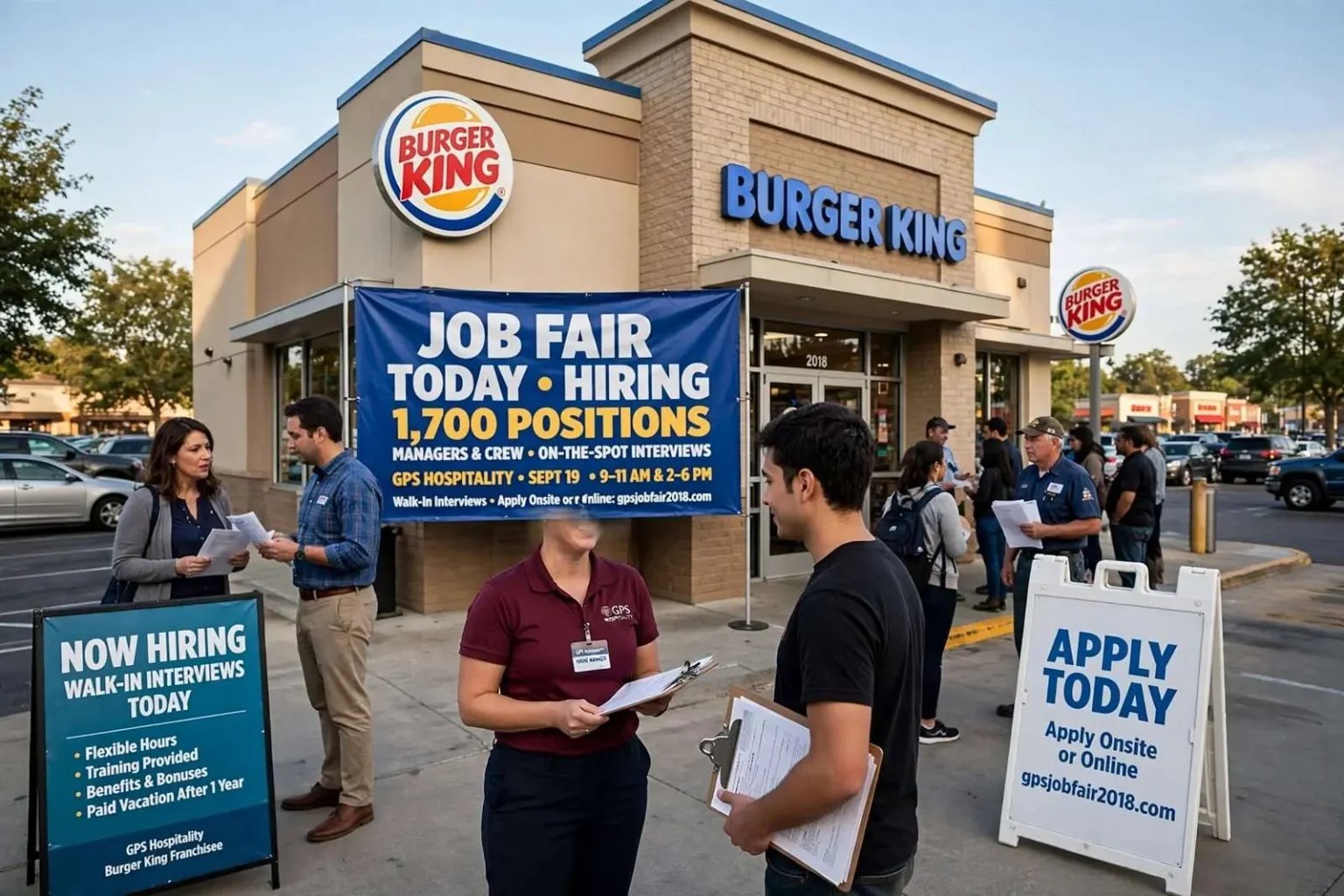
A Burger King franchisee is looking to hire 1,700 managers and crew members during a one-day job fair, a hiring push that ranks among the larger single-day employment drives in the Mobile area’s restaurant industry. GPS Hospitality, which operates Burger King locations in the Mobile area, scheduled the hiring event for Wednesday, Sept. 19, from 9 to 11 a.m. and 2 to 6 p.m., giving applicants two windows to visit a participating restaurant, interview and potentially leave with a job offer the same day.
The company said the positions offer flexible hours and training, with management roles eligible for performance bonuses, benefits and other perks. After one year of full-time employment, team members qualify for accrued paid vacation. The franchisee said it is seeking motivated applicants for both entry-level and management positions, a range that makes the fair relevant to first-time job seekers and experienced restaurant workers alike.
Applicants can find the nearest participating restaurant at gpshospitality.com/locations/ or apply online at gpsjobfair2018.com. The dual approach — in-person interviews on fair day, online applications for those who prefer to apply ahead of time or from a distance — reflected the realities of hiring in 2018, when restaurants increasingly compete for workers through both digital portals and walk-in convenience.
Who GPS Hospitality is
GPS Hospitality has grown into one of the larger Burger King franchise operators in the Southeast since its founding early in the decade, building its portfolio through acquisitions of existing restaurants and the development of new ones. The company, whose name reflects its founding identity as a Georgia-based operator, has expanded across a band of Southern states, acquiring restaurant groups and opening new locations in markets from the Gulf Coast to the mid-Atlantic. Operating Burger King restaurants is its core business, and the company has also added Popeyes Louisiana Kitchen locations to its portfolio as it has grown.
The Sept. 19 hiring fair’s scale — 1,700 managers and crew members sought in a single day across the company’s footprint — signaled both expansion and the persistent staffing challenge of the quick-service restaurant industry. Each Burger King restaurant typically employs a general manager, assistant managers and a rotating crew of part- and full-time team members; a chain of hundreds of restaurants supporting steady growth needs continuous recruitment at every level, from first-job crew members to seasoned managers who can run a store’s daily operations.
For the Mobile area, the fair meant opportunities spread across multiple neighborhoods. Burger King’s franchise locations are embedded in the commercial corridors of the region — along the airport boulevards, the beach highway connections, the suburban arteries of west Mobile and the smaller towns of Baldwin and Washington counties — so the hiring push reached job seekers where they live rather than concentrating them at a single fairground or convention hall. Applicants simply went to their nearest participating restaurant during the two scheduled windows.
The 2018 hiring climate
The job fair came at a moment when hiring hourly workers had become one of the restaurant industry’s chief difficulties. The American economy in September 2018 was in its tenth year of expansion, unemployment had fallen to its lowest levels since the 1960s, and employers of entry-level workers across retail and food service reported persistent vacancies. In that climate, restaurants competed on scheduling flexibility, training, perks and advancement — exactly the attributes GPS Hospitality emphasized in announcing the 1,700 openings.
The positions described in the company’s announcement reflected the standard ladder of quick-service employment. Crew members handle food preparation, order taking and customer service, typically with flexible scheduling suited to students, parents and workers holding more than one job. Management roles carry responsibility for shift supervision, inventory, food safety compliance and staff development, and companies like GPS Hospitality regularly promote from within — a progression that turns entry-level crew positions into salaried restaurant management careers over a few years.
The perks highlighted in the announcement — performance bonuses and benefits for management, accrued paid vacation after one year of full-time work, and training at every level — were pitched at a labor market where such offerings had become differentiators. Fast-food operators in 2018 were raising wages and adding benefits not only to attract workers but to keep them, since turnover in the industry has historically run high and every departure costs recruitment and retraining money.
What the day looked like
The structure of the Sept. 19 event was simple and practical. Participating restaurants opened their doors for interviews in two blocks — morning from 9 to 11 a.m. and afternoon from 2 to 6 p.m. — avoiding the lunch rush that occupies kitchen and counter staffs in the middle of the day. Applicants could walk in, complete an application on site or present one already submitted through gpsjobfair2018.com, and speak with hiring managers about openings at the location or nearby stores in the company’s network.
For job seekers, the format lowered the usual barriers of the hiring process. There was no need to navigate a corporate careers website, wait days for a callback or travel to an office park; the interview happened at the restaurant where the work would take place, with the people who would do the supervising. For the company, the concentrated one-day format let it fill vacancies across the entire operating area at once, interviewing hundreds of candidates in parallel and extending offers quickly enough to capture applicants before competitors did.
The dual-track application system also accommodated the realities of the Mobile-area labor pool. Workers with daytime jobs could apply online in advance and visit during the evening window; students could come in the morning; applicants without reliable internet access could simply walk in. The company’s websites — the locations page for finding the nearest participating restaurant and the fair-specific site for online applications — served both audiences throughout the process.
Fast food as an economic anchor
Hiring drives of this scale are worth attention because of what the quick-service restaurant industry represents in local economies like Mobile’s. Fast food is one of the region’s largest sources of first jobs — the sector where many teenagers land their first work experience, where parents find schedules that fit around school hours, and where workers of all ages find immediate openings that require no résumé-building history. A single restaurant employs dozens of people; a franchisee operating dozens or hundreds of them is a significant employer by any measure.
The industry also functions as a ladder. Restaurant companies have increasingly formalized advancement: crew members become shift leaders, shift leaders become assistant managers, assistant managers become general managers, and general managers can advance to multi-unit supervision. The training, bonuses and benefits GPS Hospitality advertised for management roles map onto that ladder — incentives designed to make the step from crew to management an attainable career move rather than a vague possibility. Paid vacation after a year of full-time work, meanwhile, addressed a benefit that hourly restaurant workers have historically rarely received.
For the Mobile area’s economy in the fall of 2018, a one-day push to fill 1,700 positions also reflected confidence in demand. Restaurants hire when customer traffic justifies the staffing, and the region’s economy — diversified across healthcare, aerospace, shipbuilding at the Alabama Port’s growing yards, tourism along the Baldwin County beaches, and the Port of Mobile’s expanding container operations — was supporting steady commercial activity along the corridors where the company’s restaurants operate.
Advice for applicants
Hiring fairs reward preparation, and the basics apply whether the applicant is seeking a first job or a management position. Candidates who arrived at the Sept. 19 event ready — knowing their availability, bringing identification needed to complete hiring paperwork, and able to describe their work history briefly — moved through the process faster. For management candidates, demonstrating familiarity with food-service operations, inventory control and staff scheduling made the strongest impression; for crew candidates, reliability and customer-service attitude were the qualities hiring managers most often sought.
Flexibility was an asset on both sides. The company advertised flexible hours as a feature of the positions, and applicants who could offer wider availability — evenings, weekends, holiday periods — generally had the best odds, since restaurant scheduling is built around peak meal periods. At the same time, the industry’s part-time structure is what makes it accessible: workers looking to fit a job around classes, child care or another job could target the openings suited to their constraints.
Online applicants using gpsjobfair2018.com before or after the fair had the advantage of completing the process from home, and the locations page at gpshospitality.com/locations/ let candidates target the restaurant nearest to home or school — a practical consideration in an industry where most employees work within a short distance of where they live. Applicants who missed the fair could still apply through the same channels, since quick-service restaurants accept applications continuously; the hiring day simply concentrated the process into a single, high-volume event.
The bigger picture
The GPS Hospitality hiring fair of September 2018 captured the quick-service industry at a turning point. Franchise operators had grown larger and more professional, bringing corporate-style benefits, training programs and career paths to businesses once run as simple counter-service shops. Wage growth and benefits competition had reached the entry level. And one-day mass hiring events — once associated mainly with warehouses and seasonal retail — had become a standard tool for restaurant companies competing for workers in a tight labor market.
For the 1,700 workers the company hoped to hire on Sept. 19, 2018, the event offered more than a paycheck: the advertised package of training, flexible scheduling, management bonuses, benefits and paid vacation reflected the industry’s new understanding that recruiting was only half the job, and retention the other half. For the Mobile area, the fair was a reminder of how many jobs flow through the region’s restaurant counters — and of how a franchisee’s growth plans translate directly into employment opportunities in the neighborhoods where those restaurants stand.


