Burglary Alarm Leads Police to Man With Headlamp Inside Box Truck Behind Mobile Best Buy
Mobile police arrested Robert Gornto after a burglary alarm led them to him inside a box truck behind the Best Buy on Tingle Circle.
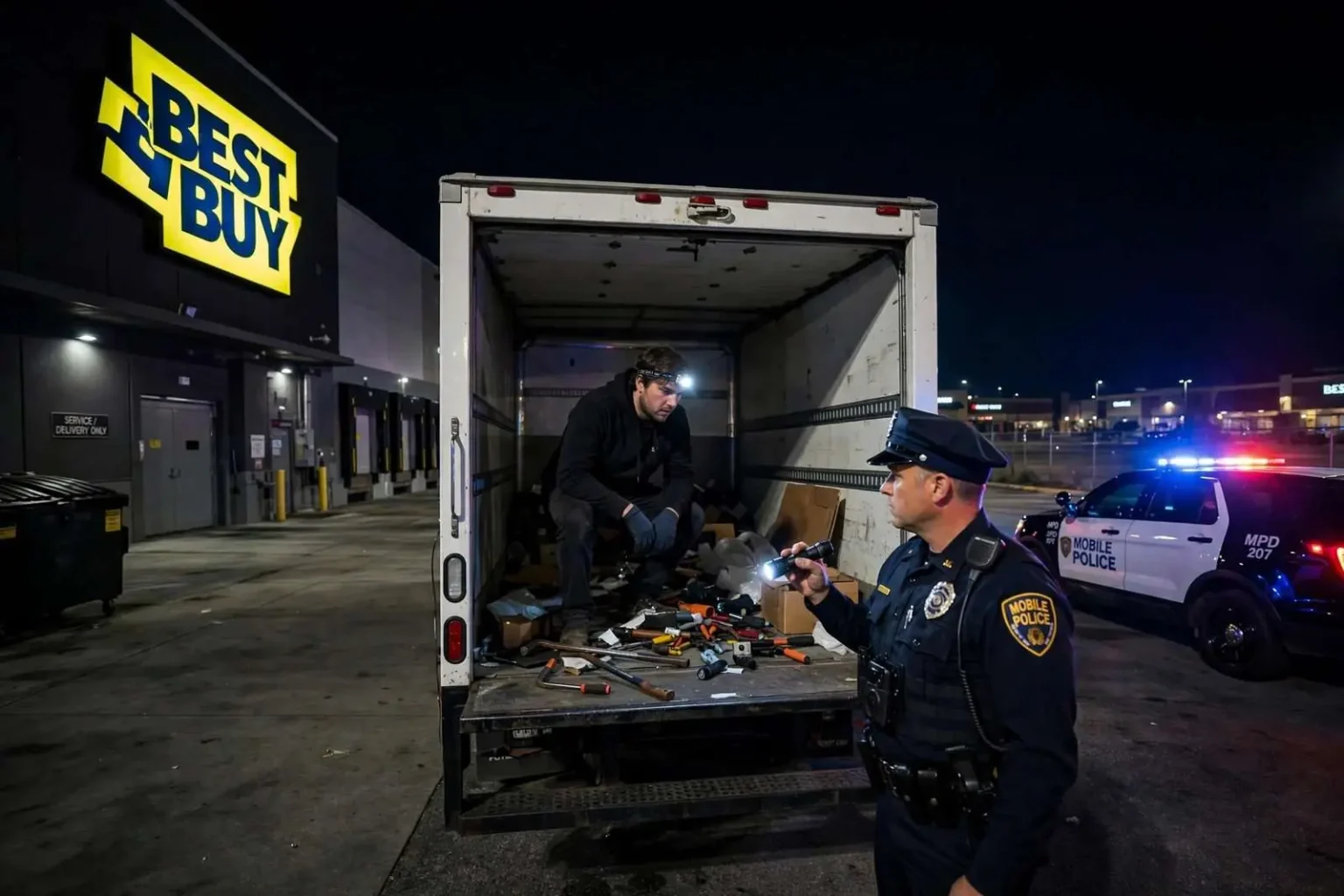
A triggered alarm gave Mobile police a head start on catching a would-be thief in the act. Officers arrested 29-year-old Robert Gornto on Thursday, May 12, after a burglary alarm sounded at the Best Buy off Tingle Circle in west Mobile. When officers arrived at the big-box electronics store, they found Gornto wearing a headlamp inside a box truck parked behind the store, according to a news release from the Mobile Police Department. The scene — a dark parking lot, a parked box truck and a man with a light strapped to his head — offered little ambiguity about what was underway.
Police said Gornto had no permission to be inside the truck, and officers said he was carrying burglary tools as well. He was charged with unlawful breaking and entering of a vehicle and possession of burglary tools, charges that together cover both the act of entering the vehicle without consent and the implements commonly used to force locks, pry panels or defeat ignitions. The arrest was made without incident, and the quick response came straight from the alarm call — with the suspect still exactly where the noise pointed them.
Alarm activations are among the most common calls police departments receive, and the overwhelming majority turn out to be false alarms caused by system malfunctions, employee error or cleaning crews. That reality forces officers to treat every alarm as genuine, because on the occasions when it is not false, minutes matter. In this case the response time and the suspect’s location combined to produce an arrest in progress rather than an after-the-fact investigation into a completed theft.
The Best Buy off Tingle Circle sits in a busy retail corridor of west Mobile, an area of shopping centers, restaurants and commercial strips that draws heavy traffic throughout the day and into the evening hours. Retailers in corridors like this one depend on layered security — surveillance cameras, alarm systems, lighting and coordinated police response — to deter theft after closing hours. The arrest demonstrates how that system is supposed to work end to end: a sensor detected an intrusion, a monitoring service relayed the alarm, and officers arrived while the intruder was still on the property.
What officers found behind the store
The rear service area of a large retail store is a vulnerable spot after dark. Loading docks, delivery doors, dumpsters and employee exits all sit behind the building, away from public view, and service vehicles — including contractors’ box trucks — are a common sight there during business hours. That traffic is precisely what makes the area attractive to someone attempting to move through it unnoticed, and it is why police departments encourage retailers to keep rear areas fenced, well-lit and covered by cameras.
A headlamp, in this context, reads as a tool of the trade: it leaves both hands free for prying, lifting or carrying, and it illuminates a work area in a dark lot without advertising the user’s presence the way a flashlight beam or vehicle lights might. Officers found Gornto inside the parked box truck with the headlamp on, and the burglary tools he was carrying completed the picture. Police did not say what, if anything, had been taken from the truck or from the store itself, and the news release did not indicate whether the truck was connected to the retailer, a delivery contractor or another business.
The charges and what they mean
Unlawful breaking and entering of a vehicle is a felony offense in Alabama, distinct from the theft of the vehicle itself. The charge targets the act of forcibly entering a vehicle — breaking a window, defeating a lock, prying a door — with the intent to commit a crime inside, regardless of whether anything is ultimately stolen. Prosecutors treat vehicle break-ins as serious property crime because of the damage they cause and their frequency, and a suspect caught in the act, as here, faces a stronger case than one pieced together after the fact from surveillance video.
Possession of burglary tools is a separate charge that criminalizes carrying instruments intended for use in a burglary or theft. Pry bars, lock picks, slim jims, bolt cutters and similar items are lawful to own in ordinary circumstances, which is why the charge depends on context — the circumstances of possession. Found inside a vehicle the defendant had no permission to enter, behind a retail store after hours, with a headlamp illuminating the work, the tools’ intended purpose became the basis of the second count. Together the two charges reflect the full sequence of what officers interrupted.
Gornto, 29, was taken into custody and processed at the Mobile County Metro Jail under the standard procedures for arrests made by Mobile police. The case now moves to the court system, where prosecutors will review the report, the evidence recovered at the scene and any statements made before deciding how to proceed. The Mobile Police Department’s news release did not indicate whether additional charges are possible or whether investigators are looking at connections to other incidents in the area.
How alarm response works in Mobile
The sequence that ended in Gornto’s arrest begins long before the alarm sounds. Commercial alarm systems at stores like Best Buy use door contacts, motion detectors and glass-break sensors tied to a monitoring service. When an armed zone is breached after hours, the monitoring company attempts to verify the alarm and then dispatches police to the address. Priority is high: an unverified alarm at a commercial property is treated as a possible burglary in progress, and officers are typically sent immediately rather than after the usual verification steps that apply to residential alarms.
For the responding officers, the challenge is approach. Arriving units position themselves away from the front entrance, check the perimeter first — loading docks, rear doors, dumpsters and parked vehicles — and look for signs of forced entry or movement. The rear of the store is where this search paid off: the box truck sitting in the back lot provided cover for the intrusion attempt, but it also boxed the suspect in. With officers converging, Gornto had nowhere to go, and the arrest unfolded without reports of injury to anyone involved.
Vehicle burglary along Mobile’s retail corridors
Vehicle break-ins and thefts from vehicles are persistent property crimes across Mobile, and commercial parking lots are their most common stage. Thieves target cars and trucks in retail corridors because they sit unattended for hours, often contain valuables in plain sight, and are covered by cameras only at the storefront rather than across the lot. Police routinely ask shoppers to remove purchases from view, lock vehicles and park in well-lit areas — advice aimed at the opportunistic break-in, which is far more common than the sort of after-hours intrusion police say they found off Tingle Circle.
After-hours commercial burglary is a different category: fewer incidents, but higher stakes and often an organized approach. Someone entering a restricted area behind a retail store after closing is usually after inventory, equipment or the contents of service vehicles, and the precautions retailers take — fencing, motion-activated lighting, cameras covering dock areas, alarm zones on service doors — exist specifically to interrupt that activity. The Best Buy location’s alarm system did exactly what it was installed to do, triggering a police response fast enough to catch the intruder on scene.
What businesses and residents can take from the case
For business owners along Mobile’s commercial corridors, the case is a straightforward case study in layered security. The elements that produced the arrest were all passive: an alarm zone that covered the vulnerable area, a monitoring service that relayed it, lighting and sight lines that let officers search the perimeter quickly, and a suspect who had not yet left the property. Businesses that leave rear areas unlit, unfenced or uncovered by sensors give intruders the time and cover that make a clean getaway far more likely.
For residents, the arrest is a reminder of what reporting suspicious activity accomplishes. Commercial areas are quiet after closing, and unusual sights — a parked vehicle where none should be, a person moving behind a closed store, a light moving through a dark lot — are exactly the kind of thing a late-night call to police can turn into an arrest in progress. As Mobile police noted in their release, this arrest came straight from the alarm call, with the suspect still exactly where the noise pointed them.
Gornto’s case now rests with the courts, where the charges of unlawful breaking and entering of a vehicle and possession of burglary tools will be adjudicated. No injuries were reported in the incident, and police have not announced any recovered property. For the department, it was the kind of night that makes the alarm-response investment pay for itself: officers dispatched on a routine signal, a perimeter search done by the book, and a suspect in custody before the shift ended.