
Buried Beneath the Floor: MCSO Identifies Body Found Under Abandoned Lott Road House
The Mobile County Sheriff's Office identified Daniel Mario Preslar as the man found buried beneath an abandoned Lott Road house.
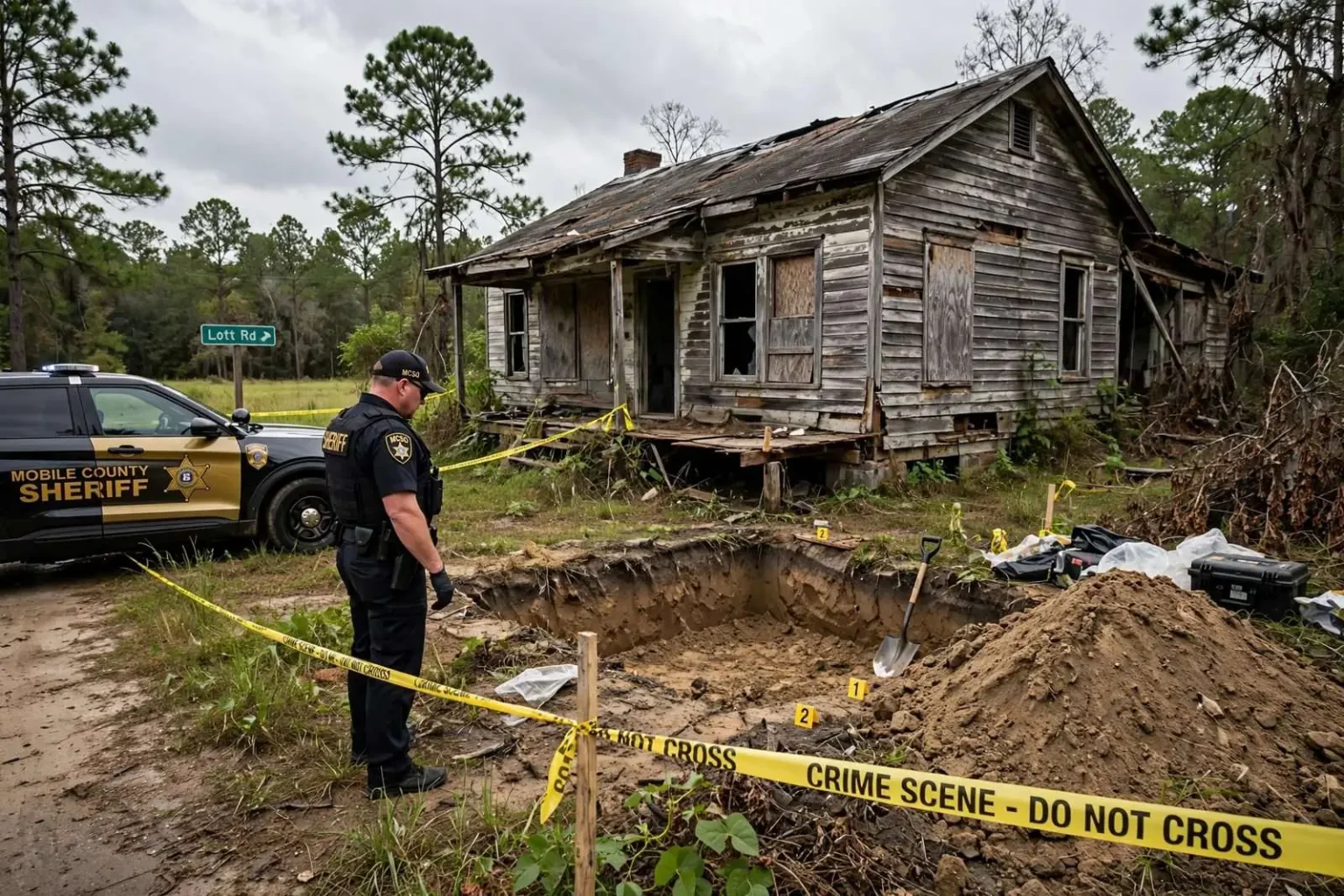
The Mobile County Sheriff’s Office has identified the man whose body was found buried more than six feet beneath an abandoned house on Lott Road as Daniel Mario Preslar, 47 — a man investigators believe was reported missing in 2020. Deputies confirmed the remains through Preslar’s pacemaker, according to the agency, closing one long-running question while opening another: how the 47-year-old ended up beneath the floor of a vacant residence in northwest Mobile County.
Sheriff’s officials said they acted on reliable tips that a body was buried at the unoccupied home, and the discovery came on their third search of the property in recent weeks — the first time they found human remains. On two earlier visits, deputies stopped digging over concerns the house might not hold up. The structure, vacant and deteriorating, posed a risk of collapse that investigators had to weigh against the urgency of the information they had received.
A Burial Deliberately Concealed
The burial itself was deliberately concealed. A section of floor had been removed, the body buried beneath it, and the flooring replaced — work that investigators say shows the concealment was planned rather than rushed. Anyone walking through the abandoned residence would have seen an ordinary floor, with no visible sign of what lay more than six feet below it.
“No one would ever think to look under the house of an abandoned residence,” Sgt. Mark Bailey said. “We appreciate the information that led us here. Anyone else that we have not interviewed that may have information would be helpful to us.”
The sheriff’s office said it believes the death is tied to a criminal case dating back roughly 13 months, and declined to say when the tips arrived or whether they pointed to additional bodies. The agency has also not named any suspects, leaving investigators to work backward from the scene: the condition of the remains, the method of burial and the timeline of the criminal case they believe is connected.
Lott Road runs through the Wilmer area of northwest Mobile County, a rural stretch where houses sit far from the road and vacant structures can go unnoticed for months. Abandoned homes in unincorporated parts of the county fall under the sheriff’s office’s jurisdiction, and the agency regularly asks residents to report suspicious activity at vacant properties — the kind of tips that, in this case, ultimately broke the case open.
Identifying remains through a pacemaker is an established forensic technique. Implanted medical devices carry unique serial numbers tied to manufacturer records, allowing investigators to match a device recovered from remains to the medical history of a specific person. For families of long-missing loved ones, such confirmations — along with dental records and DNA comparison — are often the final word in cases that linger for years without answers.
Preslar was believed to have been reported missing in 2020, meaning his disappearance had gone unexplained for years while the answer sat beneath a house on a quiet county road. Missing person cases in Mobile County can number in the hundreds at any given time, and investigators say the ones that go cold most often are those where the person left willingly, had no fixed address or simply lost touch with family. Tips from the public remain the single most common trigger for reopening them.
The sheriff’s office has not said how long deputies spent excavating the site or what condition the remains were in when they were recovered, details that typically factor into a coroner’s determination of identity, cause and manner of death. Once a body is found in a suspected homicide, the scene becomes evidence: the soil around the remains, the cut section of flooring and anything else on the property will be documented and processed before the investigation moves forward.
What Comes Next for the Case
The connection to a criminal case roughly 13 months old suggests investigators already had a file on activity connected to the death, even before the body was found. Detectives will now work to reconcile that case with the physical evidence from Lott Road — a process that can include re-interviewing people who knew Preslar, tracing who had access to the abandoned house and consulting with prosecutors about what charges the evidence will support.
Bailey’s appeal for more information signals that the sheriff’s office does not consider the inquiry closed. Investigators routinely revisit the circles of a victim’s life — family, coworkers, acquaintances from the months before the disappearance — and unsolved disappearances from the same period are often re-examined once a burial site surfaces. Anyone with information has been asked to come forward.
The case has drawn attention across the county both for its macabre details and for its patience. It took three searches of the property before the remains were found, and the earlier efforts stopped not because investigators lost confidence in their tips but because the building itself was failing. The eventual discovery vindicated the decision to keep the property on the list rather than write it off.
For neighbors along Lott Road, the identification of Preslar turns a months-long mystery into a legal question: who put him there, and why. Those answers now rest with sheriff’s investigators and prosecutors, who must turn a concealed burial into a case that can be proven in court — starting, as Sgt. Bailey made clear, with whatever the public still remembers about Daniel Mario Preslar and the people around him in the months before he vanished.
The pacemaker confirmation also illustrates how modern forensics has changed the pace of identification in cases like this. A generation ago, remains found in that condition might have required lengthy DNA analysis before a name could be attached. A single implanted device, matched against manufacturer registries, can produce a confirmed identity within days — allowing detectives to shift their focus from who the person was to what happened to him.
What investigators have described so far paints a picture of methodical work. Reliable tips pointed them to a specific unoccupied house. The first two searches stopped out of caution for the structure’s stability. The third went deep enough — more than six feet — to reach the remains, which were then identified through a device most people never think about after it is implanted. Every step of that sequence will now be scrutinized as the criminal case develops.
A Case That Stayed Alive
The resolution also highlights the role that anonymous information plays in cases involving buried remains. Investigators across the Gulf Coast regularly say that tips — from neighbors who noticed unusual visitors, from people who overheard conversations, from acquaintances who kept a secret too long — are how old cases find new life. Bailey’s public thanks to the tipsters, and his invitation for anyone not yet interviewed to come forward, suggests the sheriff’s office believes there is more to hear.
The roughly 13-month-old criminal case the sheriff’s office tied the death to remains its anchor. If that case involves people now in custody or already charged in unrelated matters, prosecutors will have additional leverage and additional complications: statements made before the body was found, evidence gathered under different assumptions and witnesses whose accounts may shift now that a victim has a name and a grave.
Preslar’s family, believed to have reported him missing in 2020, now faces the confirmation no family waits for. In Mobile County, as elsewhere, the identification of long-missing persons typically prompts renewed public appeals — both for information about the death and for patience while the legal process runs its course. The sheriff’s office has given no timeline for arrests or charges, and none may come quickly: cases built on buried evidence move at the speed of forensics, interviews and court filings.
What began as a rumor about an abandoned house on Lott Road has become a homicide investigation with an identified victim, a possible timeline and a request to the public still standing. Deputies found what the tips promised was there. The question they are now pressing — with the help, they hope, of people who have not yet spoken — is who put Daniel Mario Preslar six feet under a floor and sealed it behind him.
For the sheriff’s office, the case is also a reminder of how much depends on persistence. The agency could have treated the first two fruitless searches as evidence that the tips were bad. Instead, deputies adjusted for the building’s condition and kept the property in play until the third effort reached the remains. Cases involving hidden graves are among the most labor-intensive investigations a county agency can run, requiring excavation support, forensic specialists and coordination with the coroner — resources that smaller departments across Alabama often have to borrow or share.
Residents in the Wilmer area who remember activity at the house — vehicles coming and going, people seen on the property, noise in the months surrounding the criminal case investigators tied to the death — are the kind of details that can turn a timeline into a prosecution. Sgt. Bailey’s request was broad on purpose: anything not yet in the file, from anyone not yet interviewed, is useful. In cases like this one, the difference between an identified victim and an answered case is almost always a phone call someone has been putting off.