Burn bans in effect for Mobile and Baldwin counties
ADEM burn bans cover Mobile and Baldwin counties through Oct. 31. Officials warn against burning Hurricane Sally debris due to fire and smoke hazards.
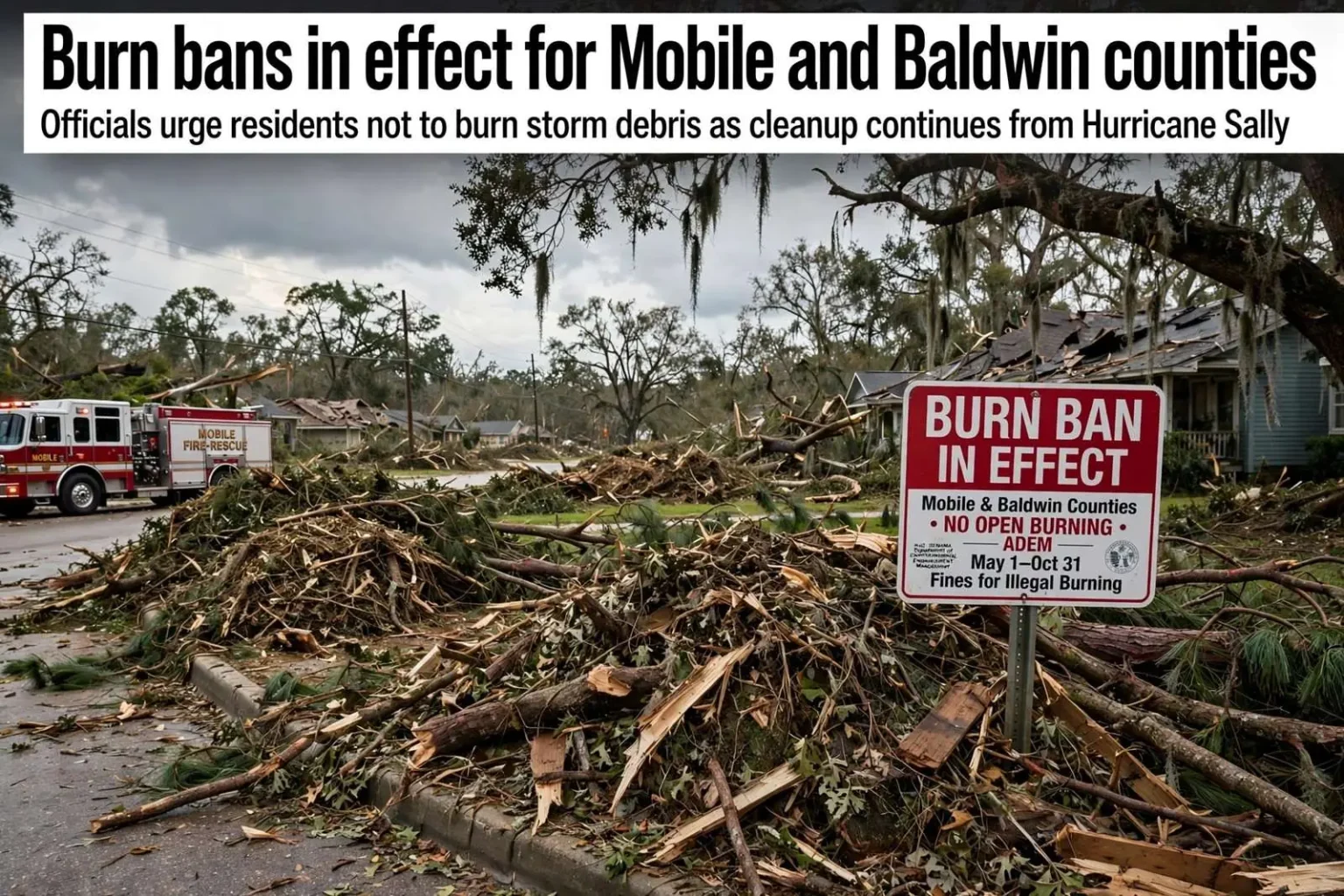
Burn bans remain in effect for Mobile and Baldwin counties, and officials are urging residents not to burn storm debris as cleanup continues from Hurricane Sally.
The plea comes as both counties — the two hardest-hit in Alabama by the September hurricane — continue to grapple with mountains of downed limbs, uprooted trees and yard waste left along roadways and stacked in neighborhoods from Bayou La Batre to Fairhope. With debris piles standing on curb lines for weeks awaiting collection, some residents have been tempted to take matters into their own hands and set the piles on fire.
Officials want them to stop.
Each year the Alabama Department of Environmental Management issues burn bans for a dozen counties, including Mobile and Baldwin, from May 1 through Oct. 31. The annual prohibition covers outdoor open burning of wood, brush, leaves and yard debris, and it exists for a straightforward reason: warm-season weather patterns trap smoke and ozone-forming pollutants close to the ground, degrading air quality across the region’s population centers.
Even outside the seasonal ban, burning storm debris without a permit is prohibited in urbanized areas of both counties, and a hurricane’s aftermath does not suspend the rules. The penalties for illegal open burning can include fines, and — more to the point for fire officials — the practice creates hazards that emergency crews already stretched by the storm response cannot afford.
Why the annual ban exists
Alabama’s open-burning rules date back decades and are administered by ADEM, the state environmental agency, under air-quality regulations that implement federal Clean Air Act standards. The warm-season ban applies to the state’s dozen most populous counties — a band running across the Tennessee Valley, through the Birmingham metro, along the River Region and down to the Gulf Coast — where ozone and particulate pollution are most likely to exceed federal thresholds.
The counties included in the ban are not chosen arbitrarily. They share the conditions that make open burning a public health problem: dense-enough populations that many people breathe the same smoke, weather patterns that hold pollutants near the ground for months at a time, and enough yard waste and land clearing activity that unregulated burning would add a measurable load of ozone-forming pollution each summer. Mobile and Baldwin, at the bottom of the list along the coast, check every box — and the hurricane’s debris has multiplied the amount of material sitting where one match could add it to the air.
During the banned months, meteorological conditions work against anyone who lights a pile. Stagnant air, high humidity and afternoon temperature inversions hold smoke near the neighborhoods where it is produced, and smoldering debris can emit particles for days. Residents with asthma, chronic obstructive pulmonary disease and other respiratory conditions are the first to feel it.
The ban does not apply to some limited exceptions — such as certain agricultural and prescribed burns managed by forestry professionals — but household debris is not among them. Homeowners who want yard waste gone during the banned months have one legal route: haul it, mulch it or set it out for the debris contractors working the storm zones.
Mobile Fire-Rescue: talk first, call 911 for emergencies
Steven Millhouse of Mobile Fire-Rescue said neighbors should talk to each other about burning or contact the Bureau of Fire Prevention if it becomes a major issue, and reserve 911 for emergencies.
The guidance reflects a practical reality of the storm aftermath: with debris piles on nearly every block, disputes and near-misses over burning are common, and fire departments want residents to resolve questions without tying up emergency dispatchers. A neighbor worried about smoke drifting into a home, or about a pile burning too close to a structure, can raise it directly with the person burning or take it to fire-prevention staff, who can explain the rules and step in when a violation is clear.
What belongs on 911 is a fire that is out of control or threatening something. Officials stress that a debris pile is not the place to test that line — fires in stacked debris can generate intense heat, throw embers and spread faster than they appear to from the curb.
Baldwin County: harder for trucks to reach
In Baldwin County, Barnwell Fire Chief Roy Glenn warned that downed power lines and tree debris make some areas hard for firefighters to reach, and an out-of-control fire could be life-threatening.
The warning points to a specific risk that Baldwin residents know from Sally’s aftermath: weeks after landfall, some rural and heavily wooded roads remained choked with fallen trees, tangled limbs and utility lines pulled down across driveways and lanes. A fire engine that cannot get within hose distance of a fire is an engine that cannot save the house behind it.
Glenn’s department covers the Barnwell area north of Fairhope, a mix of subdivisions and wooded acreage where debris piles sit close to homes, fences and pine stands. In those conditions, a debris fire on a dry, breezy day can run from a curb pile into the tree canopy in minutes, and the embers it throws can start spot fires a hundred yards downwind.
Fire officials across the county echoed the same arithmetic: every crew tied up with an illegal debris burn is a crew unavailable for a genuine emergency somewhere else — a medical call, a wreck on a debris-clogged road, or a structure fire of the kind Baldwin County fought repeatedly in the weeks after the storm.
Sally’s debris problem
Hurricane Sally came ashore in mid-September near Gulf Shores as a slow-moving Category 2 storm, and its crawl across the region is precisely what produced the debris problem now lining the streets. Rather than racing inland, the storm sat over the Gulf Coast for hours, pushing a sustained surge into coastal neighborhoods and dropping torrential rain and wind that snapped pines and oaks by the thousands.
Residents of Baldwin County saw some of the worst of the wind damage — the eyewall tracked directly over the county — while Mobile experienced widespread tree loss, prolonged power outages and flooding along the bay and its rivers. In both counties, the storm left behind a landscape of blocked roads, tangled utility lines and yard debris measured in tons per household in the hardest-hit neighborhoods.
The cleanup burden that followed ranks among the largest in Alabama history. Debris contractors under contract to the counties and municipalities began collecting vegetative debris, construction and demolition material and household hazardous waste in separate streams, and the volume of cut wood and limbs has required months of hauling to temporary staging sites before final disposal.
For homeowners, the sight of a pile that has sat on the curb for weeks is frustrating — and it is exactly the frustration officials say leads to illegal burning. Their message is patience: the piles are scheduled, the collection is ongoing, and setting one on fire trades a cleanup delay for a citation, a smoke complaint or a house fire.
Even rain does not end the risk
Officials noted that even after rain, drying debris can keep smoldering, and smoke can enter homes of people with breathing problems.
The point matters in a hurricane zone, where afternoon thunderstorms are routine. Rain wets the outside of a debris pile while the interior stays relatively dry, and once the shower passes the pile can rekindle or continue smoking for days. Smoldering wood waste produces thick, acrid smoke at ground level, and that smoke does not respect property lines — it seeps through open windows, into crawl spaces and into the homes of neighbors who may have no idea a pile nearby was lit.
For residents with asthma, emphysema, heart disease or other respiratory sensitivities, that low-level smoke exposure is more than a nuisance. Health officials routinely warn that fine particle pollution from open burning can trigger asthma attacks and worsen chronic lung conditions, and children and older adults are the most vulnerable.
The bottom line for residents
The rules for residents of both counties are simple: do not burn storm debris, do not burn yard waste during the ban, and report a genuinely dangerous fire to 911. Questions about burning, permits and debris collection can go to fire-prevention offices or municipal public works departments, which coordinate the curbside pickups.
Alternatives are available in most jurisdictions — curbside vegetative collection, drop-off sites and mulching programs that turn the storm’s waste into compost and ground cover. As the cleanup stretches on, officials say the patience of residents remains the safest tool in the effort, and the fire crews of both counties would rather answer an emergency than write a ticket for a pile that should have waited for the trucks.