Burst Fire Main Blamed for Million-Gallon Flood at Downtown Mobile’s Merchants Plaza
A burst six-inch fire main sent one million gallons into the basement of downtown Mobile's Merchants Plaza, submerging it under 7.5 feet of water.
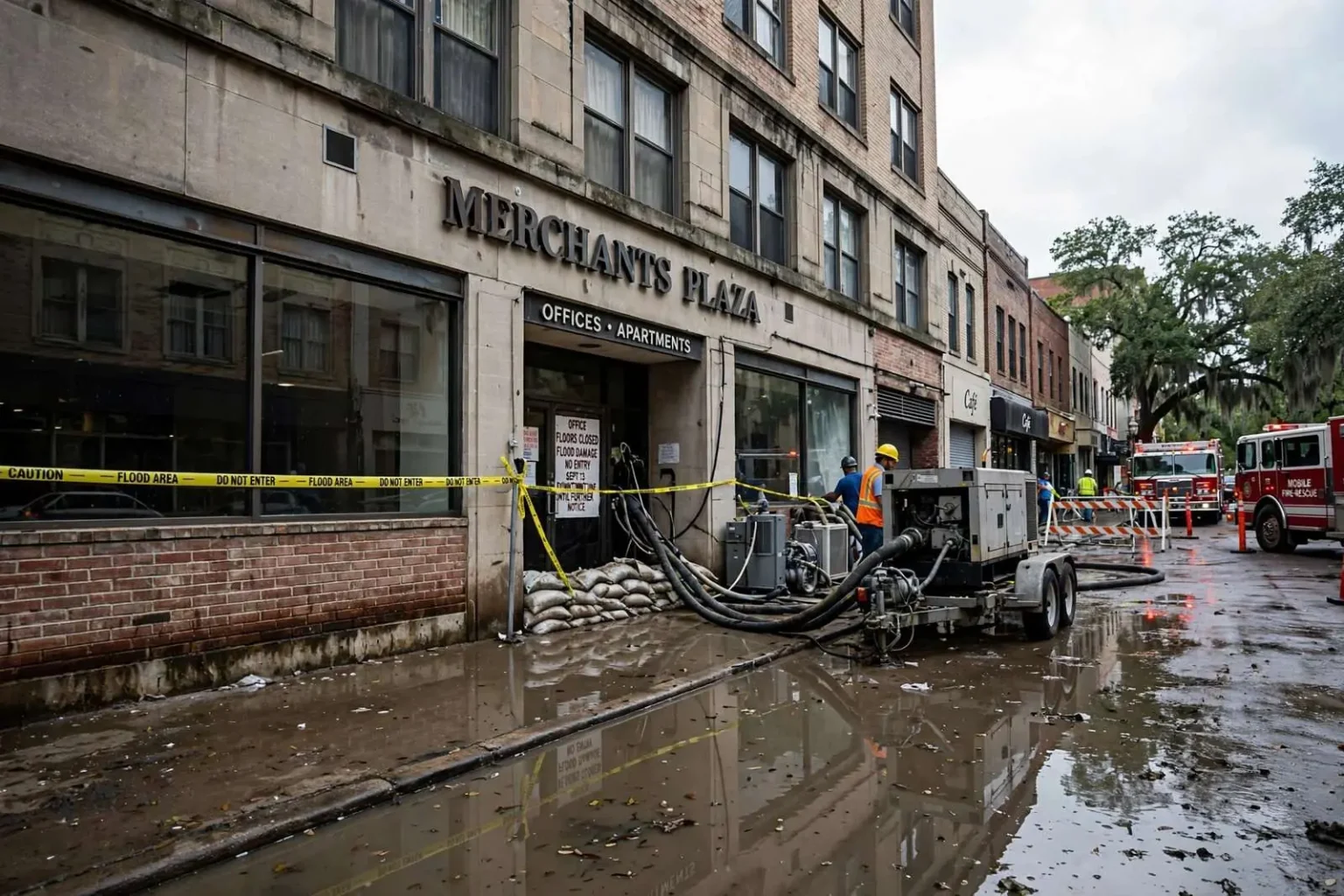
A busted six-inch fire main pipe is what sent a million gallons of water pouring into the basement of a downtown Mobile office building, according to the company that manages the property. The flood hit Merchants Plaza on Tuesday, Sept. 13, submerging the lower level in seven and a half feet of water and leaving one of the city’s recognizable downtown buildings with its most heavily used floors out of commission.
Jason Scott, an asset manager for Sterling Properties, said the ruptured fire main was the source. The volume is worth pausing on: a million gallons is enough water to fill a small reservoir, and it poured into a confined basement space over the course of the incident, rising seven and a half feet before the source could be controlled. A six-inch main carries a large, continuous flow, and once it failed inside the building’s lower level, there was no natural place for the water to go — the basement filled until the rupture was shut down.
The flood damaged key equipment in the basement, including an electrical switch gear and the pump that activates the building’s sprinkler system. That combination created cascading problems: with the switch gear damaged, the office portion of the building lost power, and with the sprinkler pump out of service, the building’s fire protection systems required interim measures while repairs proceeded. In the days after the flood, the office portion of the building remained without power and off-limits to everyone.
What Was Damaged — and What Was Spared
Scott said only the building’s office workers were affected by the flooding — residents of the apartments upstairs were untouched, and no other floors took on water. The distinction matters for a mixed-use building like Merchants Plaza, where the operational health of the office component and the residential component depend on separate systems. Water followed gravity into the lowest level, sparing the upper floors directly, but the loss of the electrical switch gear meant the impact rippled through building services above it.
The damage list reads like a catalog of what modern buildings keep in their basements. Electrical switch gear — the large breaker and distribution assemblies that route power through a building — is almost always located at or below grade, as is the fire pump that pressurizes a sprinkler system. Both are expensive, long-lead-time pieces of equipment: replacements typically must be ordered, built and shipped to specification, which is why floods that reach mechanical levels so often set recovery schedules in months rather than weeks.
In the days after the flood, Scott and contractors have been working to restore the building, using a temporary generator to help dry out the basement. The generator served double duty — powering the pumps and drying equipment working around the clock to remove a million gallons from a confined space, and supplying whatever temporary power could safely be routed to keep essential services running. Drying a masonry and concrete basement after seven and a half feet of standing water is a slow process, and humidity control matters as much as pumping: lingering moisture drives mold growth that can compound the original damage.
There was no timeline yet for when the building would be back to normal. For the office tenants displaced by the flood, that open-ended answer is the most disruptive fact of all — without a firm restoration date, businesses must arrange interim space, mail and package handling, and continued payment of rent on offices they cannot occupy. Commercial property managers in such situations typically coordinate temporary accommodations while contractors work, but the uncertainty itself carries a cost.
Merchants Plaza in Downtown Mobile
Merchants Plaza is a longtime fixture of downtown Mobile, combining office floors with residential apartments in a building whose name recalls the commercial district it serves. Downtown Mobile’s office stock includes a range of mid-century and older buildings near the waterfront, Government Street and the central business district, and buildings of this type house the small firms, professional offices and service businesses that form the everyday backbone of the city’s economy. When one of them goes dark, the effect spreads to the tenants’ clients and employees who arrange their days around the address.
The incident also highlights the hidden infrastructure on which downtown buildings depend. Fire mains are pressurized supply lines connected to the municipal water system, sized to feed sprinklers and hydrants, and they run through buildings constantly — silently, invisibly, and almost always without incident. A six-inch main operates under substantial pressure, and when one fails inside a structure, the failure combines the worst features of a plumbing leak and a burst city main: high flow, continuous supply and no shutoff that a building occupant can reach.
Why Fire Main Failures Are So Disruptive
Fire protection systems are designed with redundancy for firefighting, but a ruptured main inverts that design. The same pressure that guarantees water for sprinklers guarantees that a break will release enormous volumes until the line is valved off. Building engineers and first responders responding to such failures must locate the appropriate isolation valves, often under time pressure and in poor lighting, while water is already accumulating. The seven and a half feet that accumulated in the Merchants Plaza basement reflects how quickly that process unfolds.
Age and corrosion are the typical culprits in fire main failures, though the specific cause of the Merchants Plaza rupture has not been detailed by the property manager. Pipe failures of this kind tend to occur at fittings, joints or previously repaired sections, and they are more common in systems decades old. For downtown building owners across Mobile, the incident is a reminder of the value of inspection and maintenance programs for the systems that are least visible and most catastrophic when they fail.
The sprinkler pump damage adds a regulatory dimension as well. Fire protection systems are subject to code, and a building operating without a functional sprinkler pump generally must implement fire watch or other interim safety measures approved by the fire marshal until the system is restored. Those requirements shape the sequence of repairs — fire protection and life safety systems move to the front of the line regardless of the broader renovation schedule.
The Recovery Sequence
The restoration of a flooded mechanical level follows a well-established sequence, and the work at Merchants Plaza has been moving through it. First comes dewatering — pumping out the standing water, which for a basement filled to seven and a half feet means days of continuous pumping and disposal. Next is the dry-out: commercial dehumidifiers and air movers running around the clock, monitored with moisture meters until the masonry, concrete and remaining materials return to acceptable moisture content. Only then can electricians begin assessing equipment, and only after assessments can replacement switch gear and a replacement fire pump be specified, ordered and installed.
That last step is the schedule driver. Major electrical distribution equipment and fire pumps are not off-the-shelf items; they are built to order, and lead times commonly run to months. Until new equipment is energized, the office portion of the building cannot return to normal operation, which is why Scott’s absence of a timeline was not evasion but an accurate reflection of the process. The temporary generator bridging the gap in the meantime carries its own logistics — fuel deliveries, maintenance and noise management — for as long as it is needed.
The insurance dimension runs in parallel. A commercial property loss of this scale triggers claims covering the property damage itself, the equipment replacement, business interruption for the office tenants and the extra expense of temporary measures like generator power. Documentation — photographs, moisture logs, contractor assessments — accumulates from the first day, and the adjuster’s determinations will shape the pace at which the owner can commit to major equipment purchases.
What It Means for Downtown Mobile
For downtown Mobile, the flood is a localized event with broader lessons. The city’s central business district has been in the midst of a long revival — residences added to older buildings, restaurants and venues drawing evening traffic, and offices housing the professional firms that serve the Gulf’s maritime, legal and medical economies. Every building taken partially offline removes tenants from the district’s daily population, the pedestrian traffic that downtown businesses count on, and the occupied storefronts and floors that keep a block vibrant.
The separation of fates between the apartments upstairs and the offices below also tells a small story about how mixed-use buildings weather disasters. The residents continued living above a million-gallon flood without taking on water — a testament to how far the damage reached and how little farther it could have gone. Had the failure occurred elsewhere in the system, or had the water risen past the first floor, the residential side of the building would have been drawn into the same displacement affecting the office workers.
For building owners throughout the downtown district, the Sept. 13 failure at Merchants Plaza is a case study arriving unbidden: pressurized fire mains are critical infrastructure, mechanical equipment belongs in basements out of necessity but not out of safety, and the difference between an inconvenience and a catastrophe is often the speed with which a break is isolated. Sterling Properties’ managers and contractors continue the restoration work — pumping, drying, assessing and replacing — with a temporary generator humming and a return-to-normal date that remains, for now, unwritten.
The million gallons have been pumped away and the upper floors stand dry, but the work of bringing Merchants Plaza’s offices back to life continues below the street, one replaced component at a time.