
Calcedeaver Firefighters Called to Tractor Engulfed in Flames in North Mobile County
The Calcedeaver Fire Department responded to a large tractor engulfed in flames on Little Chestang Road in north Mobile County. No injuries were reported.
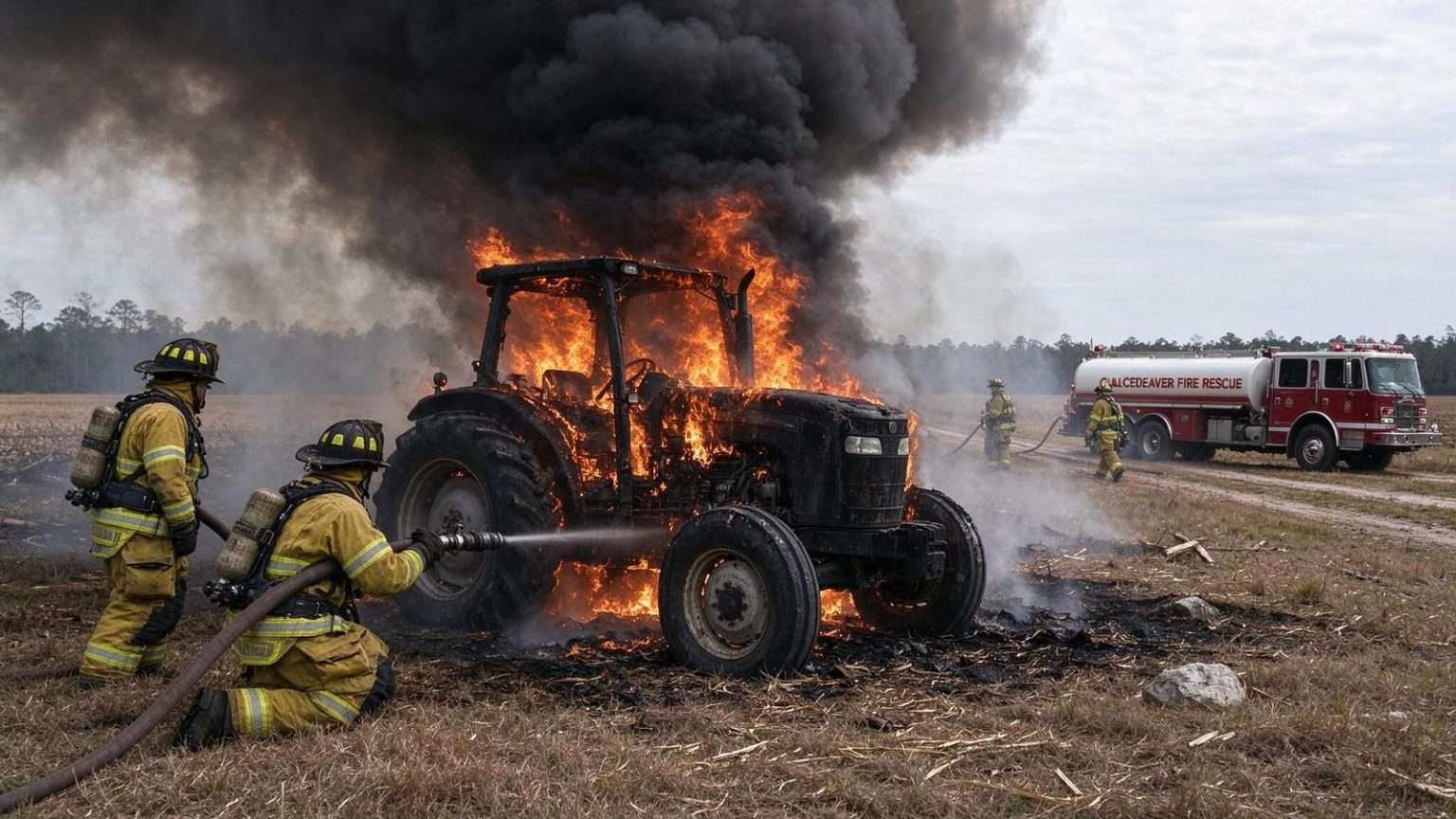
A large tractor was found burning in north Mobile County on Tuesday morning, drawing a response from the Calcedeaver Fire Department to one of the rural volunteer department’s more memorable equipment calls of the season.
Firefighters were called to Little Chestang Road at about 9 a.m. When crews arrived, the tractor was already fully involved in flames — an advanced stage of fire that changes everything about how the call is worked. A tractor engulfed on arrival cannot be saved; the job becomes protecting the surrounding field, structures and equipment from the fire’s spread and then safely extinguishing the burning machine itself. No injuries were reported in connection with the fire.
The Scene on Little Chestang Road
Little Chestang Road runs through the rural stretches of north Mobile County, an area of farms, timber land and scattered residences beyond the suburban growth that has pushed up Highway 45 and Highway 43 from the city. The landscape there is served almost entirely by volunteer fire departments — Calcedeaver among them — whose stations are staffed by trained volunteers who leave fields, jobs and dinner tables when the pager sounds. A 9 a.m. call on a Tuesday finds most of that roster at work somewhere in the county, so response times are measured in the minutes it takes members to reach the station and roll the trucks, not the minutes of a career-staffed urban department.
By the time engines reached the burning tractor, the machine was fully involved, which is common with equipment fires. A neighbor or passerby typically makes the initial report, and the interval between ignition and the first hose line is long enough for fire to work through a tractor’s fuel, hydraulics and accumulated debris. The firefighter’s task is then twofold: knock down the burning machine and make sure the fire — which throws embers as it burns — has not jumped to dry grass, woods or a nearby barn.
Equipment Fires in Rural Mobile County
Fires involving farm machinery are a recurring call for the volunteer departments that cover the rural stretches of Mobile County. Tractors carry diesel fuel, hydraulic fluid and often a buildup of dry crop debris around hot engine and exhaust components, all of which can feed a fire quickly once it starts. Hay and straw packed around an engine manifold, an oil leak finding a hot exhaust, or a wiring fault in a machine parked near dry vegetation — these are the classic ignition paths, and north Mobile County’s late-spring dry spells provide plenty of tinder.
Diesel itself is hard to ignite in open air, but that margin disappears on a machine: pressurized hydraulic lines spray atomized fluid that flashes into fire, rubber hoses and tires burn hot, and battery terminals arc through ruptured wiring. Once a tractor’s engine compartment is burning, the fire has a fuel supply and airflow built into its own chassis. Fully involved, a burning tractor produces a plume of black smoke visible for miles across the flat farmland — the signature that draws second and third calls from concerned residents before the first engine is even on scene.
Water Supply and the Rural Response
Because these fires often happen well away from hydrants, crews typically have to bring their own water supply to the scene by tanker. The logistics define rural firefighting across Alabama: a volunteer department responding to Little Chestang Road carries its water in the trucks, and once the initial load is spent, the call becomes a shuttle operation — tankers running between the fire scene and a fill site, usually a hydrant at the edge of coverage or a static water source like a pond, dumping into portable tanks that engines draft from.
That shuttle arithmetic is why rural departments push mutual aid. A tractor fire may need only a few thousand gallons, but a fire that has spread into hay, a barn or the tree line can consume tens of thousands — and the difference is bridged by neighboring departments’ tankers. Calcedeaver and the other volunteer companies of north Mobile County train on these movements together precisely because no single station’s water supply can cover a rural working fire alone. For a fully involved machine fire in open ground, the system usually works: enough water arrives to extinguish the equipment and protect what surrounds it, and the loss stays limited to the machine.
What the Loss Means
For a working farm, a tractor is not a machine among machines — it is the pivot of the operation. Depending on the season, the burning tractor may have been due in a hayfield, a garden plot or a timber cleanup, and its loss lands mid-calendar with no substitute in the shed. Equipment insurance covers some operations, but the gap between claim check and working tractor is measured in months of waiting on replacements, and smaller farms feel the absence through a whole season.
Prevention on the Farm
Fire officials use calls like this one to repeat a short list of habits that prevent most machinery fires. Keep engines and engine compartments blown free of chaff, straw and grease buildup — the debris that turns a hot exhaust into an ignition source. Fix the leaks: hydraulic fluid and fuel lines are the accelerants, and a damp hose is a warning, not a nuisance. Carry a charged fire extinguisher on the machine and know how to use it, because a fire caught in its first seconds can be stopped and a fully involved tractor cannot. And park cold equipment away from dry vegetation, since a parked machine near a field edge can catch fire from a neighboring burn or a catalytic-hot exhaust settling into dry grass.
The prevention list matters doubly in rural Mobile County because of the response arithmetic already described — every minute a machine burns before help arrives extends the fire, and the help that arrives must first find water. Farmers who keep their equipment clean and their extinguishers charged are, in practice, their own first engine company.
The Volunteer Bottom Line
For Calcedeaver’s volunteers, Tuesday’s call was routine in the way that matters: handled without injury, contained before it spread, closed out before lunch. Departments like Calcedeaver run on fundraising, county support and donated hours, and they answer the majority of fire calls in the unincorporated northern county — structure fires, brush fires, wrecks on the rural highways and, a few times a season, burning equipment in a field.
The call also serves as a quiet reminder to the county’s suburban growth: north Mobile County’s farmland is still working land, its fire protection still rests on volunteer companies and tanker shuttles, and the nearest hydrant is often miles from the next tractor fire. Crews cleared the scene after the machine was extinguished and the hot spots were dug out; the investigation into what sparked the fire remains a matter for the owner and, if insurance is involved, the adjuster. No injuries were reported, and that — for a fully involved tractor on a Tuesday morning — is the outcome rural departments count as the one that matters.
How the Call Unfolds
From the first page to the last wet overhaul, an equipment fire like Tuesday’s follows a familiar sequence for the volunteers of north Mobile County. The call comes in as smoke or a machine fire on Little Chestang Road; the dispatcher notes the cross streets and any exposure — buildings, hay, woods — so the first-out engine knows what it is protecting before it leaves the station. Members respond directly or to the station depending on the department’s staffing pattern, and the first officer on scene sizes things up with three questions: is anyone hurt, what is burning, and where is the nearest water.
For a fully involved tractor with no injuries and no exposure, the answers are simple and the operation is straightforward — park the engine upwind and uphill if terrain allows, protect the machine’s surroundings, cut the fire away from anything it could reach, and flow water until the metal stops steaming. Overhaul is the tedious half of the job: hay and hydraulic reservoirs hold heat and can rekindle hours later, so crews pull debris apart, foam the fuel sources and check with a thermal camera before they leave. What looks like a fifteen-minute fire becomes an hour of making sure it stays out.
Watching for Spread
The spread risk is what turns a machine fire into a county emergency, and it rises with the season. In dry late spring and summer, a burning tractor in a field is a wind-blown ember source, and Alabama’s volunteer departments have all fought grass fires that started exactly this way. Crews work the spread line as hard as the fire itself — wetting a perimeter around the machine, checking the field edges, and assigning an eye to the tree line while the main attack proceeds. Tuesday’s call stayed a tractor fire, which the outcome record reflects: one machine lost, nothing else touched.
Neighbors in the farm roads around Little Chestang Road know the drill well enough to help with the parts the trucks cannot do — meeting the engine to point out the lane in, moving other equipment away from the burning machine, and standing by with a farm extinguisher or a water trailer where it is safe to do so. Rural fire response in Mobile County is a cooperation between the departments that run the calls and the residents who keep them informed, and equipment fires are where that cooperation shows most clearly.