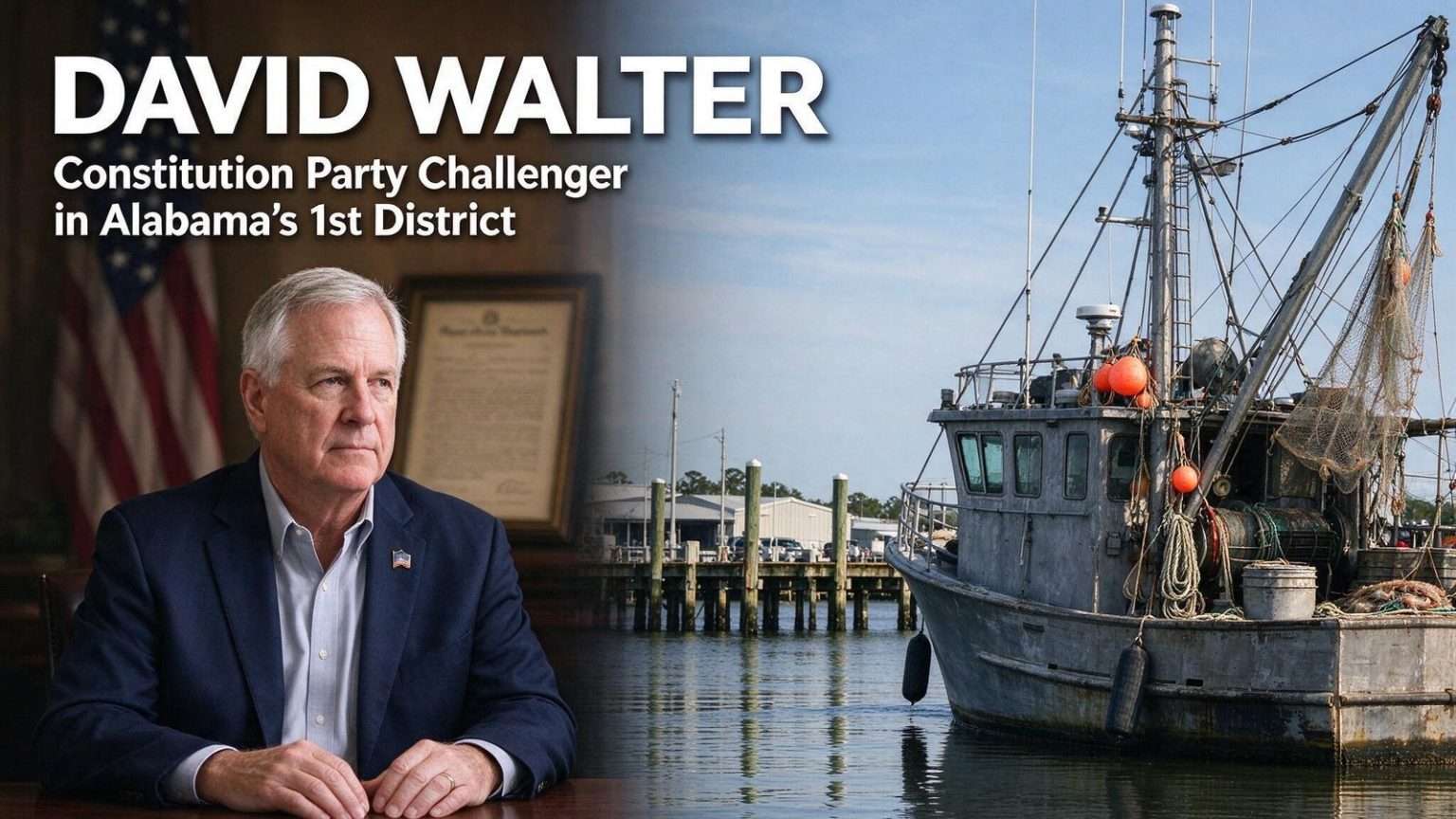
On the ballot against longtime incumbent Jo Bonner in the race for Alabama’s 1st Congressional District seat is Constitution Party candidate David Walter, a Mobile-born businessman making his first run for public office. His candidacy gives southwest Alabama voters a contrast rarely seen in the district: a challenger from outside the two major parties running explicitly on business experience rather than political credentials, in a campaign built around shrinking the federal government and redirecting its attention to the Gulf Coast’s economic recovery.
Third-party candidacies in Alabama rarely attract the funding or media attention that major-party races receive, but they matter in a different way — they put distinct ideas on the ballot and force voters to weigh the incumbent’s record against an alternative vision. Walter’s platform does that more sharply than most, combining national positions drawn from the Constitution Party’s small-government tradition with local grievances specific to the Gulf fishing industry and the aftermath of the BP oil spill.
Background: from Vietnam to Baldwin County business
Walter served as a Marine in Vietnam and received an honorable discharge. He started his business in 1968 in Baldwin County and has never held elected office. That biography is the foundation of his pitch: a veteran who came home, built a business across the bay, and spent decades meeting payroll rather than campaigning for office.
Baldwin County’s economy — built on small business, tourism, agriculture and the communities along the Eastern Shore — has long been a natural home for entrepreneurial politics, and Walter’s framing draws on that tradition. His argument is that Washington’s problems stem from career politicians who have never operated within a budget they could not print their way out of, and that the remedy is to send people who have actually run enterprises and answered to customers. It is a familiar theme in American campaigns, but in Walter’s case it is paired with a party platform that pushes it further than either major party would.
Where he stands nationally
Nationally, Walter says his priorities include repealing or defunding the federal healthcare law, reducing government regulations he argues drive up healthcare costs, controlling federal spending, shrinking the size of government, limiting defense to defending the nation’s borders, removing fraud from Medicare and welfare programs, cutting overlapping agencies, imposing term limits and addressing abortion policy.
Several of those positions mark him clearly as a Constitution Party candidate. The party, founded in the early 1990s, builds its platform on a strict reading of the Constitution’s enumerated powers, arguing that most of what the federal government now does lies outside its constitutional authority. Walter’s call to limit defense spending to defending the nation’s borders — rather than maintaining a global military footprint — is a distinctive position in that tradition, one that separates the Constitution Party from both major parties: smaller than the Democratic position on overseas engagement and more restrictive than the Republican position on defense budgets.
His healthcare stance reflects the same logic. Repealing or defunding the federal healthcare law was, at the time of the race, the signature position of the conservative movement nationally, and Walter frames the regulatory burden as a cost driver that government intervention created and only government withdrawal can fix. The proposals on Medicare and welfare fraud, overlapping agencies and term limits round out a platform aimed squarely at voters who believe Washington has grown beyond its proper function and cannot be repaired from within.
Where he stands on Gulf Coast issues
Locally, he focuses on what he calls the damage done by the National Marine Fisheries Service to the Gulf fishing industry — an industry he values at roughly $450 million — and on creating a local congressional office dedicated to helping residents resolve claims with BP after the oil spill.
Both issues land at the center of the 1st District’s economy. The commercial and recreational fishing industries of the Gulf — from the shrimp fleets of Bayou La Batre to the oyster houses and charter boats that stretch from Mobile County through Baldwin County and across the state line — have spent decades navigating federal fisheries management, including catch limits, closures and permit rules administered through the National Marine Fisheries Service. Fishermen and their allies have long argued that federal management has restricted their livelihoods without adequate regard for local realities, and Walter’s position places him squarely with that camp, framing the agency’s impact as damage measured in hundreds of millions of dollars to a regional industry.
His BP proposal addresses the other defining economic event of the Gulf Coast’s recent history. The 2010 Deepwater Horizon disaster devastated the fishing and tourism economies of south Alabama, and the claims process that followed left many residents frustrated with paperwork, delays and uncertainty. Walter’s answer is structural: a dedicated congressional office in the district whose purpose is to help residents resolve BP claims — treating constituent service not as a side function of the office but as its central local mission during the recovery.
Done right, he argues, BP money channeled with congressional help could do more than restore the coast: it could become a launching pad for new industry and jobs across south Alabama. That vision treats the settlement and restoration dollars flowing to the Gulf as seed capital — an economic development opportunity for a district whose economy has long been dominated by shipbuilding, the port, tourism and fishing.
The case against the incumbent
Walter’s pitch to voters centers on replacing career politicians with businessmen. He points to Bonner’s own survey responses on federal spending — arguing that the incumbent supported increases or flat funding in most budget categories while telling constituents he wants to fix Washington’s finances — and questions the influence of more than $1 million in campaign donations Bonner has received.
The critique follows a classic challenger’s arc: measure the incumbent’s actual votes against his public rhetoric, then attribute the gap to the money and incentives of a career in office. Bonner, first elected to the 1st District seat in 2002, had built a reputation as a reliable conservative vote during his decade in Washington, and his fundraising advantage over a third-party challenger was enormous. Walter’s argument is that the advantage itself is the problem — that an office financed at that scale answers to the donors who sustain it, and that no amount of survey language about fiscal restraint changes the underlying pattern of spending votes.
“Businessmen built this country,” Walter says, “and only businessmen, not politicians, can save it.”
The line distills the entire campaign into a single contrast and reflects the Constitution Party’s broader appeal to voters who feel unrepresented by both major parties. Whether that message could move enough voters in a district that has consistently reelected its incumbents by wide margins was the open question of the race — but Walter’s candidacy ensured that the incumbent’s record on spending, the influence of campaign money, the fishing industry’s grievances and the BP recovery all received a hearing that a two-candidate field would not have given them.
What the race means for the district
For voters in Alabama’s 1st District — spanning Mobile, Baldwin and the surrounding southwest Alabama counties — the contest presented a genuine ideological spectrum. The incumbent offered experience, seniority and membership in the majority party; the challenger offered an outsider’s platform rooted in the district’s own economic wounds. Campaigns like Walter’s rarely win, but they shape the conversation: they force incumbents to answer for specific votes, give constituencies like the fishing industry a champion for their complaints, and register on the ballot the depth of voter dissatisfaction with the political establishment. That is the role the Constitution Party businessman from Mobile asked the district’s voters to give him — and his candidacy, whatever its result, made the race about ideas as much as incumbency.
The Constitution Party’s place in Alabama politics
The Constitution Party occupies the right-most edge of Alabama’s political spectrum, and its candidates appear on ballots across the state in most election cycles. The party’s platform rests on originalist constitutional interpretation, opposition to most federal domestic programs, and a foreign policy of non-intervention — a combination that attracts voters who consider the Republican Party too accommodating of federal power. In Alabama, where third parties must clear signature or petition requirements to reach the general election ballot, a Constitution Party candidate who makes it onto the ballot represents a modest organizational achievement in itself, and his presence ensures the party’s arguments reach an audience far larger than its membership.
For down-ballot races like a congressional contest against a well-funded incumbent, the practical challenges are steep: minimal advertising budgets, exclusion from most candidate forums and debates, and news coverage that treats the outcome as a foregone conclusion. Candidates like Walter run anyway, typically funding campaigns from their own resources and small donations, because the ballot line guarantees their arguments a place in the public record regardless of the tally.
Constituent service as a campaign theme
Walter’s proposal for a dedicated congressional office helping residents resolve BP claims deserves attention as more than a single plank. Constituent service — the casework congressional offices perform for residents navigating federal agencies, from Social Security disputes to veterans’ benefits — is among the most valued and least publicized functions a representative performs. Campaigns rarely build their local message around it, because it is invisible work done office by office, claim by claim.
Making it the centerpiece of a local platform reflects a judgment about what the district needed most in the aftermath of the spill: not another ribbon-cutting speech but an advocate with federal standing to push claims through the system. For the thousands of south Alabamans whose livelihoods depended on the water or the tourist economy of the barrier islands and beaches, the promise spoke directly to their most immediate unfinished business.
The economics of the Gulf fishing industry
Walter’s valuation of the Gulf fishing industry at roughly $450 million underscores how much economic weight the federal management debate carries across the district. The industry’s footprint runs from the working waterfronts of Bayou La Batre and Coden, through the seafood processors and wholesalers of Mobile County, to the charter fleets and fish houses of Baldwin County and the restaurant trade that depends on them across south Alabama. Each layer employs residents whose incomes rise and fall with the rules coming from federal fisheries managers — which is why the National Marine Fisheries Service draws more sustained anger along the Gulf Coast than almost any other federal agency.
Fishermen’s complaints have followed a consistent pattern over the years: seasons shortened by regulatory decisions, catch shares and quotas criticized as favoring larger operators, closures imposed from afar with limited local input. Whether one accepts the industry’s critique or the agency’s rationale, the political reality is durable — federal fisheries management is a live grievance in every coastal election in the region, and Walter’s campaign gave it a prominent place in a congressional race.
A first-time candidate’s bet
Every element of Walter’s candidacy reflects the same wager: that a district shaped by the military, small business, the port and the water would respond to a Marine veteran and Baldwin County businessman promising to shrink the government, defend the fishing industry and channel BP recovery dollars into lasting economic growth. He offered no political résumé because his argument was that political résumés are the problem. Whether voters agreed would be measured at the polls — but the race itself gave southwest Alabama a fuller debate than a single-candidate contest ever provides.