Cantonment man sentenced to 25 years for child molestation
A Cantonment man was sentenced to 25 years in state prison plus lifetime probation after pleading to child molestation and sexual battery in Escambia.
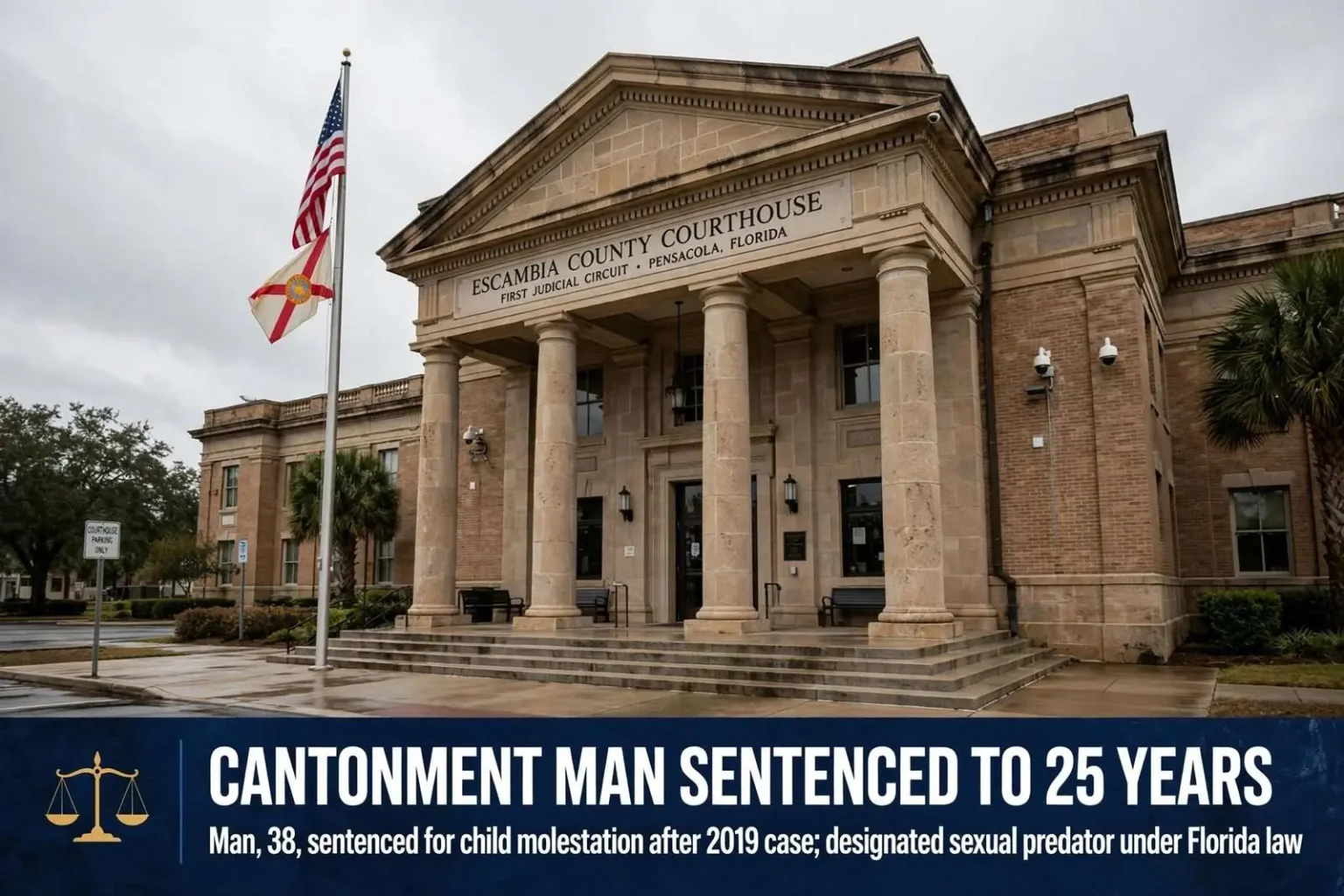
A Cantonment man will spend the next 25 years in state prison after being sentenced for sexually abusing a child, closing out a case that Escambia County investigators first opened in the fall of 2019. Adam Lee Bryant, 38, received the prison term from Judge Jan Shackelford after entering pleas to one count of sexual battery while in a position of familial or custodial authority and one count of lewd or lascivious molestation. The sentencing marked the end of a prosecution that stretched across more than five years and drew on the work of two of the region’s central child-protection agencies.
Under the sentence imposed by the court, Bryant will serve 25 years in state prison followed by sexual-offender probation for the rest of his life. The judge also designated him a sexual predator, a legal classification under Florida law that carries registration duties and community notification requirements he will have to satisfy for the remainder of his life once he is released from custody.
The Charges and the Plea
Bryant was prosecuted under two of Florida’s most serious felony offenses involving child victims. Sexual battery while in a position of familial or custodial authority applies when an offender holds a role of trust or control over a child, a circumstance the law treats as an aggravating factor because of the betrayal involved. Lewd or lascivious molestation covers intentional sexual touching of a minor. Both crimes carry substantial prison exposure, and by pleading to both counts Bryant accepted legal responsibility for the conduct at the heart of the case.
Because the case was resolved through a plea rather than a jury trial, the proceedings moved directly from the plea to sentencing. Prosecutors presented the factual basis for the charges, and the court weighed the nature of the offenses and the vulnerability of the victim in imposing a sentence that will keep Bryant incarcerated well into his sixties.
How the Investigation Began
According to the State Attorney’s Office, the Escambia County Sheriff’s Office and Gulf Coast Kid’s House began investigating the case in September 2019. Cantonment is an unincorporated community northwest of Pensacola that falls within the sheriff’s office patrol jurisdiction, and deputies worked the case alongside professionals trained specifically in interviewing children about abuse.
Gulf Coast Kid’s House, a children’s advocacy center serving Escambia County, is a nonprofit facility that brings law enforcement investigators, child protective investigators, prosecutors, therapists, and victim advocates together under one roof. The center’s model is designed so that a child who discloses abuse can be interviewed once, in a forensically sound setting, rather than being questioned repeatedly by separate agencies. That coordinated approach is credited across the country with strengthening prosecutions while reducing the additional trauma that multiple interviews can inflict on young victims.
The abuse came to light, prosecutors said, after Bryant admitted what he had done to a relative. The child victim later confirmed the abuse, providing investigators with the account that became the foundation of the charges filed against him.
What the Sexual Predator Designation Means
The sexual predator designation is the most stringent classification Florida law provides for sex offenders. It was established under the Florida Sexual Predators Act, adopted by the Legislature in the 1990s in response to public pressure for tougher monitoring of repeat and violent offenders. The designation applies to people convicted of certain serious offenses and results in automatic inclusion in the state’s public registry. Unlike classifications that depend on a judge’s discretion, predator status attaches by operation of law once the qualifying conviction is entered, and it cannot be declined or negotiated away.
As a designated sexual predator, Bryant will be required to register with the sheriff’s office in whatever Florida county he lives in after his release, and to keep that registration current whenever he moves, changes jobs, or enrolls in school. His photograph and identifying information will appear on the Florida Department of Law Enforcement’s public online registry, and law enforcement agencies are required to notify the surrounding community when a predator takes up residence in a neighborhood. Florida maintains some of the strictest registration and notification requirements in the nation, and failing to comply with them is itself a felony that can send an offender back to prison.
Lifetime Supervision After Prison
The quarter-century prison term is only one component of the sentence. When Bryant completes his incarceration, he will begin a term of sexual-offender probation that lasts for the rest of his life. Sex-offender probation in Florida imposes a demanding set of conditions: no unsupervised contact with children, restrictions on where the offender may live and work, mandatory treatment, regular reporting to a probation officer, and full compliance with every registration rule. A violation of any single condition can result in an arrest and a return to prison.
Lifetime supervision is designed to provide a continuing check on offenders whose crimes involve child victims, reflecting the view of lawmakers and courts that the risk does not simply vanish when a prison sentence ends. For the victim’s family, the open-ended probation term also provides a legal safeguard that ordinary probation, which typically runs for a fixed number of years, would not offer.
A Coordinated Regional Response
The path this case followed from disclosure to prosecution reflects the structure that Northwest Florida has built around child abuse cases over roughly the past two decades. The Escambia County Sheriff’s Office investigates the criminal conduct, Gulf Coast Kid’s House coordinates the forensic interviews and victim services, and the State Attorney’s Office handles the prosecution. Each agency plays a defined role in the process, and the information gathered at the advocacy center feeds directly into the charges that are eventually filed in court.
Gulf Coast Kid’s House is one of the busier children’s advocacy centers on the Gulf Coast, serving hundreds of Escambia County children each year. Beyond the investigation phase, the center also provides therapy to child victims and to non-offending family members at no cost to them, an important service in a field where the great majority of cases involve an offender the child knows and trusted.
Why These Cases Take Years
Child sexual abuse prosecutions often move slowly, and the timeline in this case, from an investigation opened in September 2019 to sentencing, is not unusual. Forensic interviews must be scheduled carefully, medical and counseling records reviewed, and the child’s wellbeing considered at every stage. Plea negotiations in cases involving familial or custodial authority frequently take additional time, because prosecutors weigh the certainty of a conviction against the trauma a trial would impose on a young witness who would have to testify about the abuse.
The First Judicial Circuit State Attorney’s Office, which covers Escambia, Santa Rosa, Okaloosa, and Walton counties, maintains specialized units for crimes against children. Prosecutors in those units work closely with advocacy centers and law enforcement from the earliest days of an investigation, a practice intended to identify evidentiary gaps early and to keep the victim’s experience at the center of every decision about how the case proceeds.
Sentencings of this kind also serve a broader purpose beyond the individual defendant. When a court imposes a lengthy term in a case investigated by the sheriff’s office and prosecuted through the advocacy center model, it signals to victims and their families throughout Escambia County that disclosures are taken seriously and that the system built to handle them can deliver results. Judges in the First Judicial Circuit have consistently pointed to that partnership when explaining outcomes in cases involving child victims, and the 25-year term imposed here fits within the range the law allows for these two felony counts.
What Families and Neighbors Should Know
Child welfare advocates consistently stress that most child sexual abuse is committed by someone known to the victim, which is why a disclosure to any trusted adult is so often the turning point in a case. That pattern held here: it was Bryant’s admission to a relative that set the investigation in motion, followed by the child’s confirmation to trained interviewers. Advocates encourage parents to teach children the correct names for body parts, to maintain open communication, and to take seriously any changes in behavior, sleep, or school performance.
Anyone who suspects a child is being abused in Florida can report it to the Florida Department of Children and Families through the statewide abuse hotline, which accepts calls around the clock, or contact local law enforcement directly. State law requires certain professionals, including teachers, health care workers, and day care employees, to report suspected abuse. Reports can be made anonymously, and advocacy centers urge residents not to wait for certainty before calling, because investigators, not callers, determine whether abuse occurred.
For the community in Cantonment and across Escambia County, the sentence brings to a close a case that began more than five years ago. Bryant remains in the custody of the Florida Department of Corrections, where the 25-year term will be served, with lifetime sexual-offender probation and the full set of predator registration requirements waiting when he is eventually released.