Capital Cases on Hold for Months in Mobile County, DA Ashley Rich Says
DA Ashley Rich said Mobile County's capital cases won't go to trial for at least six months due to COVID-19, while other trials continue with added.
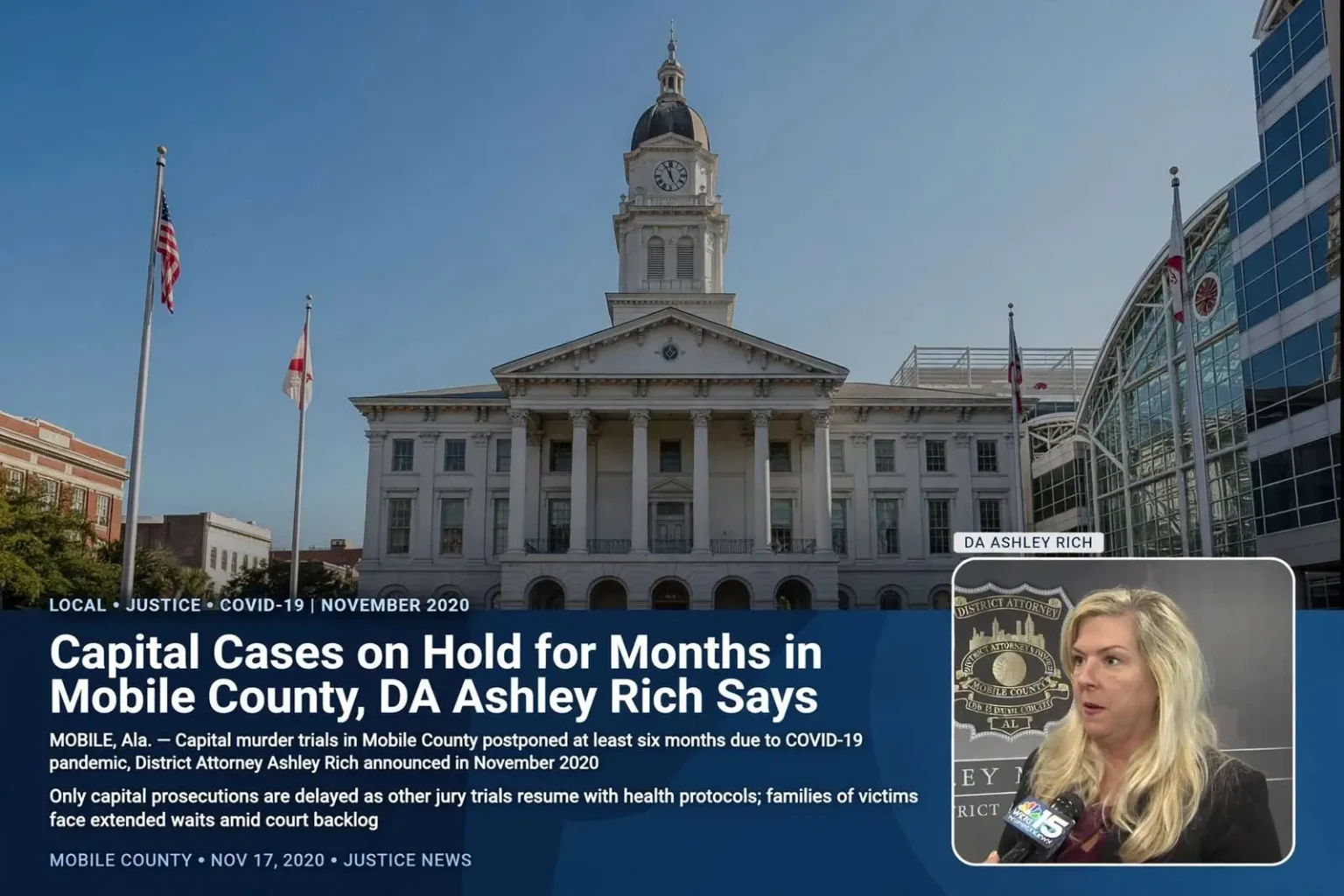
MOBILE, Ala. — Capital murder cases in Mobile County would not go to trial for at least six months because of the COVID-19 pandemic, District Attorney Ashley Rich said in November 2020. The announcement put the county’s most serious prosecutions on hold even as other court business resumed, and it extended a waiting period that had already stretched across the worst of the pandemic’s first wave. For the families of homicide victims, the news meant another half-year of postponement in cases where a death sentence was potentially on the table.
The pause applied only to capital prosecutions. Other criminal trials were set to continue, with extra security protocols in place inside the courthouse — spacing requirements for jurors and spectators, adjusted scheduling to reduce crowding, and health screening procedures that had become standard in courtrooms across Alabama since the pandemic began. The distinction reflected the particular logistical demands of capital cases rather than any judgment about their importance, and Rich’s office framed the delay as a practical necessity dictated by how those trials must be conducted.
Why capital cases need more room
Capital murder trials differ from ordinary felony trials in ways that mattered acutely during a respiratory pandemic. Alabama law entitles capital defendants to a larger jury pool, and the voir dire process — the questioning of prospective jurors to determine fitness to serve — is far more extensive in a capital case, because jurors must be asked individually about their views on the death penalty. What might occupy a courtroom for a day in an ordinary trial can occupy it for weeks in a capital case, with dozens of prospective jurors cycling through a room that health protocols required to hold a fraction of its normal capacity.
Everything downstream of jury selection is bigger as well. Capital trials involve more witnesses, more expert testimony, and two distinct phases — a guilt phase followed, if the defendant is convicted, by a penalty phase in which the same jurors weigh whether the death sentence should be imposed. Sequestered deliberations, extended daily proceedings, and courtroom configurations designed for two full legal teams all add to the logistical load. In the fall of 2020, when courthouses nationwide were operating under capacity restrictions and enhanced sanitation regimens, that load became impractical to schedule.
A court system restarting in stages
Jury trials in Mobile County had only just resumed in September 2020 after a six-month shutdown triggered by the coronavirus outbreak. When the pandemic arrived in March 2020, courts across Alabama suspended jury proceedings under emergency orders, leaving defendants awaiting trial in jail, victims awaiting resolution, and attorneys unable to move their dockets. The resumption in September was deliberately cautious: limited numbers of trials, modified courtroom layouts, masks and distancing, and priority given to defendants who had been detained the longest.
The backlog that accumulated during the shutdown was enormous by any historical measure. Every month without jury trials added cases that could not be resolved, and the cases that demand the most courtroom time — capital prosecutions chief among them — fell furthest behind. Court administrators across the state faced the same arithmetic, and county-by-county plans varied with local infection rates, courthouse space, and staffing. Mobile County, one of Alabama’s largest judicial circuits, had one of the state’s heaviest caseloads to work through.
The human cost of delay
For prosecutors, defense attorneys, and above all the families of victims, the six-month hold on capital cases carried a cost that is difficult to measure in scheduling terms. Families of homicide victims often describe the wait for trial as its own ordeal — a period in which grief is suspended between the loss itself and the legal accounting they hope will follow. Each postponement forces a fresh round of difficult announcements, rebooked travel for relatives, and renewed anxiety about whether testimony will still be available when the trial finally arrives.
Defense attorneys raised parallel concerns. Defendants in capital cases — most of whom remain jailed without bond while awaiting trial — faced additional months of pretrial detention in facilities where the pandemic itself was a danger. Outbreaks in county jails during 2020 complicated attorney-client consultations, slowed discovery, and created new avenues for legal challenges. Some defense teams argued that extended pandemic-era detentions warranted relief, while prosecutors balanced those arguments against public safety considerations that had not changed simply because the courts had slowed down.
How Alabama’s capital system works
Capital murder under Alabama law is a narrowly defined category: killings committed in connection with specified felonies such as robbery, kidnapping, or burglary; killings of police officers, children, or other protected classes of victims; and multiple-victim killings, among other circumstances. Prosecutors must present the case to a grand jury to obtain a capital indictment, and the sentencing framework differs from ordinary cases, with a separate penalty phase and enhanced appellate review in every capital conviction. Those procedural layers exist because the stakes are irreversible, and they are precisely the layers that made pandemic-era scheduling so difficult.
Mobile County has historically been one of the busiest jurisdictions in Alabama for capital prosecutions, a product of its population, its violent crime rate, and the diligence with which its district attorneys have pursued capital indictments in eligible cases. The office Rich led had handled a docket of capital cases spanning multiple years, each one dependent on courtroom time that suddenly became the scarcest resource in the justice system.
Pandemic courts across the Gulf Coast
Mobile County’s experience mirrored what was happening across the region and the country. Baldwin County to the east, Escambia County to the west, and courts in neighboring Mississippi and Florida all wrestled with the same trade-offs: how quickly to resume jury trials, how to protect jurors who had no way to decline service safely, and how to prioritize among thousands of delayed cases. Some jurisdictions turned to technology — remote hearings for pretrial motions, video arraignments — to keep cases moving even when courtrooms were closed, and those adaptations changed aspects of court practice permanently.
Jury service itself was transformed. Prospective jurors in the fall of 2020 encountered health questionnaires, spaced seating, and smaller panels, and courts excused more people than usual out of concern for older jurors and those with health risks. The reduced panels slowed selection further, compounding the arithmetic that made capital trials — with their unusually large jury pools — the hardest cases to schedule. Court officials warned the public that the pandemic’s effects on case timelines would persist long after infection rates receded, a prediction that proved accurate in courthouses nationwide.
What the delay meant going forward
Rich’s six-month projection placed the earliest capital trials in the following spring, contingent on conditions that no one could guarantee. If infection rates rose again, the timeline could slip; if vaccine distribution — then only beginning on the horizon — allowed courts to operate at full capacity, the backlog could begin to burn down in earnest. In the meantime, the capital docket continued its slower, less visible work: grand jury presentations, discovery disputes, motion hearings conducted with limited in-person attendance, and the everyday preparation that trial lawyers do even when no trial date is in sight.
The episode stands as a snapshot of an institution under strain. The courts of Mobile County, like courts everywhere in 2020, were asked to balance constitutional obligations to speedy trials against the physical safety of everyone who must be present to make a trial happen — jurors above all, who cannot participate by video. Capital cases, the heaviest matters on any docket, ended up at the back of a line that no one wanted to be in, and the people waiting at that line’s end were the families of the victims and defendants alike, for whom the promise of a verdict kept receding into the pandemic’s uncertain future.
The economics of the delay reached beyond the courthouse as well. Public defender offices and private defense attorneys absorbed the cost of keeping capital cases open for additional months, with investigators, mitigation specialists, and expert consultants all on retainer longer than planned. The district attorney’s office, funded by the county and supplemented by state dollars dedicated to capital litigation, similarly carried salaries and caseloads across a year in which the usual rhythm of indictments moving to trial was interrupted. County revenue, strained by the pandemic’s effect on sales taxes and other receipts, had to stretch across a justice system that was doing its slowest work at precisely the moment demand on other services peaked.
There were also lessons that court administrators took from the experience. The value of digital filings, remote motion hearings, and electronic evidence presentation became obvious to judges and lawyers who had previously resisted them. Planning documents circulated among Alabama’s judicial circuits after 2020 emphasized continuity-of-operations thinking: courthouse space that can be reconfigured, jury assembly that can be staged across multiple rooms, and case-management systems that can identify which delayed cases are most urgent. Mobile County’s pandemic pause on capital cases was, in that sense, part of a larger institutional education — a hard season that reshaped how the state’s courts think about scheduling, safety, and the resilience of the trial system when events interrupt it.