Capital murder case of McIntosh 7-year-old moves forward in court
The capital murder case of 7-year-old Case Ketchum in McIntosh, Alabama moved forward in Washington County court; Jacqueline Stewart faces the charge.
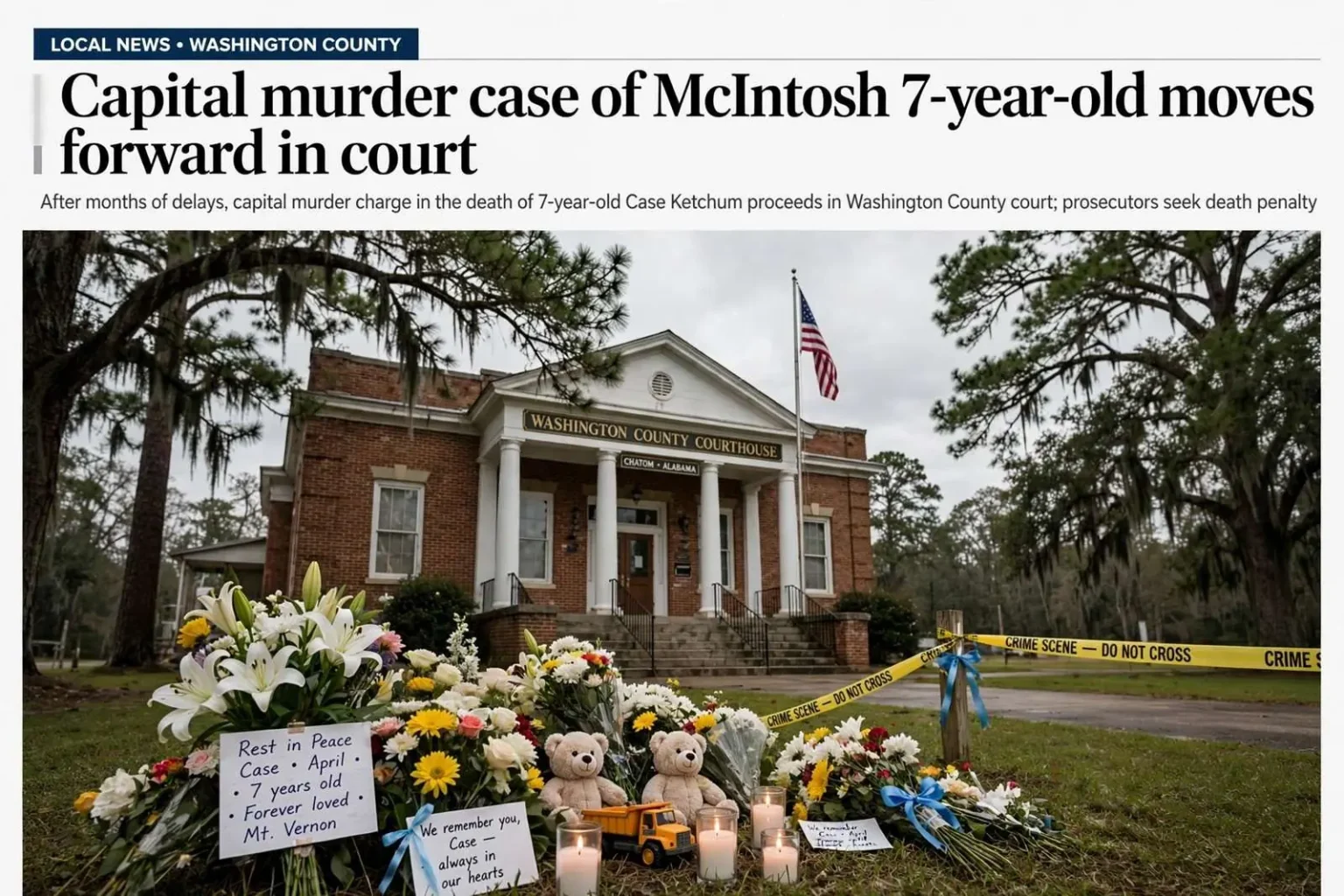
After months of delays, a capital murder case stemming from the death of a 7-year-old boy in McIntosh is moving forward in Washington County court. Jacqueline Stewart is charged with capital murder in the death of Case Ketchum. Deputies investigated a mobile home fire on Frank Snow Road in McIntosh and found Ketchum’s body inside. An autopsy determined the child died of blunt force trauma before the fire started, according to investigators.
The finding that the child did not die from the fire but from blunt-force injuries transformed what might have been investigated as a tragic accident into a homicide case. Court documents state the child did not die from the fire but from blunt-force injuries. Prosecutors are seeking the death penalty, a decision that marks the case as among the most serious on the Washington County docket and sets in motion a legal process that can stretch over years.
Stewart was taken into custody and held on an investigative hold beginning the weekend the boy’s body was discovered before being formally arrested. Investigative holds of that kind are used when authorities need additional time to complete an investigation before filing formal charges — a window during which a suspect remains in custody while investigators finalize evidence, interview witnesses and consult with prosecutors on the charges. The formal arrest followed once the capital murder charge was filed.
A Community Mourns
Family and friends said goodbye to Case during a funeral service in Mt. Vernon, where he was laid to rest. The 7-year-old had celebrated his birthday in April and was remembered by his family as active, smart, funny and full of life. The service drew the kind of gathering that small Washington County communities turn out for their own — family, neighbors and friends coming together to mourn a child whose death, under the circumstances investigators described, left the community shaken.
McIntosh and Mt. Vernon are small Washington County towns along the corridor north of Mobile, places where news travels by word of mouth and where the death of a child is felt collectively rather than as one more headline. Residents of communities this size typically know the streets involved in cases like this one, and the fire on Frank Snow Road was the kind of event that stays in local memory long after the court file closes. Grief in a small town is public grief, and the weeks between the fire and the funeral put the community through the full cycle of shock, rumor and mourning.
Child deaths under suspicious circumstances also put intense pressure on the small institutions that serve communities like McIntosh. Volunteer and career firefighters who responded to the fire, the deputies who processed the scene, the school staff who taught the child, and the pastors and funeral homes who guided the family through the service all carried pieces of a case that no one in a town this size is trained to carry. The investigation’s outcome — an autopsy finding that redirected the case toward homicide — only deepened that burden for everyone who had hoped the fire told the whole story.
The Autopsy and the Evidence
Forensic autopsies are the hinge on which cases like this one turn. When a body is found in a fire, the central question for investigators is cause and sequence: did the person die from the fire, before it, or in some other way entirely? The examination performed in this case answered that question, determining that the child died of blunt force trauma before the fire started. That determination — established through examination of the body and correlation with the scene evidence — is what allowed investigators and prosecutors to treat the death as a homicide rather than a fire fatality, and it became the foundation of the capital murder charge.
The finding also illustrates why fire scenes are treated as potential crime scenes by default. Fire destroys evidence, and the passage of time between an injury and its discovery complicates every conclusion drawn afterward. Deaths discovered in fires are investigated jointly by firefighters, fire marshals and law enforcement for precisely this reason, with the medical examiner’s office providing the forensic findings that determine how the case proceeds. In this case, the autopsy’s conclusion was public enough to shape the court file: the charge is capital murder, and the alleged mechanism is blunt force, not fire.
Capital murder in Alabama is a narrowly defined category — murder combined with specified aggravating circumstances that state law enumerates, such as the victim’s age in certain circumstances, the crime’s commission during another felony, or other statutory factors. The designation matters practically as well as morally: it is the charge that carries the possibility of the death penalty, which is what Washington County prosecutors announced they would seek. Because the death penalty is at stake, the case will be handled with additional procedural safeguards throughout, and the defense obligations are correspondingly serious.
Delays and the Path Forward in Court
The months of delays that preceded the case’s forward movement are unremarkable in the context of capital litigation, even if they try the patience of everyone watching. Capital cases move slowly by design: prosecutors must decide whether to seek the death penalty only after careful review, defense attorneys must assemble resources adequate to the charge, and courts must resolve pretrial questions — evidence, witnesses, expert testimony — before a trial can be scheduled. A capital case that reaches trial typically does so years after the arrest, and appeals, when a death sentence is imposed, extend the timeline further. For a small county’s court system, such a case is a marathon commitment of resources.
The progression from investigative hold to formal arrest to a case moving forward in court reflects the ordinary machinery of Alabama criminal procedure operating under extraordinary circumstances. The hold in the days after the body’s discovery gave investigators time to secure the forensic findings and build the charging file; the formal arrest placed the case on the court’s docket; and the prosecutors’ announcement that they would seek the death penalty determined the track the case would run on. Each step was a prerequisite for the next, and the forward motion now under way in Washington County court is the product of all of them.
As the case proceeds, the presumptions of American criminal law remain fully in force. A charge — any charge, and especially one this grave — is an accusation, and the defendant is entitled to the presumption of innocence unless and until a jury finds otherwise beyond a reasonable doubt. Coverage of the case should be read accordingly: it describes allegations, filings and announcements, not adjudicated facts.
Washington County’s Court and Community
The case is being handled in Washington County’s court system, the judicial machinery of one of Alabama’s smaller rural counties. Courthouses in counties of this size handle the full range of the state’s legal business with a small complement of judges, prosecutors, clerks and defense counsel, and a capital case concentrates that community’s attention like nothing else on the docket. Every participant — from the sheriff’s investigators who worked the original scene to the jurors who will eventually be drawn from the county’s citizens — lives alongside the case’s consequences.
The county itself is part of southwest Alabama’s pine belt, bordering Mobile County to the south and stretching toward the Mississippi line, with communities like Chatom, the county seat, McIntosh and Mt. Vernon dotting the landscape. The area’s proximity to Mobile means that major news from the county — including a case of this magnitude — resonates across the broader Gulf Coast region, while the practical work of justice remains local: deputies, prosecutors and a courthouse that everyone involved will pass for years.
Remembering Case Ketchum
Beneath the legal machinery, the case’s center remains a child. Case Ketchum was 7 years old, had celebrated a birthday in April, and was remembered by his family as active, smart, funny and full of life — the ordinary, treasured qualities of a boy at the beginning of everything. The funeral in Mt. Vernon, where he was laid to rest, was the community’s farewell to those qualities, held in the same season when his classmates were finishing a school year that he should have been part of.
Communities that experience the violent death of a child carry it in specific, lasting ways. Teachers who taught him, children who knew him and families who sought to explain the unexplainable all required the kind of support that small towns provide one another in person — casseroles, attendance, presence — because no institutional service fully meets that need. As the court case moves forward, that distinction is worth holding onto: the trial will determine legal accountability, but the community’s work with its grief proceeds on a separate track, and the memory the family has asked the public to hold is of a lively, funny boy rather than the circumstances of his death.
What happens next belongs to the Washington County court. The charge is capital murder, the death penalty is being sought, and the process that follows — motions, hearings and, eventually, trial — will unfold at the pace such cases demand. For the family and neighbors who said goodbye to Case in Mt. Vernon, the legal progress represents the beginning of whatever accountability the justice system can provide; for the wider community, it is the continuation of a story no one wanted to have to tell about a 7-year-old from McIntosh.