

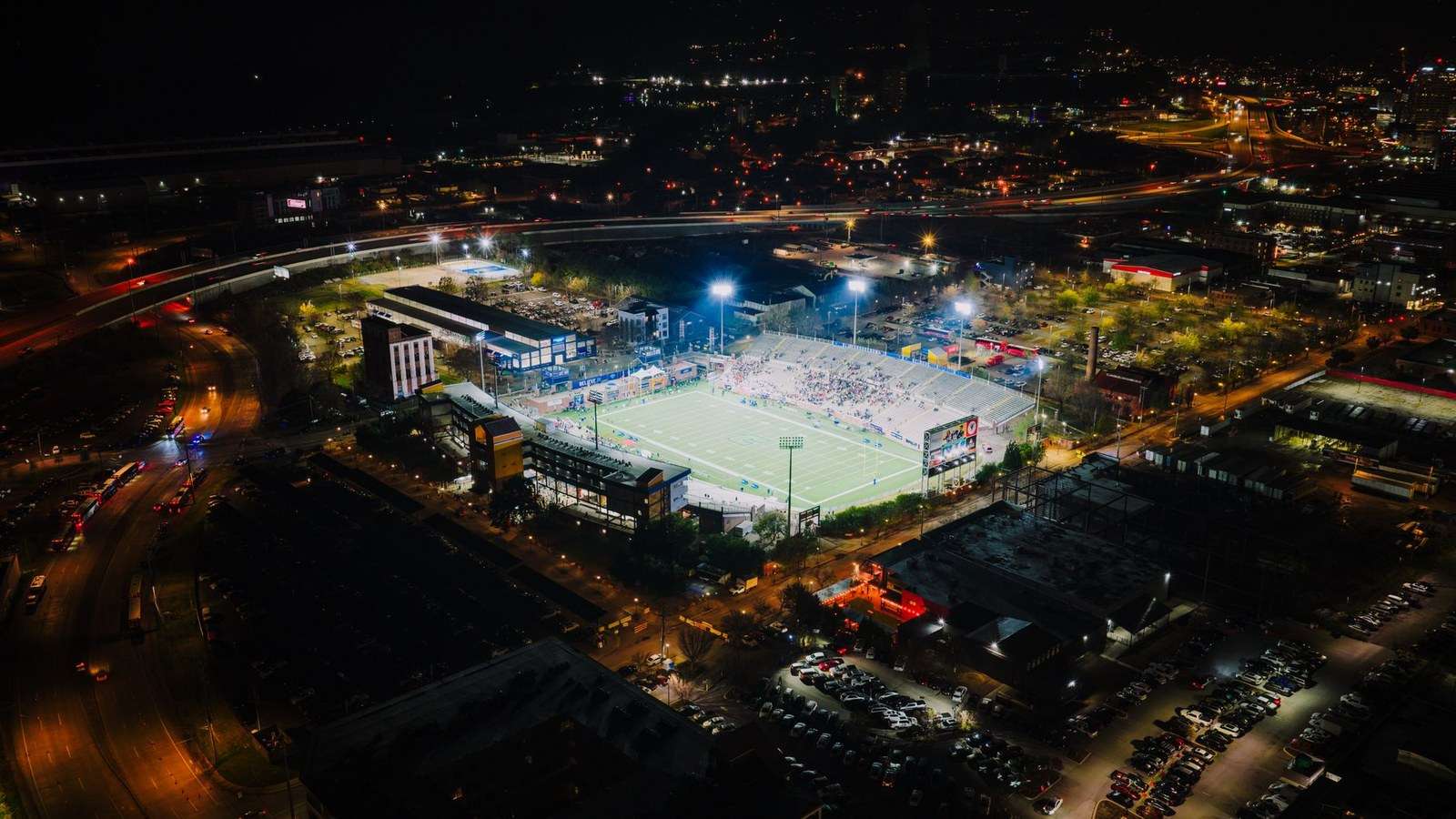
A Week 4 high school football game in Washington County ended Friday night without a final score, and not because of anything that happened between the lines. The lights went out at A.D. Britton Field, and when they could not be brought back, the McIntosh Demons and Millry Wildcats were sent home with a game still in progress.
McIntosh High School principal Jamelle Sauls said the contest would resume Saturday, Sept. 12. At the moment play stopped, McIntosh held a 15-0 lead.
What Happened at A.D. Britton Field
According to a Facebook post about the game, the stadium lights failed around the second quarter. That timing matters. A power failure before kickoff is an inconvenience; a power failure in the middle of a competitive half is a suspended game, and suspended games carry consequences that ordinary postponements do not.
Washington County Board of Education officials did not immediately call the night off. They first aimed to restart the game at 9 p.m. When that window passed without the lights returning, they set a second target of after 10 p.m. Sauls said the game was finally postponed shortly after 10:15 p.m., with the decision to finish it the following day.
That sequence — two restart windows, then a postponement — reflects a real effort to complete the game on the night it began. Finishing a football game as scheduled is almost always the preferred outcome for everyone involved. Travel has already happened. Officials have already been paid and assigned. Concessions have been stocked, gates have been staffed, and both rosters have gone through a full pregame routine. Once a game is stopped, all of that has to be reassembled.
Officials did not say what caused the lights to be shut off. That detail remained unexplained as of the postponement announcement, and the absence of an explanation is itself worth noting: no cause was publicly attributed to weather, to a storm-related outage, or to any specific equipment failure.
A 15-0 Game, Frozen in Place
The score at the stoppage gives the situation its shape. McIntosh led 15-0 sometime in the second quarter, which is a meaningful but far from decisive advantage in high school football. Two scores is a lead a team can lose in a single possession swing, particularly in a game that is about to restart cold after an interruption of nearly a full day.
When a game resumes rather than restarts, it picks up from the exact situation in which it was suspended — the same score, the same quarter, the same down, distance and field position. Everything that has already happened counts. Every statistic already recorded stands. For Millry, that means the deficit does not reset to zero on Saturday. For McIntosh, it means a lead built Friday night has to be defended by a team that has spent the intervening hours doing anything but playing football.
Those are genuinely different competitive circumstances than either team prepared for. Coaching staffs spend a week building toward a Friday night. They script opening drives, plan halftime adjustments and manage substitutions against a rhythm they know. A Saturday continuation scrambles all of it. Players who were warm and in a groove at 9 p.m. Friday have to find that again the next day, and coaches who had a read on what was working have to decide how much of that read still applies.
The Practical Problems a Suspended Game Creates
The most immediate issue is logistical. Both schools have to bring back players, coaches, trainers, officials, medical personnel, security and game-management staff on short notice, on a Saturday, for what may amount to two and a half quarters of football. Families who attended Friday have to decide whether to make the trip again.
There is also the question of what a Saturday finish does to the following week. High school football schedules are built around a Friday-to-Friday rhythm, and that rhythm governs recovery, practice planning and injury management. A team that plays part of a game Friday night and the rest of it Saturday has effectively compressed its week. Sunday becomes the first real recovery day rather than the second, and Monday’s practice plan has to account for players who competed less than 48 hours earlier.
For a small-school program, where rosters are thinner and a significant number of athletes play both offense and defense, that compression is felt more sharply than it would be at a large school with two-deep depth at most positions. McIntosh and Millry are both small Washington County schools, and the athletes who were on the field in the second quarter Friday are, in many cases, the same athletes who will be on the field for the entirety of Saturday’s continuation.
Lights as Infrastructure
It is easy to treat stadium lighting as background scenery until it fails. In practice, a lighting system is one of the few pieces of infrastructure at a high school stadium whose failure stops everything at once. Playing surfaces can be wet. Scoreboards can be replaced by a person with a clipboard. Public address systems can go down and a game continues. Lights cannot be worked around.
Alabama high school football is played almost entirely at night for reasons that have very little to do with tradition and a great deal to do with September heat along the Gulf Coast. Afternoon kickoffs in early-season conditions raise real safety concerns for players in full pads. That is a substantial part of why Friday nights became Friday nights in the first place — and it is also why a Saturday continuation of a night game is not a simple matter of showing up a few hours earlier.
Because no cause was announced, it is not publicly known whether the outage originated with the stadium’s own electrical system, with the utility feeding it, or with something else entirely. Those are meaningfully different problems with meaningfully different timelines for repair, and the distinction matters for whether A.D. Britton Field can reliably host the rest of its home schedule.
What the Score Does Not Tell You
A 15-0 second-quarter score line does not reveal much about how the game was actually being played. It does not say whether McIntosh was controlling the line of scrimmage or capitalizing on turnovers. It does not say whether Millry had been moving the ball and stalling, or had not moved it at all. Public information about the game to that point was limited to the score and the circumstances of the stoppage.
What can be said is that McIntosh had put together enough offense for two scores and at least one successful conversion or additional point, and that Millry had not yet answered. In a game that will restart with roughly two and a half quarters remaining, the Wildcats will have had an unusual amount of time — most of a day — to decide what to change.
Communication Through Social Media
One small detail in how this unfolded is characteristic of small-school athletics: the public accounting of the lighting failure came through a Facebook post, and the confirmation of the postponement came from the high school principal rather than from an athletics communications office.
In communities where the high school game is a central weekly event, social media has become the default channel for exactly this kind of real-time information — delays, relocations, weather calls and restart times. It is fast, it reaches the people who need it, and it requires no infrastructure beyond a phone. It also means the official record of a night like Friday’s lives in a series of posts rather than in a formal statement, which is part of why the cause of the outage remained unexplained.
Looking Ahead
With the game set to resume Saturday, Sept. 12, both programs faced the same unusual assignment: finish a game that started the night before, with the score, the clock and the field position exactly where they were left. McIntosh carried a 15-0 lead into that continuation. Millry carried the deficit and the knowledge that better than half the game remained.
For Washington County officials, the longer question is the one that was not answered Friday night — what caused the lights at A.D. Britton Field to go out in the middle of a football game, and what it will take to make sure they stay on for the rest of the season.