
Car Crashes Into Extend-a-Suite in Tillmans Corner; Driver Had Medical Emergency
Mobile police say a driver suffered a medical emergency before a car crashed into the Extend-a-Suite building in Tillmans Corner.
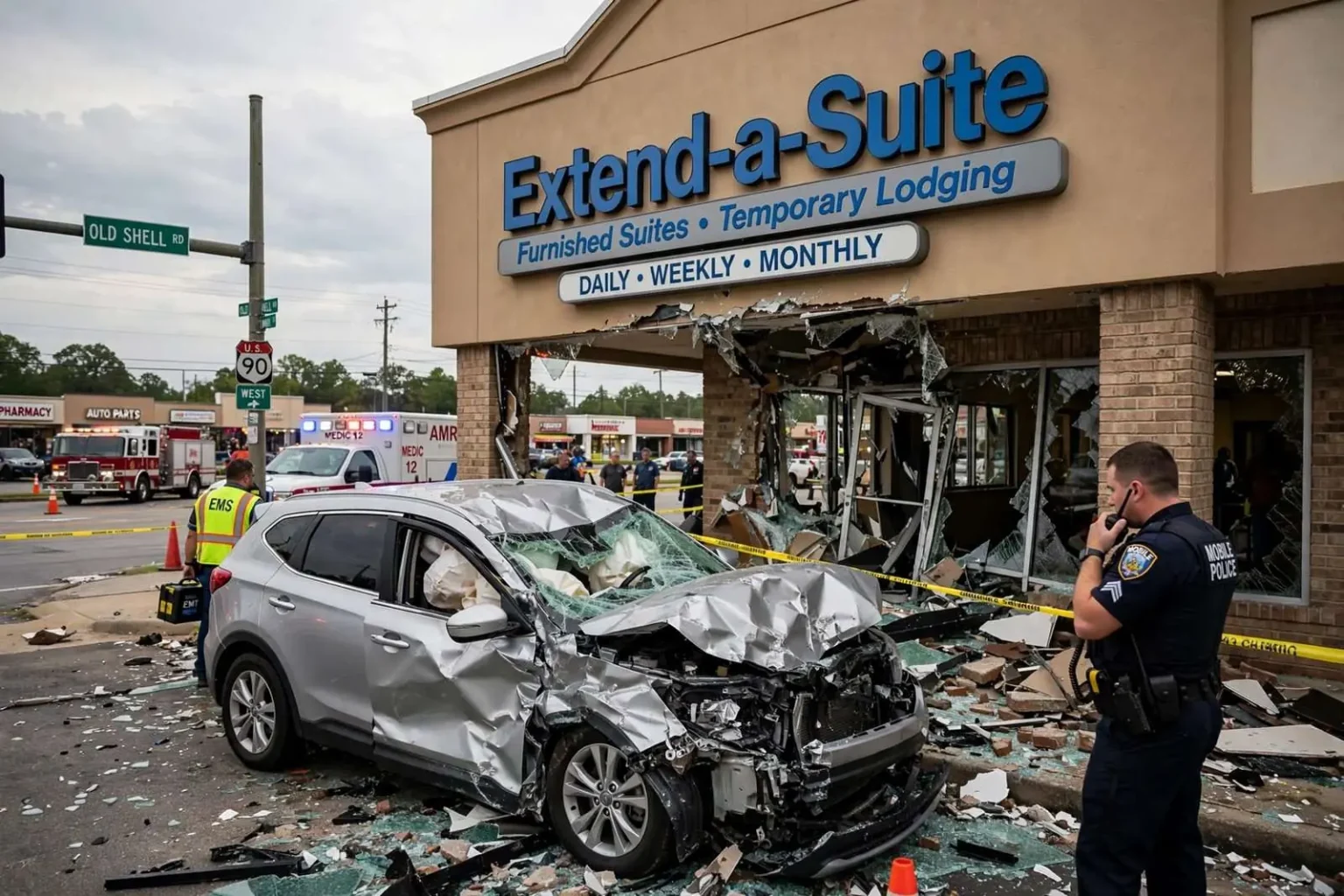
TILLMANS CORNER, Ala. — A vehicle slammed into the Extend-a-Suite building in Tillmans Corner, and police say the driver appears to have been in medical distress at the time of the crash. The Mobile Police Department confirmed the crash but released few details, saying only that the driver was suffering from a medical emergency when the vehicle struck the business. The driver’s condition was not immediately known, and no other injuries were reported in the incident.
The crash sent a vehicle into the commercial building along one of the busiest intersections in southern Mobile County, an area where U.S. Highway 90 and Old Shell Road converge with the commercial sprawl of the Tillmans Corner district. Extend-a-Suite, a furnished-suite and temporary lodging business that serves traveling workers and families in transition, occupies a spot in the corridor where traffic volumes are heavy throughout the day. Details about the time of the crash, the extent of the structural damage, and whether anyone was inside the business at the time were not included in the police department’s initial confirmation.
Officers who responded to the scene found that the driver appears to have lost control of the vehicle because of a medical emergency rather than impairment or recklessness, according to the information police released. Emergency medical care for the driver became part of the response, and the driver’s condition remained unclear in the immediate aftermath. No other injuries were reported, a result that responders and neighbors alike considered fortunate given the location.
A busy corridor and a sudden impact
Tillmans Corner is one of the most densely developed commercial districts in Mobile outside the downtown core. The area takes its name from the long-standing corner intersection at Hitt Road and U.S. 90, and it has grown over decades into a hub of retail plazas, restaurants, motels, churches, and service businesses that draw shoppers and travelers from across the southern end of the county. U.S. 90 carries commuter and commercial traffic through the district at all hours, connecting downtown Mobile to the communities of Theodore, Grand Bay, and the Mississippi line beyond.
Buildings that sit close to the roadway in corridors like this one absorb vehicle impacts more often than most people realize. Storefront crashes — vehicles leaving the travel lane and striking a commercial building — occur thousands of times a year nationally, with parking lots, drive-through lanes, and high-speed arterials accounting for most of them. The consequences range from minor facade damage to structural collapses, and engineering studies have repeatedly found that standard storefront glass and framing provide little resistance when a moving vehicle leaves the road.
When the driver involved appears to have experienced a medical emergency, the investigation takes on a different character than a typical crash case. Officers document the scene and the vehicle’s path, but the central questions shift to the driver’s condition and the nature of the medical event. Police in these situations generally do not pursue criminal charges when the evidence points to a sudden medical episode, and the case file becomes primarily a matter of medical records, insurance, and property damage rather than prosecution.
Medical emergencies behind the wheel
Sudden medical events — including cardiac incidents, strokes, seizures, and episodes related to diabetes — are a recurring factor in single-vehicle crashes into buildings. Drivers in the grip of such an event often make no attempt to brake or steer, which is one of the markers investigators look for when distinguishing a medical crash from an impaired or distracted one. Witnesses frequently report that the vehicle traveled in a straight line at constant speed until it struck something, a pattern consistent with the driver being unresponsive rather than careless.
Alabama law requires drivers to self-report certain medical conditions that could impair safe operation of a vehicle, and physicians in the state are obligated to report specific diagnoses that present a danger behind the wheel. In practice, most drivers with managed conditions drive safely for years, and public health guidance focuses on honest conversations between patients and their doctors about when it is appropriate to continue driving. Crashes like the one at Tillmans Corner often involve a first, unforeseen event — precisely the scenario no screening requirement can predict.
Responses to storefront crashes in Mobile typically involve multiple agencies. Police secure the scene and investigate the crash, fire crews assess the building and stabilize any hazards, and medical personnel treat the driver and evaluate anyone else who may have been hurt. When a vehicle penetrates a wall, firefighters check for gas leaks, compromised electrical lines, and structural movement before declaring the scene safe — work that happens quickly but thoroughly while bystanders watch from a distance.
Fortunately for everyone nearby, crashes of this kind more often damage property than injure pedestrians or customers. Storefronts and office buildings in commercial districts have people inside and out throughout the day, and the margin between a property-damage incident and a mass-casualty event is often a matter of feet and seconds. The absence of other injuries in the Tillmans Corner crash, despite the location, reflected that narrow margin holding.
What drivers and businesses can take from it
Safety advocates use crashes like this one to remind drivers of the practical steps that reduce risk when a medical emergency strikes on the road. The signs of a developing cardiac or neurological event — sudden confusion, loss of coordination, chest pain, vision changes, or numbness — are reasons to pull over immediately and call for help rather than to push toward a destination. Drivers with diagnosed conditions that can cause sudden incapacitation are encouraged to keep that conversation open with their physicians and to follow the guidance that results.
Passengers and family members also play a role. Anyone riding with a driver who shows signs of a medical emergency should be ready to take the wheel, guide the vehicle to a stop, or call 911 from the passenger seat. On busy arterials like U.S. 90 in Tillmans Corner, seconds of warning can mean the difference between stopping safely and leaving the roadway.
For business owners in the corridor, storefront crashes have prompted growing interest in protective measures. Bollards — short steel posts set in concrete at the front of a property — have become a common sight at banks, retail stores, and restaurants across the Gulf Coast, and engineering guidance from national safety organizations encourages businesses near intersections and parking areas to evaluate their exposure. Concrete planters, raised curbs, and reinforced storefront framing all provide layers of protection that standard construction lacks.
The investigation going forward
Because police indicated the driver appears to have been in medical distress, the case is expected to conclude as a medical emergency rather than a criminal matter, pending confirmation of the driver’s condition and the completion of the scene documentation. The Mobile Police Department’s crash investigators will finalize their report from the physical evidence and witness accounts, and that report will support the insurance and property-damage process that follows for the Extend-a-Suite property.
For neighbors and regulars in Tillmans Corner, the incident served as another reminder of how quickly routine travel can turn dangerous without warning. The drivers and pedestrians who move through the district each day have little way of knowing when a medical emergency will disable the person in the next lane, and the best available protections — seat belts, attentive driving, and defensive awareness — are the same ones that serve the community every day.
Local business owners in the Tillmans Corner area also noted the practical disruption a single crash can cause. When a vehicle strikes a commercial building, the property typically needs a structural inspection before utilities can be restored, and neighboring tenants sometimes share water, gas, or electrical service lines that must be cut during the response. For a lodging operation like Extend-a-Suite, which depends on occupancy to operate, even a short closure affects reservations and staffing. Merchants along the U.S. 90 corridor have long supported each other through such interruptions, redirecting customers and sharing parking while repairs move forward.
The driver’s identity was not released, and police said additional details would come only as the investigation and medical assessment allow. No other injuries were reported, and the business district resumed its normal rhythm as the scene work concluded.
Emergency responders across Mobile County have also pointed to the value of quick bystander action in medical crashes. The first people on scene after a vehicle leaves the roadway are almost always other drivers, and knowing to call 911 immediately, give a precise location, and describe the driver’s condition helps dispatchers send the right combination of police, fire, and medical units. In incidents where a driver is unresponsive inside a crashed vehicle, that early information shapes every decision that follows, from extrication to hospital notification.
South Alabama News will update this story as more information becomes available from the Mobile Police Department.


