
Car Found Fully Engulfed in Flames Near I-65 Service Road Hotel in Mobile
A car was fully engulfed in flames around 5 a.m. Sunday near the Comfort Inn on Mobile's I-65 Service Road; the cause remains unknown.
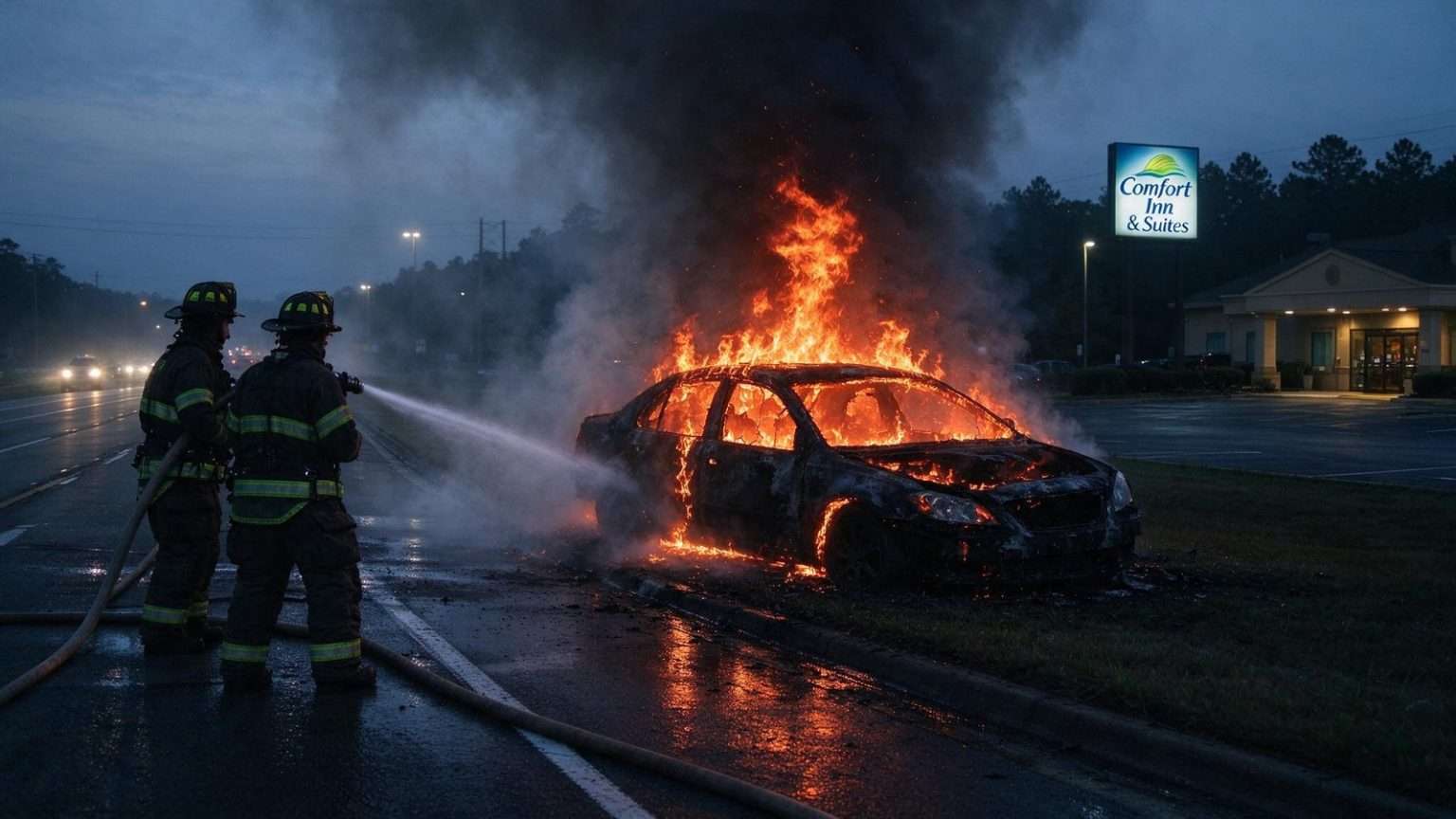
MOBILE, Ala. — Early-morning drivers got an alarming sight Sunday when a car was found fully engulfed in flames along the I-65 Service Road. The fire broke out around 5 a.m. near the Comfort Inn and Suites on the service road parallel to the interstate in west Mobile. Authorities had not said what may have sparked the blaze or whether anyone was hurt.
A car burning at full involvement produces a scene that stops drivers in their tracks — heavy black smoke, the pop of tires and small components, and flames that can climb higher than the vehicle itself. Motorists passing along the service road and the interstate main lanes spotted the fire in the early morning darkness, and calls reporting the blaze went out to Mobile fire dispatchers around 5 a.m.
Firefighters arriving on the scene faced a vehicle at the most intense stage of burning, with the threat of the fire spreading to nearby grass, signage, or structures if it was not knocked down quickly. Fires along commercial strips like the I-65 Service Road carry extra concern because of the proximity of hotels, restaurants, and businesses whose parking lots sit close to the roadway.
The scene on the service road
The I-65 Service Road runs parallel to Interstate 65 through west Mobile, a corridor lined with hotels, restaurants, and retail businesses that serve travelers on the interstate. The Comfort Inn and Suites sits directly along that stretch, and its guests and overnight staff were close enough to the burning car to see the flames and hear the sounds of a vehicle fire in the dark. Early-morning traffic on the service road is light, but the drivers who did pass the scene reported the fire to authorities.
Vehicle fires at that hour raise immediate questions that firefighters and police must answer: whether anyone was inside or near the car, whether the occupant escaped, and whether the fire started spontaneously or was set. Authorities said they had not determined what sparked the blaze and had not confirmed whether anyone was hurt, leaving the circumstances open while the investigation began.
Mobile Fire-Rescue handles vehicle fires across the city as a routine part of its workload, but the department treats each one as a potential crime scene until the evidence says otherwise. Burned vehicles are examined for signs of accelerant use, wiring failures, fuel system breaches, and other indicators that tell investigators where the fire started and how it spread.
Why cars catch fire
Vehicles burn for a range of reasons, and investigators sort them into a few broad categories. Mechanical and electrical failures — leaking fuel lines, frayed wiring, overheated engines — are among the most common causes, particularly in older vehicles that have not been maintained. Collisions can rupture fuel systems and ignite fires, though no crash was reported in this incident. And a significant share of vehicle fires are intentionally set, whether for insurance fraud, to cover up another crime, or out of vandalism.
The distinction matters for what happens next. An accidental fire becomes an insurance claim; an intentionally set one becomes a criminal investigation, potentially involving arson charges. Mobile fire investigators look at the burn patterns on the vehicle, the position and condition of its components, and any evidence found in the surrounding area before making that determination. Until those findings are complete, authorities appropriately say only that the cause is unknown.
Modern vehicles also burn differently than older ones. Lightweight composite materials, plastics, and magnesium components burn hot and fast, and pressurized gas struts and airbag inflators can explode with dangerous force as a fire reaches them. Firefighters keep a defensive distance from fully involved vehicles for those reasons, protecting nearby property while the fire consumes itself.
The hotel corridor and fire risk
West Mobile’s stretch of service road alongside I-65 is one of the city’s densest hotel corridors, with properties clustered near the interstate exits to capture overnight travelers. The area sees steady traffic around the clock, including long-haul truckers, families on road trips, and business travelers. A vehicle fire at 5 a.m. in that environment, near the Comfort Inn and Suites, meant the fire department’s priority was containing the blaze before it could reach landscaping, signage, or buildings.
Hotel guests in the area reported the glare and smoke visible from their windows, and some captured photos and videos that circulated on social media before official word of the fire emerged. Fire officials remind the public that burning vehicles can shed burning debris and that curious onlookers who approach for photos put themselves at risk from explosions of tires and fuel sources.
What investigators will look at next
In the days after a vehicle fire, investigators trace the car’s history: its registration, whether it was reported stolen, who owned it, and where it had been. A burned car found on a service road at 5 a.m. with no reported crash draws particular scrutiny, since the possibility of an abandoned and torched vehicle cannot be ruled out until the owner is located and the circumstances are explained. Police and fire investigators work together on those questions.
The department’s public statements left the key questions open — cause unknown, injuries unconfirmed — which is typical in the early hours of a fire investigation. Findings, when they come, usually arrive through fire investigation reports and, if a crime is suspected, police releases asking the public for information.
For Sunday morning drivers on the I-65 Service Road, the burning car was a jarring sight to start the day. For investigators, it was the start of a process: sift the ashes, trace the vehicle, and determine whether the fire that lit up the pre-dawn dark in west Mobile was misfortune or malice.
Vehicle fires along Mobile’s interstate corridors
Mobile’s interstate network — I-65, I-10, and the Cochrane-Africatown USA Bridge connecting I-165 — carries some of the heaviest traffic in Alabama, and vehicle fires along those corridors are a regular call for the city’s firefighters. Breakdowns at highway speed, collisions in congested lanes, and fires in parking areas and frontage roads all keep Mobile Fire-Rescue’s engine companies busy along the interstate edges of the city.
The service roads that parallel the interchanges add a layer of complexity: fires there burn close to businesses and hotels rather than in open interstate lanes, and access requires navigating the same commercial driveways that respond crews share with early-morning delivery trucks. The 5 a.m. timing of Sunday’s fire fell in the quietest window of the week, with light traffic allowing firefighters to reach the scene and work without shutting down the surrounding area.
Travelers through Mobile encounter the aftermath of such incidents regularly — burned patches on shoulders, scorched signage, and the occasional lane closure while a wreck is cleared. Fire officials use those reminders to urge drivers to pull fully off the roadway if their vehicle shows signs of trouble, exit away from traffic, and call 911 rather than attempting to diagnose a burning engine themselves.
The insurance and legal aftermath
Once the fire is out, the practical machinery takes over. If the fire was accidental — an electrical fault or mechanical failure — the owner’s insurance covers the loss under comprehensive coverage, and the burned wreck is towed from the scene for salvage or disposal. If investigators conclude the fire was set deliberately, the case moves to police detectives, and possible charges range from criminal mischief to second-degree arson depending on the circumstances and intent.
Fires in parking areas near businesses also raise liability questions for investigators: whether the burning vehicle damaged hotel property, landscaping, or other vehicles parked nearby. The proximity of the Comfort Inn and Suites to the burn site made those assessments part of the Sunday morning response, with fire crews protecting the surrounding property while the car burned itself out under their hoses.
The quiet hours that responders know well
The hours before dawn have their own rhythm for fire crews. Calls in those hours — wrecks on nearly empty interstates, structure fires discovered by early risers, and abandoned vehicles burning along service roads — tend to involve scenes where no one reported the problem for minutes or hours, allowing small problems to grow. A car fire that starts at 5 a.m. in a commercial corridor may not be discovered immediately, and by the time flames are visible, the vehicle is fully involved.
Mobile fire officials credit early-morning callers with limiting damage in such incidents, since a prompt 911 call brings crews while the fire is still confined to the vehicle of origin. Sunday’s reports from passing drivers did exactly that, and the response ended with the car destroyed but the hotel, the businesses, and the travelers around it unharmed — so far as authorities have said.
Waiting for answers
As of the latest information available, authorities had not determined what sparked the blaze or whether anyone was hurt, and no further details had been released. Those two questions — cause and casualties — will define how the story ends: a mechanical failure and an insurance claim, or a deliberate fire and a police case.
Anyone with information about the fire, the vehicle, or who may have been with the car before it burned can contact Mobile Fire-Rescue’s investigators or the Mobile Police Department. Vehicle fires leave evidence in the metal and the burn patterns that investigators can read, but witnesses who saw the car before the flames are often the key to understanding why a quiet service road outside the Comfort Inn became the site of a Sunday morning blaze.