Carl Declines Debate Request From Democratic Rival Jones Ahead of CD-1 General Election
Republican Jerry Carl declined a debate request from Democratic nominee Clyde Jones Jr. ahead of Alabama's 1st Congressional District general election, prompting a public exchange between the two campaigns.
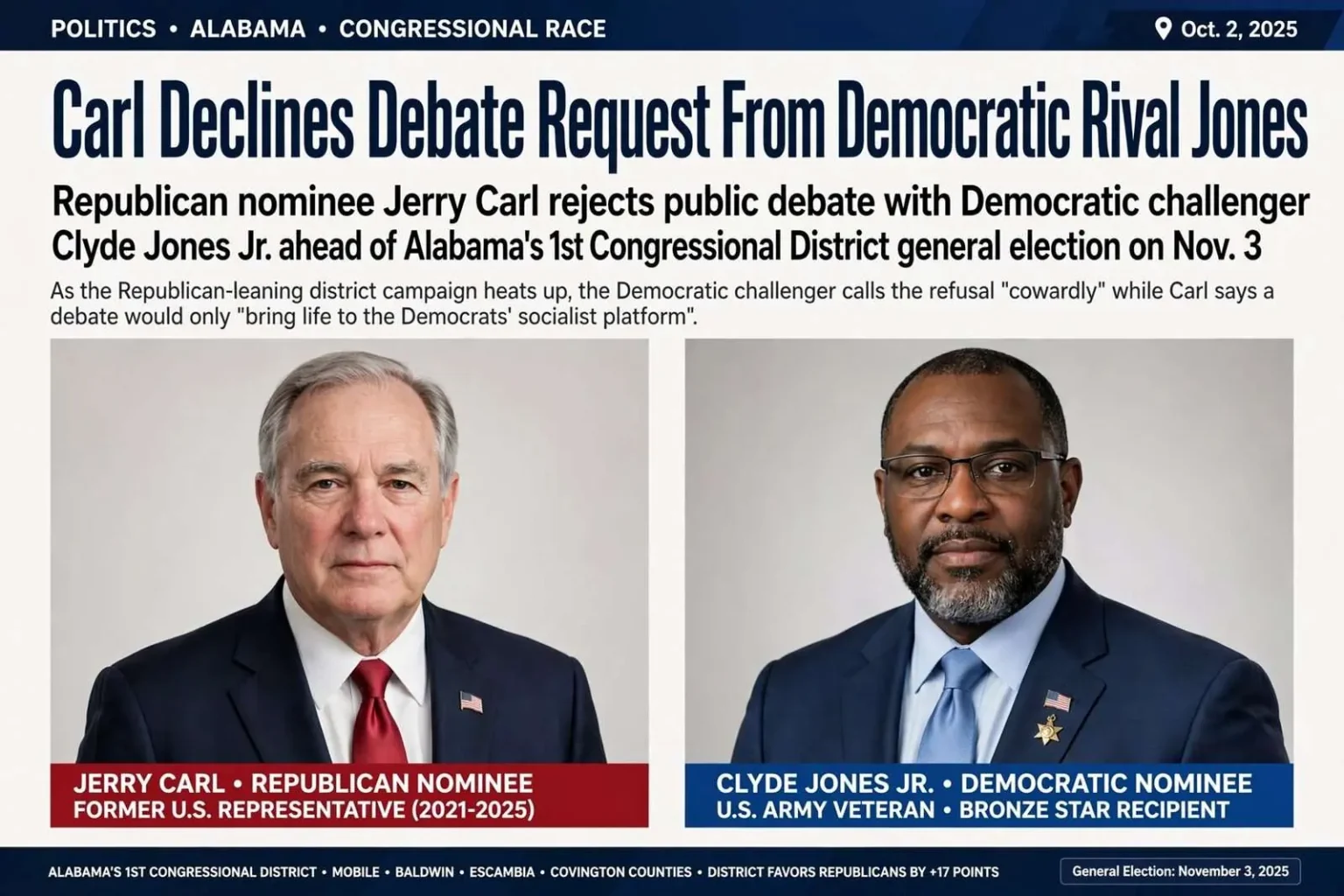
A request for a public debate ahead of Alabama’s 1st Congressional District general election has turned into a public dispute between Republican nominee Jerry Carl and Democratic nominee Clyde Jones Jr. Fresh off his primary victory Tuesday, Carl said he would not debate Jones, a Daphne resident who responded by calling on the former congressman to take part in at least one public forum before the Nov. 3 general election.
“Let the voters hear from us and make an informed choice when they vote for their representative in November,” Jones said Tuesday. He added that, if elected, he wants to ensure Congress “accepts its responsibility” in crafting policy on immigration, health care and veterans affairs.
Carl rejected the request in a statement issued Wednesday. “A debate only brings life to the Democrats’ socialist platform,” Carl said. “We feel confident in our ability to bring America First and Alabama Values directly to the Alabama voters. We will not commit to any debates at this time.” Carl’s campaign declined further comment.
Jones criticized Carl’s decision, calling it “cowardly.” “As a veteran, I find it cowardly not to give them that opportunity,” said Jones, a U.S. Army veteran and Bronze Star recipient who served in Operation Desert Storm and Operation Iraqi Freedom II. “We respect our voters enough to know that we need to earn their vote, and that includes giving them an opportunity to hear our platform, face-to-face.”
The exchange set the tone for a general election that, by the numbers, is expected to be one-sided. Debates in congressional races serve different purposes for the two sides: for an underdog, they are the cheapest route to a broadcast audience; for a favorite, they are an unnecessary risk that offers the opponent a stage. Both campaigns’ positions followed the classic logic, with Jones arguing the public deserves the forum and Carl calculating that a race he is favored to win needs no help.
A Republican-leaning district
Jones, an associate minister at Macedonia Missionary Baptist Church in Daphne, faces long odds in the Republican-leaning district. Carl represented Alabama’s 1st Congressional District from 2021 to 2025 and is seeking to return to Congress after winning Tuesday’s Republican primary. His return bid came after he lost the seat in a primary of his own two years earlier, and the district’s boundaries he would step back into are the ones he first represented — not the reshaped version voters saw in between.
The district was re-established during a special legislative session in May and includes Mobile, Baldwin and Escambia counties, along with portions of Covington County. Its boundaries closely resemble those used before 2023, prior to a court-ordered congressional redistricting that created a second majority-Black congressional district and shifted Baldwin County and much of the Wiregrass region into the 1st District.
Following U.S. Supreme Court decisions on redistricting and voting rights this spring, the pre-2023 Republican-backed map was restored, along with a new, GOP-leaning District 2 seat in south Alabama. By nonpartisan election analyses, the 1st Congressional District favors Republicans by 17 percentage points.
The map’s short history has made the state’s congressional politics unusually fluid. The court-ordered 2023 lines briefly paired Mobile and Baldwin County voters with Wiregrass communities in a more competitive district, and the state’s spring redraw pulled those ties apart again. For candidates, the shifting boundaries mean campaign coalitions built over years can dissolve with a single special session; for voters, the consequence is that the district they voted in two years ago is not the one they vote in now.
Jones’ platform
Despite the long odds, Jones is using the race to promote a platform that includes expanding Medicaid, overturning Citizens United through congressional action, banning stock trading by members of Congress and their immediate families, and pursuing immigration reform that includes a “clear path” to documented status.
Each plank points at a live national argument. Medicaid expansion has been debated in Alabama for a decade, with the state among those that declined to broaden the program, and its absence is frequently cited in discussions of rural hospital closures across the Black Belt and south Alabama. The stock-trading ban has drawn support across party lines in Congress, driven by documented conflicts-of-interest controversies, though repeated attempts have stalled. The immigration position Jones describes — a clear path to documented status — places him at odds with the enforcement-first approach that dominates Alabama’s congressional delegation.
Jones also criticized Carl’s prior record in Congress, arguing that Carl “legislated zero bills that became law” during his previous term. The claim frames a two-term record through a single measure — enacted legislation — a standard by which most back-bench members of either party score poorly. Carl’s supporters would answer that a Gulf Coast congressman’s value lies in appropriations, infrastructure projects and constituent service rather than in named bills, and that the district’s shipbuilding, aerospace and port economy depends on exactly that kind of Washington work.
Jones said voters deserve to hear Carl discuss issues beyond what Jones characterized as familiar campaign talking points, such as pledging support for President Trump and describing Democrats as socialists. The critique dovetails with his debate demand: a platform dispute can only be tested in person, and a refusal to debate, in the challenger’s telling, is itself an argument about whose positions can survive contact with questions.
A broader trend in Alabama politics
The dispute comes as debates between major-party candidates have grown increasingly uncommon in Alabama’s statewide and federal races. The most recent congressional debate ahead of a general election took place in 2024, when Republican Caroleene Dobson and Democrat Shomari Figures met before their race in Alabama’s redrawn 2nd Congressional District, which Figures ultimately won.
That 2024 contest was the exception that proves the rule. The court-ordered second district was newly competitive, the parties were near-even on paper, and both campaigns concluded a debate could matter. In districts where one party holds a double-digit advantage, the calculus reverses — the favorite sees only downside, and the underdog’s request goes unanswered.
This year, Democratic gubernatorial nominee Doug Jones has said he welcomes a debate with Republican U.S. Sen. Tommy Tuberville, a request Jones also made during Tuberville’s successful 2020 Senate campaign; the two have never shared a debate stage. The pattern repeats: a Democrat with statewide or federal ambitions asks, a Republican favorite declines, and no forum is ever held.
Alabama Gov. Kay Ivey has also largely avoided formal debates during her gubernatorial campaigns — including skipping a 2018 Republican primary debate in favor of a Birmingham Barons baseball game appearance, a decision that drew criticism from rivals but did not appear to hurt her politically. Ivey won that primary outright and went on to defeat Democratic nominee Walt Maddox in the general election. The Barons detour became a small legend in Alabama political lore, cited ever since as proof that a front-runner can absorb the criticism that comes with refusing a stage.
Alabama’s 1st Congressional District seat has seen debates before: in October 2018, Republican U.S. Rep. Bradley Byrne debated Democratic challenger Robert Kennedy Jr. during a one-hour radio event. That contest, too, featured an incumbent with a comfortable lead agreeing to a controlled format — a radio hour rather than a television stage — suggesting that debates in the district occur when both sides find a format they can live with.
Whether the Nov. 3 race produces any such forum now rests with Carl, who has closed the door “at this time.” Jones says he will keep asking, and the campaign’s remaining weeks will show whether a favorite who declined a debate finds that the absence itself becomes the story voters remember.
The dynamics of a one-sided congressional race in the Mobile area follow a familiar script. The Republican nominee concentrates resources on the primary, treating the general election as a formality, while the Democratic nominee builds a campaign around message rather than money, using the race to introduce themselves, test themes and build a list for future contests. General elections of this kind are decided more by turnout mechanics than by persuasion, which is precisely why an underdog wants a debate — it is the one venue where the race can be made about substance instead of arithmetic.
For voters in Mobile, Baldwin and Escambia counties, the absence of a debate means the campaign will reach them mostly through advertising, yard signs and party machinery rather than through any direct comparison of the candidates. Congressional offices, however, shape consequential local questions: the future of the Port of Mobile, the shipbuilding and aerospace workforce, the rural hospitals hanging on across the district, and the federal research presence along the Gulf Coast. Those are the subjects a joint stage would have forced both men to address in the same hour.
Jones’ background has shaped the campaign he is running. His military service — Desert Storm and Iraq, with a Bronze Star — anchors his argument on veterans affairs, an area where the district’s large veteran population gives the theme real weight. His work as an associate minister at a Daphne congregation places him in the tradition of Alabama candidates who lead with community service rather than party apparatus. Whether either résumé line can move a district that analysts put at plus-17 for Republicans is the open question the Nov. 3 election will answer.