Carnival Fantasy Diverted to Mobile After 2008 Mississippi River Spill
Because of a Mississippi River oil spill near New Orleans, the Carnival Fantasy ended and began voyages in Mobile in July 2008.
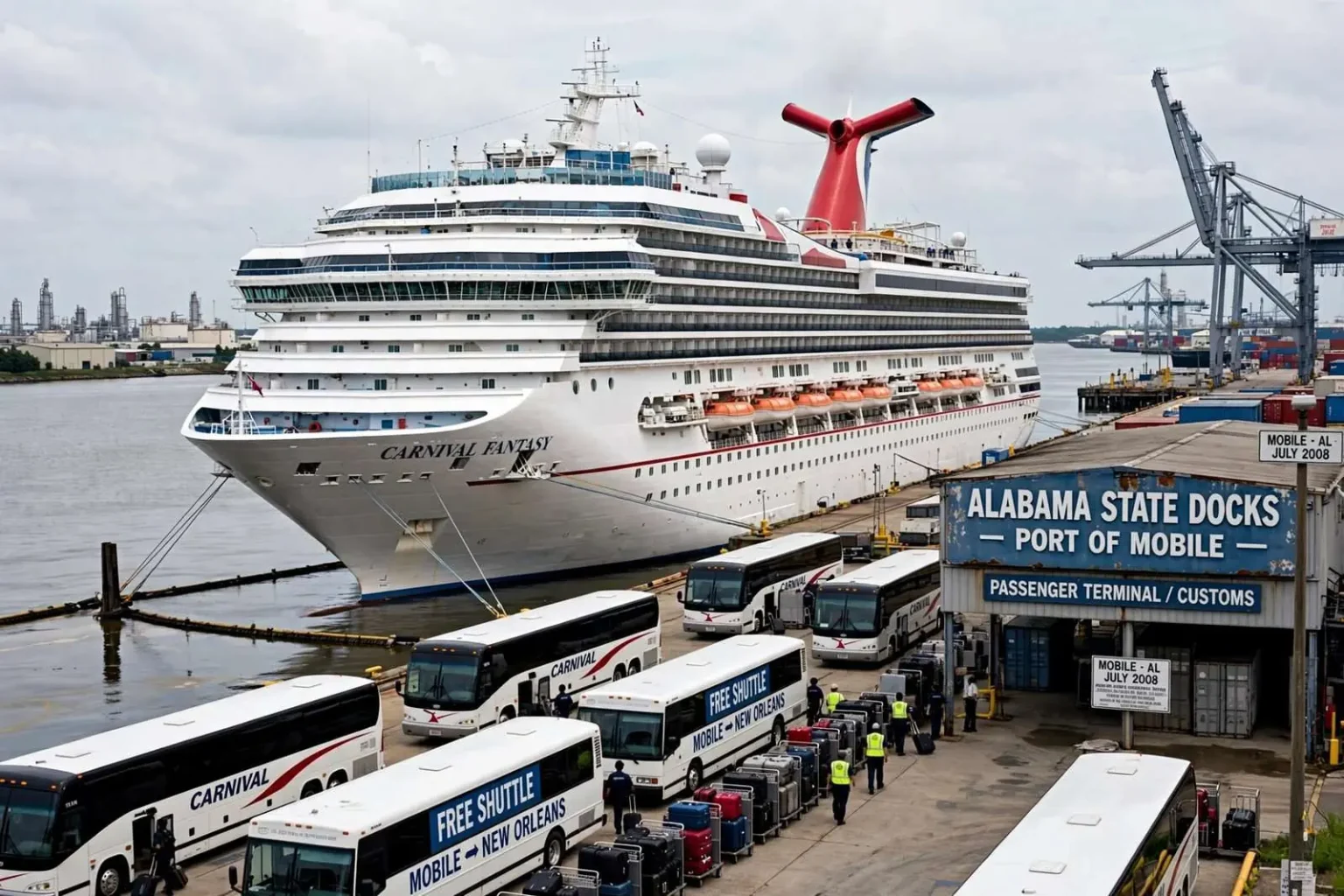
The Carnival Fantasy, for years a familiar sight on the Mississippi Gulf Coast cruise scene, ended a voyage in Mobile in July 2008 rather than at its regular New Orleans homeport after a massive oil spill on the lower Mississippi River disrupted shipping near New Orleans. The diversion, originally reported by local news on July 31, 2008, was a direct consequence of the spill, which had closed a stretch of the river critical to both commercial and passenger traffic. Mobile’s Alabama State Docks, already handling cargo from its location on Mobile Bay at the head of the Gulf of Mexico, suddenly found itself serving as an impromptu arrival port for one of Carnival’s most established Gulf vessels.
The spill occurred when a barge and tanker collision on July 23, 2008 released hundreds of thousands of gallons of fuel oil into the river near New Orleans, coating miles of shoreline and prompting authorities to restrict vessel traffic until the channel could be cleaned and deemed safe. Cruise lines with New Orleans itineraries faced an immediate logistics problem: ships still needed to turn around their passengers on schedule, but the homeport itself was difficult or impossible to reach. Rerouting a ship to Mobile, roughly 150 miles to the northeast by water, allowed Carnival to keep its sailing calendar intact while the river reopened.
Getting passengers between Mobile and New Orleans
Passengers aboard the diverted sailing faced their own logistical puzzle. Many had flown into New Orleans and parked cars or planned post-cruise stays there, so ending a voyage in Mobile left them stranded roughly two hours away by road. Carnival arranged free motorcoach transportation for passengers who needed to travel between Mobile and New Orleans, shuttling them and their luggage back to the Big Easy so flights, hotels and car returns still worked as planned. The arrangement spared travelers from having to scramble for last-minute rentals or one-way transport on their own during the height of summer travel season.
The disruption did not end with a single sailing. The Fantasy’s next voyage was also scheduled to leave from Mobile and end in New Orleans, meaning two consecutive sailings bore the brunt of the river closure. Embarking passengers for that next trip had to start their vacations in Mobile instead, with the ship positioned to return to New Orleans once the river reopened and port operations normalized. For a city still rebuilding its tourism economy after Hurricane Katrina, the 2008 spill and its fallout was an unwelcome reminder of how dependent the cruise business is on a single navigable waterway.
What the diversion meant for Mobile
For Mobile, the episode was a small but visible demonstration of the port’s capacity to absorb passenger operations on short notice. The city had long hosted its own cruise operations, and the Alabama Cruise Terminal on Mobile Bay offered the berthing space, customs facilities and ground transportation a diverted ship required. Dock workers, tour operators, taxi and shuttle drivers, and downtown businesses all got a brief surge of activity from two unplanned turnarounds. It was also a reminder to Gulf Coast travelers that cruise itineraries are always subject to the realities of the waterways that serve them.
The Mississippi River spill of July 2008 remains one of the more significant pollution events on the lower river in recent decades, and its effects rippled well beyond the cruise industry. Commercial shipping was delayed, fishing and boating were restricted along affected stretches, and cleanup crews worked for weeks along the banks between New Orleans and the Gulf. Against that backdrop, the Carnival Fantasy’s Mobile diversions were a comparatively minor inconvenience, though one that hundreds of passengers experienced directly.
This article records a temporary 2008 cruise diversion and is not a current travel notice or Port of Mobile schedule. Cruise operations, homeports and itineraries have changed repeatedly in the years since, and travelers should consult Carnival and the Port of Mobile directly for present-day schedules. What the July 2008 episode preserved in the record is a snapshot of how quickly a Gulf port can stand in for another when the river that serves it is closed, and how a cruise line’s contingency planning translates into buses, berths and rerouted vacations for the people aboard.
The Fantasy itself carried a long Gulf Coast history by the time of the 2008 diversion. The vessel had been the centerpiece of Carnival’s former “Fun Ship” deployment from Mobile in earlier years, and its moves between Mobile, New Orleans and Gulfport over the years traced the fortunes of the entire regional cruise market. Hurricanes, refinery economics and shifting itineraries repeatedly shuffled Gulf-based ships between ports, and the 2008 spill was simply one more contingency in a market where weather and waterways call the shots. Passengers who sailed that July got an unusual two-port experience: boarding or disembarking in one city while their luggage and plans were anchored in another.
Travel industry observers noted at the time that diversions like this one test a cruise line’s ground game more than its seamanship. A ship can sail to an alternate port in a matter of hours, but the passenger experience depends on things that happen on land: buses staged at the terminal, airline rebooking desks staffed, and luggage routed to the right city. Carnival’s decision to provide free motorcoach transport between Mobile and New Orleans was the standard remedy, one that avoided therefund disputes and stranded-traveler stories that unmanaged diversions can produce. For most passengers the trip ended with a scenic ride along the Gulf Coast instead of the river journey their itinerary had promised.
The river closure’s wider footprint
The closed river also had implications for the port economy of New Orleans beyond cruise traffic. Grain elevators, container terminals and refinery docks all depend on continuous river access, and each day of restricted traffic represented millions of dollars in delayed commerce. That commercial pressure is what drove the aggressive cleanup timeline, and it explains why a cruise diversion measured in days rather than weeks was the realistic outcome. Once the channel was surveyed and reopened, the Fantasy resumed its normal rotation, and Mobile’s role as substitute homeport ended as quickly as it began.
For the Alabama Gulf Coast, the summer of 2008 offered a preview of the resilience argument civic leaders have made ever since: Mobile’s port infrastructure can support passenger traffic at scale, whether planned or improvised. The Alabama State Docks, now operated as the Port of Mobile, rank among the largest deepwater ports on the Gulf of Mexico, with the channel depth and terminal capacity to handle vessels far larger than the Fantasy. A cruise diversion is a rounding error in that operation, but it demonstrated the flexibility that later helped Mobile pursue and host regular cruise programs of its own.
Travelers researching the episode today should keep its vintage firmly in mind. The Carnival Fantasy class of ships has been steadily retired and sold as Carnival modernizes its fleet, New Orleans’ cruise terminal operations have changed, and Mobile’s own cruise service has come and gone over the years. None of the 2008 arrangements remain in place, and no current sailing is affected by a river spill that happened well over a decade and a half ago. The value of the record is historical: it shows how the lower Mississippi’s health directly shapes Gulf Coast tourism, and how a barge collision near New Orleans could rearrange vacation plans in Mobile within a week.
Weather has repeatedly reshaped Gulf Coast cruise operations in ways that have nothing to do with demand. Hurricane season, which runs from June through November, overlaps the summer cruise calendar and regularly forces itinerary changes across the region. A storm threatening the Louisiana coast can close the Mississippi just as effectively as a spill can, and lines with New Orleans homeports routinely build contingency plans that list alternate ports. Mobile’s location on Mobile Bay, with direct deepwater access to the Gulf and a highway network connecting it to New Orleans, Pensacola and the rest of the central Gulf Coast, makes it a natural fallback in those plans, which is exactly the role it played in July 2008.
The 2008 spill also underscored the economic interdependence of the Gulf’s ports. A problem at one port immediately becomes an opportunity, and a burden, for its neighbors. Mobile absorbed two Carnival turnarounds within days, which meant additional demands on customs staffing, terminal security, ground transportation and parking. Ports that want to be reliable alternates need that capacity on standby, and the episode gave Mobile a low-stakes test of systems it had built for its own cruise traffic. Cities smaller than Mobile, without comparable terminal infrastructure, could not have absorbed a diverted ship so smoothly.
How passengers experienced the change
For the passengers themselves, a diversion is equal parts inconvenience and story. Disembarking in Mobile meant a motorcoach ride instead of a short taxi to a French Quarter hotel, and embarking passengers had to redirect flights or drives to a different city on short notice. Carnival’s customer service operation handled rebooking questions, and the free buses kept the immediate out-of-pocket impact at zero. Travelers’ recollections of the episode tend to center on that bus ride: two hours of Gulf Coast highway between a ship that arrived somewhere unexpected and a city that still had their car or their connecting flight.
Archived local coverage of the diversion captured the basic facts that still define it: the spill’s cause near New Orleans, the Fantasy’s Mobile arrival, the free transportation arrangement, and the plan for the following voyage to depart Mobile and conclude in New Orleans. Those four details are the durable record of the episode. Everything else, from the cleanup timeline to the eventual resumption of normal operations, belonged to the broader story of the July 2008 oil spill and the lower river’s recovery.
Readers who want to verify the history should treat this account as a starting point that preserves the original local reporting rather than a living travel resource. Schedules, terminal facilities and fleet deployments have all changed since 2008, and no current cruise passenger is affected by this event. Its lasting significance is the reminder it offers Gulf Coast residents and travelers alike: the region’s tourism economy, for all its beaches and terminals, ultimately depends on a single river staying open, and when that river closes, the whole coast rearranges itself for a while.