
Carnival Fantasy Leaves Mobile to Ferry Healthy Crew Members Home
The Carnival Fantasy left the Port of Mobile to return healthy crew members to their home countries as cruising stayed paused during the COVID-19 pandemic.
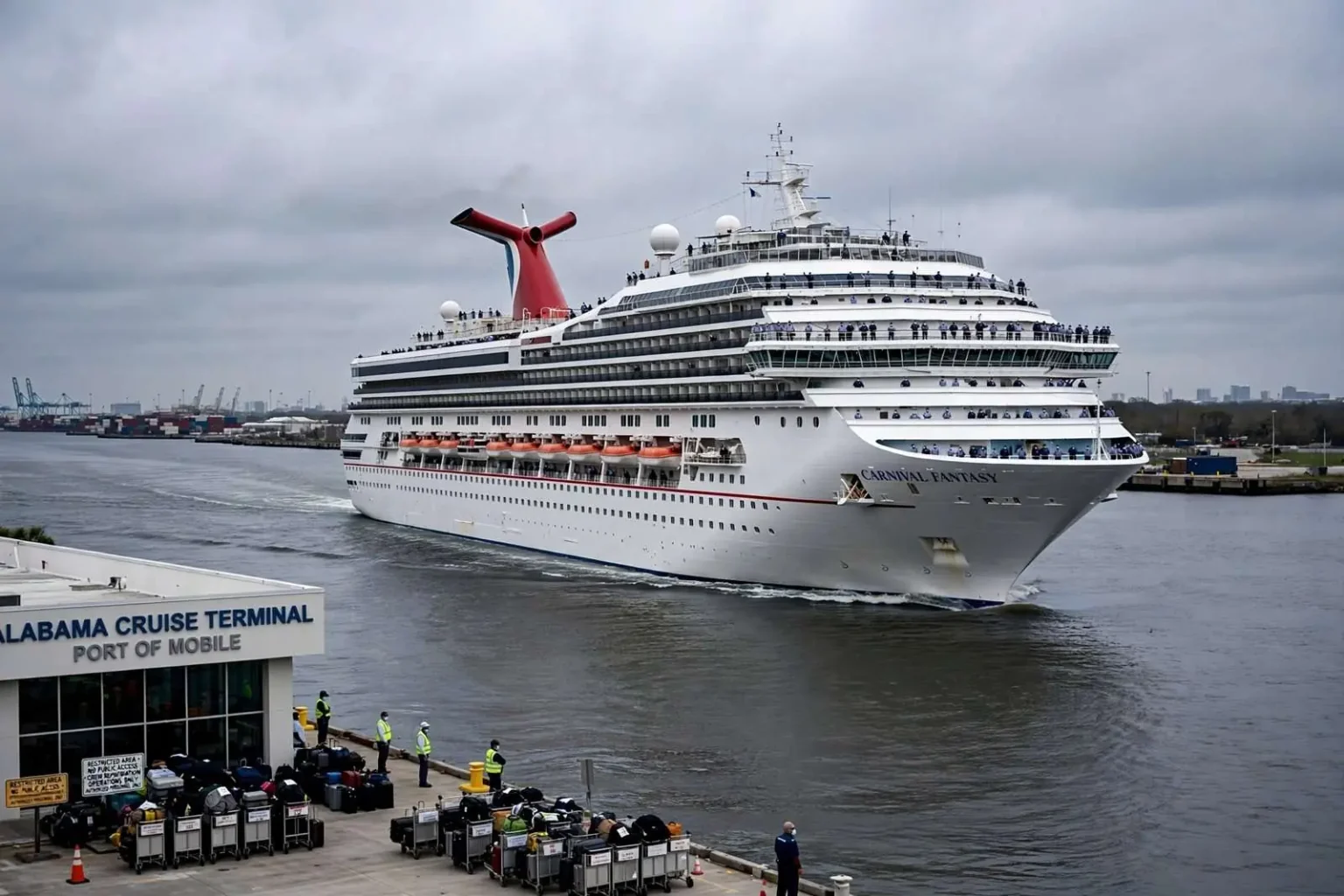
The Carnival Fantasy has sailed out of the Port of Mobile on an unusual mission: carrying healthy crew members back to their home countries as the cruise industry idled during the coronavirus pandemic.
Carnival Cruise Line confirmed the ship’s departure from Mobile, saying it was part of a company-wide effort to reduce onboard staffing to safe operational levels while sailings remain suspended. Rather than keeping thousands of crew members aboard idle vessels, the line is using its ships as transport, moving crew between vessels in the fleet so they can travel home.
The departure marked a striking reversal of the Fantasy’s usual role. The ship, which for years had carried vacationers on short Caribbean itineraries from the Alabama Cruise Terminal, instead became a ferry for its own industry’s workforce — one piece of a vast, improvised logistics network that stretched across oceans and involved dozens of vessels, charter flights and government negotiations.
The scene at the terminal underscored how thoroughly the pandemic had inverted the port’s routine. Instead of passengers with luggage tags boarding for Cozumel, the terminal saw crew movements orchestrated under international maritime rules, with the ship departing on an itinerary that had nothing to do with tourism and everything to do with getting thousands of workers home.
Part of a fleetwide repatriation effort
“As the company moves to safe operational manning levels, we have begun the process of returning healthy crew members to their home countries using our ships as transport,” the cruise line said in a statement. “Carnival Fantasy has departed Mobile to meet up with other ships in the fleet and allow crew members to join the vessels that will transport them home.”
The statement described the mechanics of a genuinely complex operation. With commercial airline service dramatically reduced in the spring of 2020 — and with many of the countries where cruise crew members come from having closed their borders or restricted incoming flights — ships became the most reliable way to move large numbers of seafarers across oceans. The Fantasy’s mission to rendezvous with other vessels in the fleet reflected that reality: crew members transferred between ships at sea or in port so that a single vessel could consolidate enough people bound for the same region to make the voyage home practical.
The workforce involved was international to a degree that surprised many outside the industry. Cruise lines recruit the bulk of their crews from countries including the Philippines, Indonesia, India, and nations across Eastern Europe and Latin America. When the sailing ban took effect in March 2020, tens of thousands of those crew members were stranded aboard ships in ports around the world, unable to work and unable to fly home. The repatriation effort that followed consumed months of scheduling, diplomacy and testing, and became one of the pandemic’s less visible humanitarian logjams.
The move mirrored actions across the cruise industry in spring 2020, when lines around the world worked for months to repatriate crew members stranded at sea by pandemic-related sailing bans. Rival lines ran similar shuttle operations, and news reports through the spring and summer tracked ships crossing oceans almost entirely full of crew rather than guests — vessels steaming from the Caribbean to Manila, from Europe to Jakarta, on itineraries that existed purely to get workers home.
Mobile’s Alabama Cruise Terminal, normally a departure point for vacationers headed to the western Caribbean, temporarily became part of that logistics operation. The facility, which ordinarily handles embarkation lines, luggage carts and parking shuttles, instead supported the movement of crew members through the port as the Fantasy made its unusual departure.
What the mission said about the pause
Reducing crews to “safe operational manning levels,” in the company’s phrasing, was both a cost measure and a safety measure. Idle ships still require engineers, deck officers, hotel staff and security to maintain systems and keep the vessels compliant with maritime rules, but they do not require full hospitality staffing. Keeping only essential crew aboard cut payroll and provisioning costs during a period with no revenue, while reducing the number of people living in shared crew quarters — an environment where a single coronavirus introduction could spread quickly, as outbreaks on several cruise ships early in the pandemic had demonstrated.
Crew members who remained healthy and were returned home were among the fortunate ones during the shutdown’s early months. Industry publications documented the strain on seafarers who stayed aboard for months beyond their original contracts, confined to ships with no guests to serve and, for long stretches, limited ability even to go ashore. The situation prompted repeated calls from maritime organizations for governments to designate seafarers as essential workers so they could travel and be relieved of duty — a designation that came only gradually and unevenly across countries.
Cruise operations from Mobile remained paused at the time of the Fantasy’s departure, with no firm date for the resumption of passenger sailings from the Port City. The CDC’s restrictions on cruise travel remained in force, and the line had not set a date for when the Fantasy — or any Carnival ship — would carry paying guests again.
For Mobile, the episode was a reminder of how integrated the cruise terminal had become with the industry’s worldwide operations. The same pier where families board for long weekends in Mexico had become one node in a global repatriation map. And the ship at the center of it, the oldest vessel in Carnival’s fleet and the linchpin of Mobile’s cruise business, was proving useful to the company even in idleness — as transport for the seafarers who, whenever cruising resumed, would once again be the workforce behind the city’s sailings.
The Fantasy’s departure also raised quiet questions among cruise watchers about the ship’s own future. As the oldest vessel in Carnival’s fleet, the Fantasy had already survived multiple waves of fleet consolidation when the pandemic hit, and the extended shutdown prompted industry speculation about which older ships would return to service and which would be sold or retired. For Mobile, whose cruise business had been rebuilt around the Fantasy, the health of that single ship was effectively the health of the local cruise industry.
The ship’s history with Mobile stretches back nearly two decades. It was a Fantasy-class vessel that inaugurated cruising from the Alabama Cruise Terminal, and after Carnival exited the market for a period, the line’s return to Mobile again centered on the same class of ship. The vessel’s short itineraries — a mix of four-day and five-day cruises — fit the drive-to-port market that Mobile serves, drawing passengers from across south Alabama, Mississippi, the Florida Panhandle and southern Louisiana who prefer loading the car and driving to the pier over flying to a distant homeport.
That regional customer base is one reason the extended pause has been felt so acutely in Mobile specifically. Unlike ports that depend on air travelers connecting through hub airports, the Alabama Cruise Terminal’s fortunes rise and fall with the convenience of a short drive. During normal operations, embarkation days bring a noticeable surge of activity downtown — filled parking areas near the terminal, restaurants busy the night before departure, and hotels that market directly to cruise passengers looking for a place to stay before an early boarding call.
City and port officials have long described the cruise terminal as an anchor of the broader effort to activate Mobile’s waterfront. The terminal sits within sight of the port’s container operations and the causeway, and cruise traffic complements the convention center, the museums and the entertainment venues that draw visitors to the downtown core. Losing a full year of sailings did not empty the waterfront — cargo operations continued through the pandemic, as they must — but it removed one of the most visible and recurring expressions of the port’s connection to the traveling public.
The human logistics behind the headlines
Repatriation voyages like the Fantasy’s required coordination that went far beyond a single company. Cruise lines worked with foreign embassies and consulates to secure entry approvals for crew members, arranged COVID-19 testing before disembarkation, and chartered flights from ports of call to final destinations when direct routes did not exist. Where commercial flights were available, lines booked seats in bulk; where they were not, ships did the long-haul work themselves.
Maritime organizations pressed governments throughout 2020 to treat seafarers as key workers, noting that the world’s cargo trade depended on the same class of crew being able to sign on and off vessels. The cruise industry’s stranded crews became one of the most prominent examples of the problem, since tens of thousands of workers were stuck aboard vessels with no operations to perform. The repatriation voyages — like the one that took the Fantasy out of Mobile — were the industry’s answer while official designations lagged.
For the crew members passing through Mobile, the journey home could still involve multiple legs: a transfer between ships at a rendezvous point, a long ocean crossing, and then connecting flights from whichever port finally put them within reach of an airport with service to their home country. Each leg carried its own paperwork, testing requirements and quarantine rules depending on the destination.
The Alabama Cruise Terminal’s role in that process was brief but real. Facilities built to move thousands of vacationers through embarkation in a matter of hours turned out to be equally serviceable for moving crew — the same gangways, the same staging areas, the same coordination between the ship’s officers and port staff. What changed was the mood: instead of the anticipation that marks a sailing day, the terminal hosted the quieter business of getting workers home.
Whenever passenger service returns to Mobile, the fantasy of a quick restart will meet the practical reality of reassembly. Ships will need full crews recalled from around the world — many of them brought back across the same oceans that carried them home — before the first paying passenger walks up the gangway. The Fantasy’s crew shuttle mission out of Mobile was, in that sense, an early piece of the industry’s path back: clearing the decks, literally, for the day the Port City’s cruise schedule resumes.


