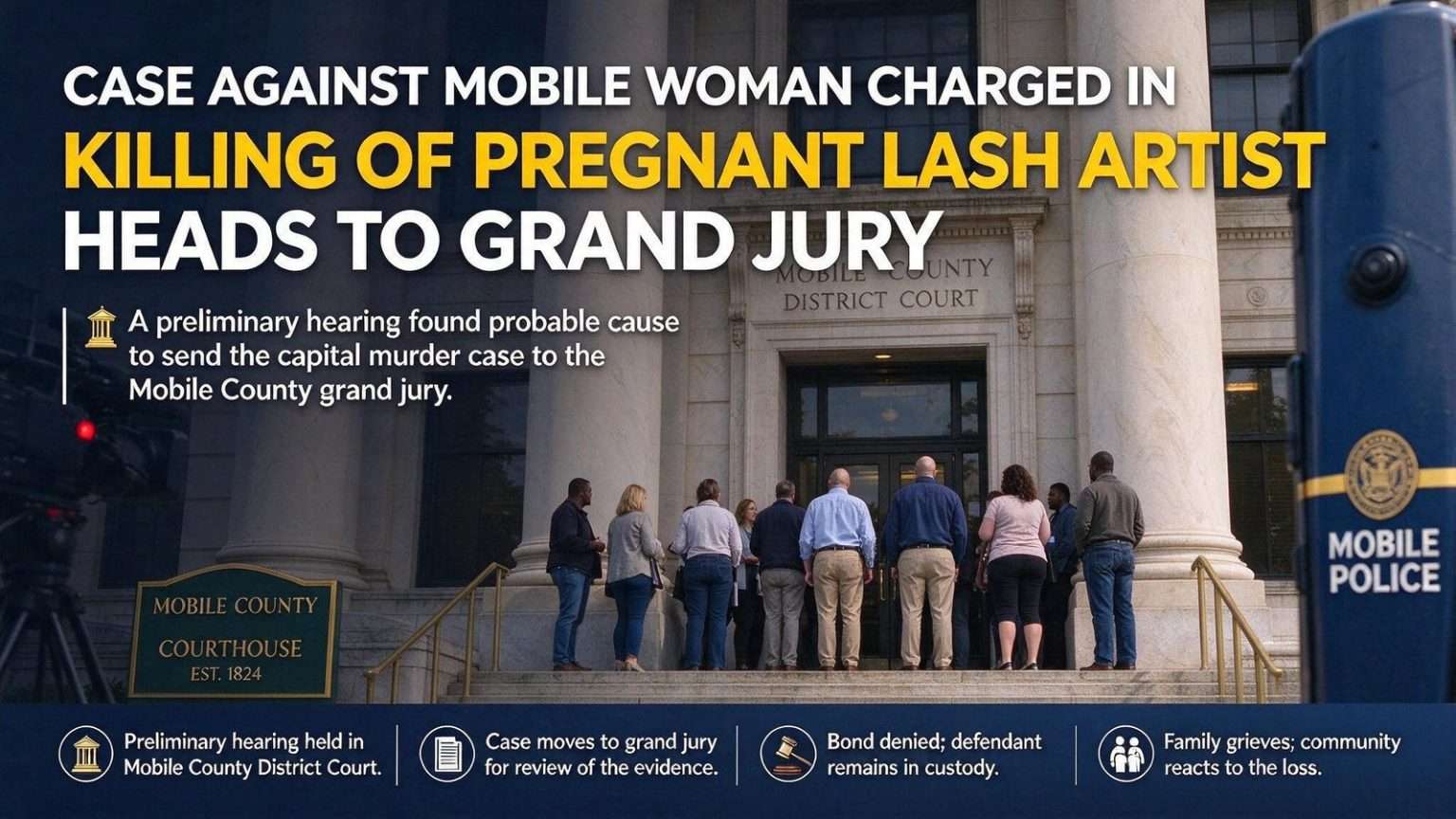
MOBILE, Ala. — The case against a Mobile woman charged with capital murder in the death of a pregnant lash artist will move to a grand jury following a preliminary hearing held Thursday. The hearing, held in Mobile County District Court, gave prosecutors their first public opportunity to lay out the evidence supporting the charge, and a judge found the showing sufficient to send the case forward. The next step now rests with grand jurors, who will decide whether to return an indictment.
Kanedrea Davis, 29, is accused of killing 23-year-old Chyna Hickman. The charge carries the possibility of the harshest penalties in Alabama law, because it falls under the state’s capital murder framework. Davis was arrested the same day as the shooting and has remained in custody since.
Investigators say the two women connected over social media through a $15 lash extension special, and that a dispute over a refund led to the shooting. What began as a routine transaction between a service provider and a client, arranged the way countless small-business exchanges now happen online, escalated in a matter of days into a deadly confrontation. The details laid out at the hearing traced that escalation step by step.
Mobile police responded to a shooting on July 11 and found Hickman suffering from a gunshot wound to the chest; she later died at the hospital. An autopsy confirmed she was also pregnant. Officers and investigators spent the days that followed reconstructing the timeline that ended outside Hickman’s home, drawing on witness accounts, phone records and surveillance footage from the neighborhood.
What the detective testified
During Thursday’s preliminary hearing, homicide detective Anthony Blackman testified that Davis called 911 and said she was trying to recover her $15 from Hickman, claiming Hickman had been aggressive. The call placed Davis at the center of the events investigators were piecing together, and her account of the dispute became a focal point of the testimony. Prosecutors used the detective’s account to walk the court through the sequence of contact between the two women.
Investigators say a Ring camera captured Davis driving past Hickman’s home several times and arguing with her, and that Davis could be heard on the footage threatening to shoot up Hickman’s house. Home security cameras have become a routine part of investigations in Mobile neighborhoods, and in this case the footage provided investigators with timestamps and audio that mapped the confrontation in detail. Prosecutors presented the recording as central to the chain of events leading to the shooting.
Hickman reportedly responded, “So what, you gonna shoot me?” The exchange, as described in testimony, captures how quickly the dispute moved from a money disagreement to a fatal encounter. A neighbor told investigators she heard the two arguing and then saw Hickman get shot in the chest, providing investigators with an eyewitness account that corroborated the sequence captured on camera.
Bond denied, defense pushes back
Davis was arrested July 11, and a judge denied her request for bond. Denial of bond in a capital case reflects the weight courts assign to the charge, and it means Davis will remain in the county jail while the case moves through the system. Her legal team had argued for release pending trial, but the court sided with prosecutors on the risk presented by the allegations.
Defense attorney Tom Walsh said Thursday’s hearing was the first time his team had heard the evidence against his client. “There’s a lot we don’t know. And this hearing we were hearing evidence for the first time. At some point we were going to get the discovery, the videos, and make an assessment as to what was said in the preliminary hearing as to whether that was accurate,” Walsh said. His comments underscored the limited role defense attorneys play at this early stage, when the hearing exists to establish probable cause rather than to test the full case.
That is a normal feature of the process, but it shapes public perception. A preliminary hearing presents only the prosecution’s version of events, tested minimally, and evidence that appears one-sided at this stage can look different once the defense obtains recordings, interviews and its own investigation. Walsh indicated his team would take that closer look once the discovery materials are in hand.
A family’s grief outside the courtroom
Hickman’s mother, Chasity Bell, spoke outside court about the toll her daughter’s death has taken on the family. “It has been devastating for the entire family. Especially when you have her 3-year-old son asking for mom and wanting to go home. Chyna was loved by a lot of people. This is truly heartbreaking that my baby had to go through this. We trust in God, and believe that God will move in the direction that needs to be moved for my baby,” Bell said. Her remarks drew support from family members and friends who filled the hallway outside the courtroom.
Hickman’s death has resonated among local beauty professionals, a community of independent lash artists, stylists and technicians who build clientele through social media promotions much like the one that connected the two women. Practitioners across Mobile and the Gulf Coast book clients through online specials daily, and the case has prompted conversations among them about screening clients and meeting safely. What was an ordinary business arrangement for thousands of local workers became, in this case, the thread that led to a killing.
What happens at the grand jury
The case will now go before a Mobile County grand jury. In Alabama, the grand jury reviews the evidence presented by the district attorney’s office in secret sessions and decides whether probable cause exists to return an indictment. Unlike a preliminary hearing, the defense does not present evidence, and the proceedings are not open to the public or the press.
An indictment from the grand jury would move the case toward circuit court, where felony cases are tried. If the grand jury declines to indict, the case can end there, though prosecutors can re-present evidence under certain circumstances. The panel’s schedule and the volume of cases awaiting it determine how quickly the matter is heard, and no firm date for the presentation has been announced.
The charge and what prosecutors must prove
Capital murder in Alabama covers killings committed alongside specified aggravating circumstances, and prosecutors have particular reasons for the classification in this case. The conviction of the charge carries the most serious penalties available under state law, which is why such cases are handled at the circuit level with capital case procedures. Prosecutors have not yet decided whether they will seek the death penalty, a determination that typically follows a review process within the district attorney’s office after an indictment.
The path from here is a long one. Capital cases involve extensive pretrial litigation, from discovery battles to competency and penalty-phase preparations, and months or years can pass between indictment and trial. For Hickman’s family, each step reopens the loss they described outside the courthouse, and they have indicated they intend to follow the process closely as it unfolds.
The presumption of innocence
Davis remains presumed innocent unless and until proven guilty. That presumption is the foundation of the criminal process, and nothing established at a preliminary hearing amounts to a finding of guilt. The evidence heard Thursday was presented to show probable cause, a far lower threshold than the proof required for a conviction, and the defense will have full opportunity to challenge it as the case proceeds.
For now, the file sits with the grand jury, the recordings and testimony gathered in a July investigation are in prosecutors’ hands, and a 3-year-old boy’s family continues to grieve a young mother whose death began, investigators say, with a $15 dispute. The legal system will take its course in the months ahead, and Mobile County’s courts will handle the case at the highest level of scrutiny state law provides. What the grand jury decides will determine whether the case moves to trial, and both sides say they are preparing for what comes next.
The July shooting also unfolded in a part of the city where residents have grown accustomed to investigators knocking on doors after incidents, and where doorbell cameras now quietly record much of what happens on front porches and streets. Those recordings have changed how cases like this one are built, replacing weeks of uncertain witness interviews with a precise audio and video record. Detectives testified that the footage in this case allowed them to corroborate the neighbor’s account and place the confrontation in a clear sequence, detail earlier generations of investigators rarely had.
Thursday’s hearing also drew a reminder of how these proceedings land on the people involved beyond the two women at their center. Courtrooms on hearing days fill quickly with family members on both sides, and the short hallway outside becomes the only space where anything can be said out loud. Bell’s statement to reporters reflected the family’s attempt to hold to faith while a legal process they do not control moves forward one hearing at a time.
As the case moves to the grand jury, the practical questions shift from what happened on July 11 to what the formal charges will look like when an indictment, if returned, is read in circuit court. Prosecutors will make their final charging decisions at that stage, including the weightiest one available to them, and the defense will begin shaping its response to a complete set of evidence rather than the preview a preliminary hearing provides. Mobile County’s courts have handled this timeline before, and both sides now settle in for a process measured in months.