Case Headed to Grand Jury in Stabbing Death of Citronelle Man Found in Trailer
The murder case against a man accused of stabbing a Citronelle man 65 times is headed to a Mobile County grand jury after testimony from a MCSO detective.
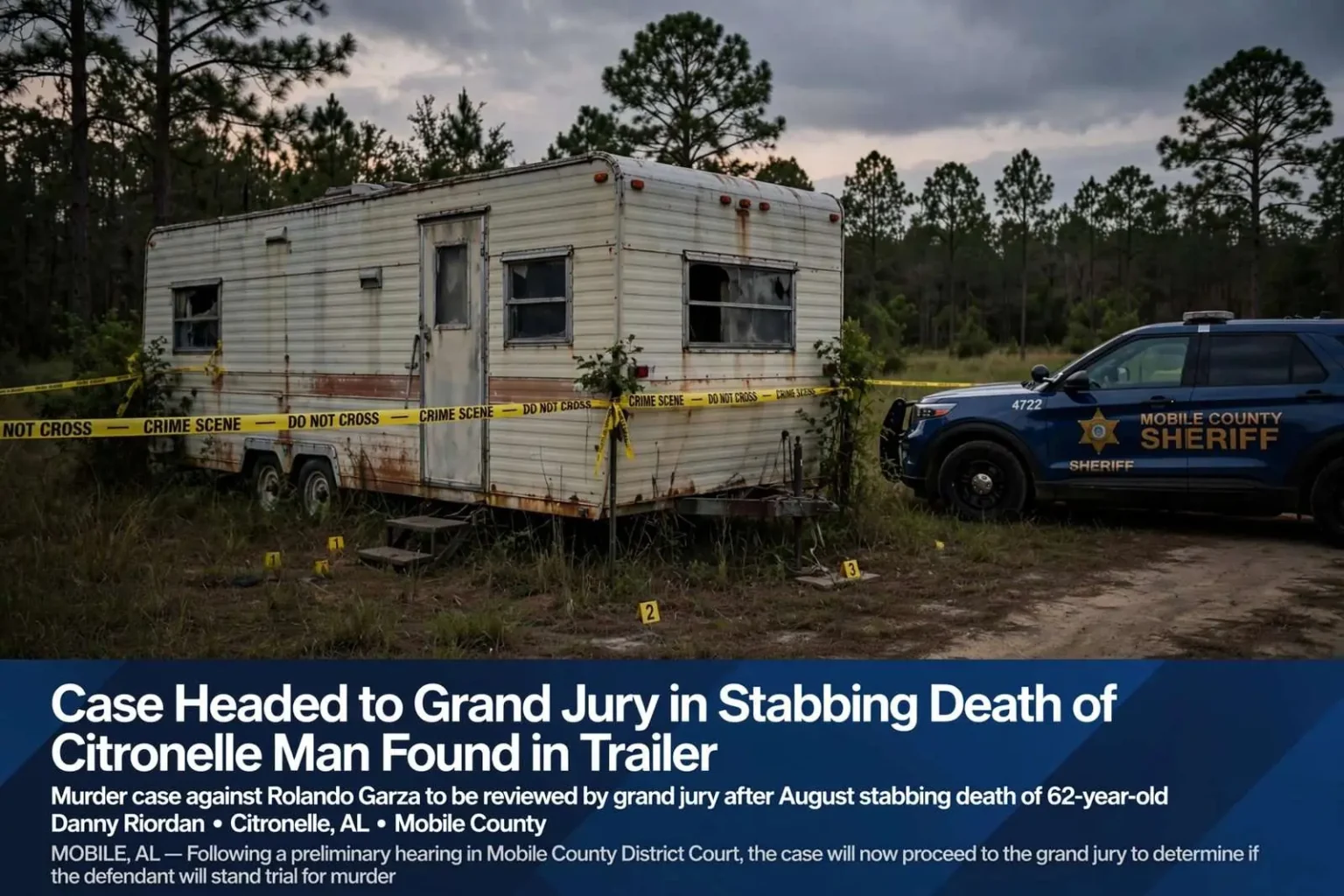
The murder case against a Citronelle man accused of stabbing a 62-year-old to death inside his trailer is headed to a grand jury after a preliminary hearing in Mobile County District Court. Rolando Garza faces a murder charge in the August death of Danny Riordan. He was arrested August 12, a week after the Mobile County Sheriff’s Office says the killing occurred.
The preliminary hearing gave prosecutors their first public test of the evidence, with a sheriff’s office detective walking a district judge through the investigation piece by piece — the discovery of the body, the autopsy findings and the statements that pointed investigators toward Garza. The judge’s decision to bind the case over to a grand jury means the evidence was sufficient to proceed, but it is not a finding of guilt; the grand jury will now decide whether the case should go to trial.
A foul odor led to the discovery
A sheriff’s office detective testified that deputies were called to a small trailer with no power in Citronelle on August 5 after two people reported a foul odor coming from the residence and couldn’t reach Riordan, who had sold them methamphetamine several days earlier. Once inside, investigators found blood throughout the trailer and Riordan’s body badly decomposed in the bedroom. An autopsy later determined he had been stabbed 65 times.
The details testified to at the hearing painted a grim scene. The trailer sat without electricity in rural Citronelle, a small town in the far northern reaches of Mobile County near the Washington County line, where homes sit far apart and a neighbor’s silence can go unnoticed for days. It was only when two people who bought methamphetamine from Riordan days earlier returned and could not reach him — and smelled something wrong from outside — that anyone called the sheriff’s office. By then, days had passed since Riordan was last known to be alive.
The autopsy and the timeline
Investigators believed Riordan was killed on the evening of August 1, a full four days before deputies entered the trailer, and the decomposition of the body matched that estimate. The forensic pathologist’s finding of 65 stab wounds transformed what might have been investigated as an unattended death into one of the most violent homicides in the county’s rural north, and it established that the attack was sustained rather than a single confrontation gone wrong.
The autopsy is only one element of the forensic work the grand jury will see. Blood evidence throughout the trailer, any fingerprints or DNA recovered from the scene, and the medical examiner’s conclusions about the timing and mechanics of the wounds all feed into the prosecution’s account of what happened inside the powerless trailer on the first evening of August. Mobile County grand juries routinely hear homicide cases presented by the District Attorney’s Office, and the detective’s preliminary hearing testimony offered a preview of that presentation.
Evidence pointed to Garza
According to testimony, the property owner’s son told detectives he believed Garza and Garza’s fiancée were involved, noting both had bought drugs from Riordan before. The detective said Riordan was known locally for selling drugs and was known to keep substantial cash at the trailer. That combination — a steady drug customer base, a stash of cash inside a powerless rural home, and buyers who knew the arrangement — formed the backdrop against which detectives worked the case.
The fiancée told investigators that Garza was not home the evening of August 1, when Riordan was believed to have been killed — and that when he returned the next day, Garza admitted to her that he had murdered Riordan, according to the sheriff’s office. Her account gave investigators both a timeline and an alleged confession, the two elements that most directly connected Garza to the killing. Taken together with the property owner’s son’s suspicion and the condition of the scene, it was enough for the sheriff’s office to arrest Garza on August 12 and charge him with murder.
Whether those statements and that evidence persuade a trial jury is the question the grand jury process begins to answer. Defense attorneys will scrutinize the witnesses’ reliability, the handling of the scene and the forensic chain of custody; prosecutors will lean on the autopsy, the confession account and the circumstances that pointed to a drug-related robbery turned killing.
How the grand jury fits in
In Alabama, a capital or felony case reaches trial only after a grand jury returns an indictment, and the panel’s review is deliberately one-sided: prosecutors present the evidence, the defendant does not appear, and the grand jury decides only whether probable cause exists to believe a crime was committed and that this defendant likely committed it. The preliminary hearing Garza just went through serves a similar screening function in District Court, but the grand jury’s indictment is the step that formally moves a murder case to Circuit Court, where trials happen.
For the detective whose testimony carried the hearing, the grand jury session will largely be a rerun — the discovery call, the scene inside the trailer, the autopsy results and the statements implicating Garza. The standard is low by design, but prosecutors treat the presentation seriously, because an indictment starts the clock on a case they may spend a year or more taking toward trial.
Rural homicide and the meth economy
The case illustrates a pattern Mobile County investigators see repeatedly in its rural northern communities, where Citronelle sits nearly an hour’s drive from downtown Mobile. Violent deaths in these areas are less likely to be witnessed, less likely to be reported quickly and more likely to involve participants in the informal methamphetamine economy — buyers and sellers whose relationships operate outside any legal record. Here, the people who discovered the crime had bought methamphetamine from the victim days earlier, the suspected motive traces back to drug purchases and cash in the trailer, and the tip that broke the case came from people in that same orbit.
For sheriff’s detectives, such cases are solved by patient work across a thin network of statements, forensic evidence and timelines reconstructed from memory. The unpowered trailer meant no electric bill cycle to anchor the timeline, few neighbors close enough to notice anything, and no surveillance cameras — investigators had to rely on what witnesses recalled and what the body itself could tell them.
Garza remains in the Mobile County jail system as the case proceeds, and he is presumed innocent unless convicted. The grand jury will weigh what the preliminary hearing showed: a body found four days after the killing, 65 stab wounds, a cash stash known to half the town’s drug buyers, and a fiancée’s statement that her boyfriend came home the day after and admitted the murder. If the panel indicts, Rolando Garza will stand trial in Mobile County Circuit Court for the death of Danny Riordan — the next step in a case that began with a smell noticed outside a dark trailer in Citronelle.
The defendant’s first appearances in the case were handled under the expedited schedule Alabama applies to felony arrests: a district court arraignment where the murder charge was read and counsel addressed, followed within days by the preliminary hearing where the detective laid out the state’s evidence. Bond in murder cases is set by a circuit judge, and defendants charged with murder in Mobile County typically await grand jury action in custody.
The grand jury itself convenes regularly in Mobile to review the stack of felony cases the District Attorney’s Office brings forward, and homicide presentations are its most consequential work. Detectives prepare binders of scene photographs, forensic reports and witness statements for each case, and the assistant district attorney handling the presentation walks the jurors through the evidence in narrative order — in this case, from the August 5 welfare check on a powerless trailer to the detective’s account of what the fiancée said about August 2. Jurors may ask questions and request additional evidence before voting, and a true bill — the formal indictment — sends the case to Circuit Court arraignment, where a trial date begins to take shape.
Family members of Riordan attended the preliminary hearing, as families of rural homicide victims typically do, and the grand jury process will bring them back to the courthouse for another round of the same testimony. That repetition is part of what survivors of violent death describe as the hardest stretch of the legal process: months of hearings in which the details of the killing are recited publicly, again and again, before a trial ever starts. In a small community like Citronelle, where many of the witnesses know one another, those public recitations carry their own weight, and the courtroom gallery at each hearing fills with residents who knew both the victim and the accused.