Caught on Camera: Thief Hits Multiple Cars Near West Mobile Golf Course
A thief broke into several vehicles in Mobile's Williamsburg subdivision near Azalea City Golf Course, stealing cash. Neighbors suspect daytime scouting.
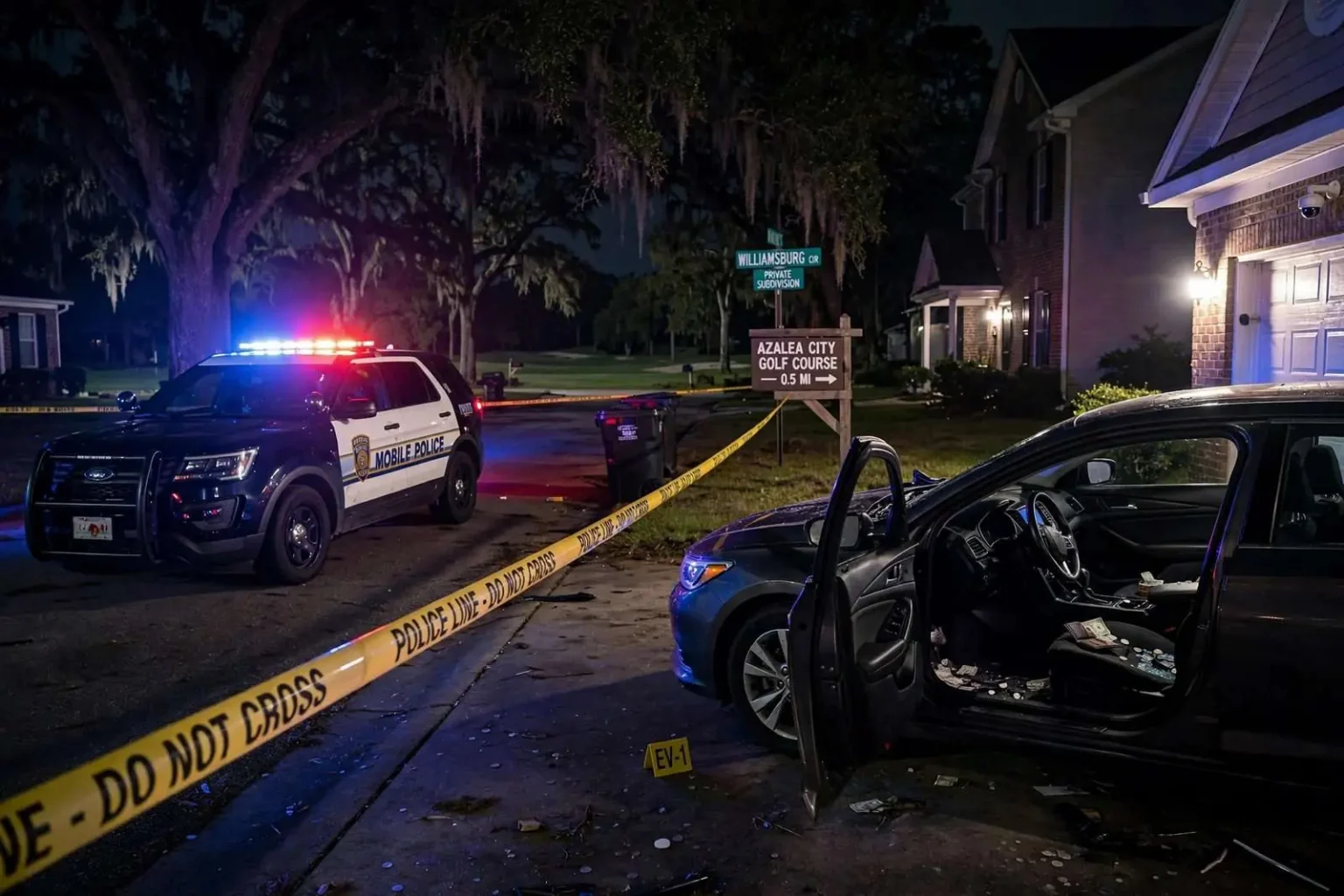
MOBILE, Ala. — Residents of a west Mobile subdivision are reviewing home security footage after a thief was caught on camera breaking into several vehicles and rifling through them for cash. The break-ins happened Monday night in the Williamsburg subdivision, not far from the Azalea City Golf Course.
The suspect targeted multiple parked cars, making off with loose change and cash left inside. The pattern captured on the neighborhood’s security cameras — a single individual moving methodically from vehicle to vehicle in the dark — is one Mobile police see repeatedly, and it is why detectives treat vehicle burglary clusters like this one as a solvable, preventable category of crime.
For the residents of Williamsburg, the discovery has turned the subdivision’s quiet streets into an evidence review. Doorbell cameras and motion-activated security lights have become common fixtures in west Mobile neighborhoods in recent years, and footage from those devices is now being collected and shared with investigators. In cases like this, that footage often does more than confirm what happened: timestamps from multiple cameras can map the suspect’s exact path through the neighborhood, showing which cars were checked and which were passed over.
Residents Suspect Daytime Scouting
Neighbors told police they had seen people riding bikes through the area earlier in the day and believe the riders may have been scouting which vehicles to hit after dark. The case is a familiar warning for Mobile-area drivers: most vehicle burglaries target unlocked cars with visible valuables. Police urge residents to lock their vehicles, remove cash and belongings from view, and report suspicious activity — including unfamiliar visitors casing streets on foot or by bike — to Mobile police.
The scouting theory fits a pattern officers describe often. Vehicle burglars rarely work blind; they look for targets in advance, noting which cars are parked in driveways rather than garages, which sit in the same spot every night, and which have bags, purses or electronics visible through the windows. A daytime ride through a subdivision offers all of that information to anyone paying attention, and residents who notice the same unfamiliar faces passing more than once are right to be alert.
West Mobile’s layout adds to the challenge. The area’s subdivisions — Williamsburg among them — sit in a web of residential streets between Airport Boulevard and Cottage Hill Road, with the Azalea City Golf Course providing a large green buffer between neighborhoods. Streets that connect subdivisions to arterial roads give an intruder quick access and a fast exit, and the golf course itself borders backyards on multiple sides, creating paths a stranger on foot or bike can use without ever driving through the front entrance.
The takings in Monday night’s break-ins — loose change and cash — sound minor, but they are typical of the trade. Vehicle burglars generally work quickly and aim for items that can be grabbed in seconds without starting a car or triggering an alarm: change trays, console compartments, garage door openers, sunglasses, phone chargers. The cumulative loss across a hit run through a neighborhood can be significant, and the cost of a broken window turns a small theft into a much larger repair bill.
How Vehicle Burglaries Work — and How to Stop Them
Police statistics across Mobile and comparably sized Southern cities consistently show the same thing: the overwhelming majority of vehicle burglaries involve unlocked cars. A thief working a street at night tries door handles one by one. Locked vehicles are passed over in seconds because time is the burglar’s enemy — every extra second spent prying a door or breaking a window raises the risk of being seen or heard. The simple act of locking up, in other words, removes a car from the target list entirely.
Visibility matters just as much. A garage door opener sitting on a console, a wallet in plain view on a seat, or a phone cable suggesting a device hidden under a jacket all invite a break-in. Police recommend the “clean car” habit: nothing of value visible from outside, garage remotes taken indoors at night, and — in a step many residents overlook — doors unlocked with the glovebox left open when a car must be parked in an exposed driveway overnight, so a window-breaker at least gains nothing more.
Lighting and cameras round out the defense. Motion-activated flood lights startle prowlers and produce the well-lit footage that home cameras need to be useful; cameras alone, without light, often capture only silhouettes. Residents’ associations and neighborhood watch groups in west Mobile have also built informal networks for sharing suspicious-activity photos quickly, which lets adjacent streets know to check their cars the same night rather than discovering break-ins days later.
What Residents Should Do Now
For Williamsburg residents, the immediate advice from police is threefold. First, review and preserve security footage from Monday night before it is overwritten — most consumer cameras retain video for only days or weeks. Second, check their own vehicles for anything missing, however small, since every confirmed entry helps investigators map the extent of the incident. Third, report anything unusual seen in the neighborhood, whether it happened Monday night or happens this week.
Reporting suspicious activity is where residents hold the most power. An unfamiliar visitor walking the street at 2 a.m., a slow-passing car with its lights off, or a bicycle rider photographing driveways in the afternoon are all worth a call to Mobile police’s non-emergency line while they are happening — not after the damage is found the next morning. Officers stress that they would far rather check out a report that turns out to be innocent than arrive too late to a street full of ransacked cars.
Anyone with information about the Monday night break-ins, or who recognizes the person captured on security video, is asked to contact the Mobile Police Department. Tips about vehicle burglary cases can also be made anonymously, and footage from home cameras can be delivered to investigators directly. In the meantime, the neighborhood’s advice to itself is the same one police give every summer: lock the car, take the valuables inside, and turn on the porch light.
A Seasonal Problem in West Mobile
Vehicle burglary clusters like the Williamsburg case tend to rise in the warmer months across Mobile County. Long evenings mean more people are out walking, more cars sit outside rather than in garages, and school breaks put more teenagers — both victims and, in some cases, offenders — on residential streets after dark. Police typically see a summer uptick in reports of entered vehicles, and the pattern repeats on a near-weekly cycle: a burst of break-ins across one or two subdivisions over a night or two, followed by a quiet stretch until the next cluster.
The west Mobile corridor between Schillinger Road and Academy Drive has seen this cycle before. Its neighborhoods are established, tree-lined and comfortable, with driveways rather than shared parking, which is exactly the environment vehicle burglars prefer. Homes set back from the street, hedges between properties and the absence of through traffic all make a prowler harder to notice — the same features that make the area pleasant to live in.
That is why the neighborhood’s instinct to check cameras matters. In recent years the calculus of residential crime-solving has shifted in west Mobile: a substantial share of vehicle burglary arrests now begins with a resident’s video, either a clear image of a suspect’s face or a vehicle tag captured by a doorbell camera. Mobile police detectives routinely canvass a hit street asking for footage, and the department has encouraged residents to register cameras through voluntary programs that map where video exists when an incident occurs.
The Bigger Picture for Mobile Drivers
Beyond the immediate case, the Williamsburg break-ins are a reminder of the gap between burglary and burglary of a motor vehicle in Alabama law — and of why police ask residents to take the small steps that prevent the crime rather than relying on arrest afterward. A vehicle burglary that involves forced entry becomes a property crime with a repair bill attached; one that leads to the theft of a firearm left in a car becomes something far more serious, since stolen guns circulate into other crimes across the region.
Firearms in parked cars are a persistent concern in Mobile and across the Gulf Coast. Police agencies in the region have repeatedly urged gun owners never to leave a weapon in an unattended vehicle, or at minimum to secure it locked and hidden. Every unlocked car in a subdivision represents a chance, not just for lost change, but for a firearm to change hands in the dark — which is why officers treat “lock it or lose it” campaigns as public safety work rather than property advice.
The Williamsburg case also shows how quickly neighbors can organize when footage exists. Within a day of the discovery, residents were comparing timestamps, identifying which cars on which streets were entered, and passing what they found to police. That kind of documentation shortens investigations considerably: a mapped sequence of entries tells detectives whether they are looking for one offender or several, a direction of travel, and an approximate window of time that narrows the search of any additional camera — including those on nearby businesses along Airport Boulevard and Cottage Hill Road.
As the investigation continues, the standing advice holds for every neighborhood adjacent to Williamsburg — and for drivers across Mobile: lock your vehicle every time, take cash, firearms and valuables indoors, leave nothing visible, light your driveway, and call police when something looks wrong. The thief caught on camera Monday night counted on dark streets and open doors; the neighborhood’s job now is to make sure neither is waiting the next time.