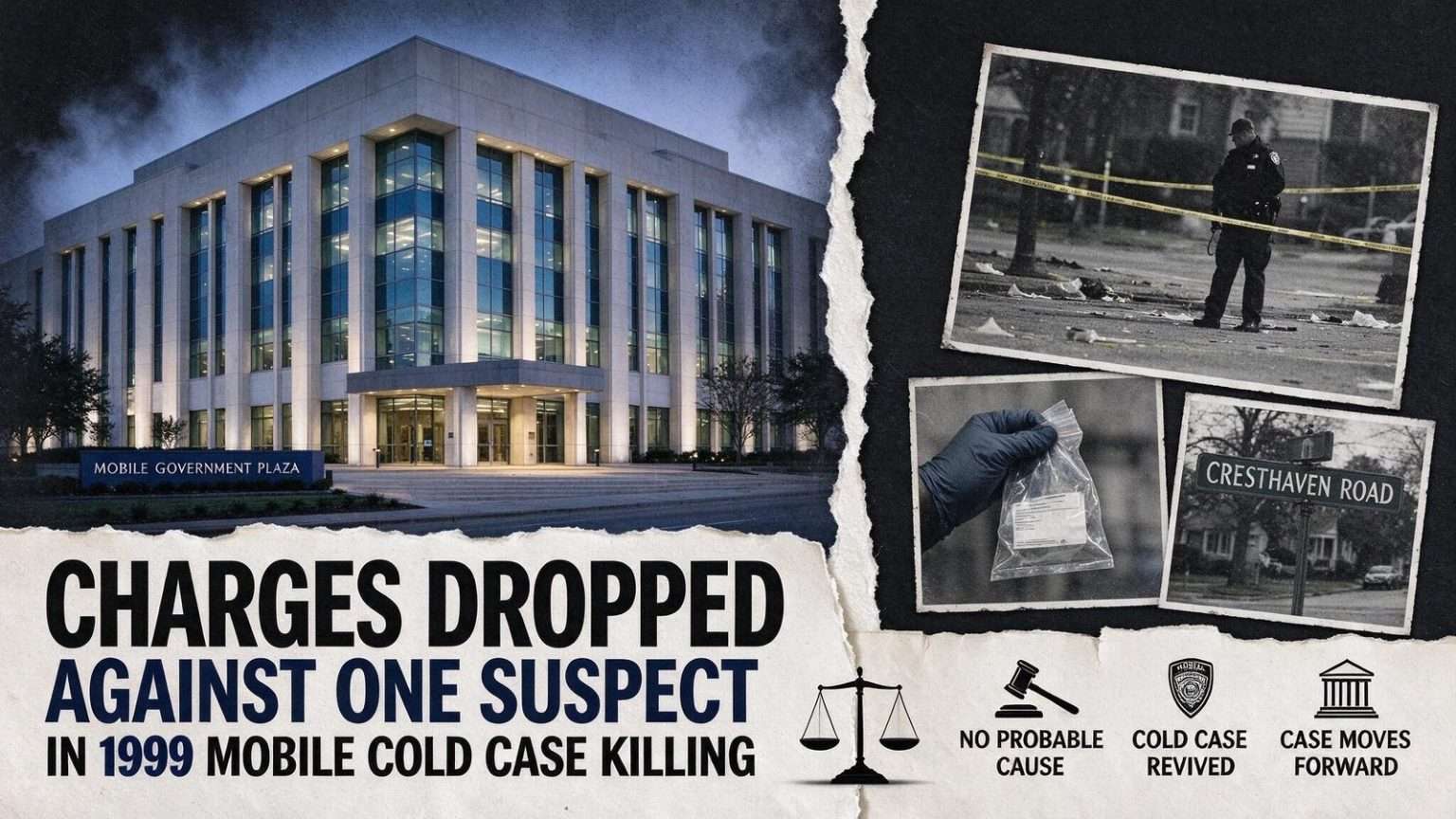
Charges Dropped Against One Suspect in 1999 Mobile Cold Case Killing
A judge found no probable cause against Dammon Wright in the 1999 murder of Marcel Chandler, while Jamelle Thomas's case heads to a grand jury.
One of two men arrested in connection with a decades-old Mobile murder is walking free, while the case against the other moves forward — a split outcome that shows how differently the justice system can treat co-defendants in a case revived after more than twenty years. The Mobile County District Attorney’s Office said a judge found no probable cause against Dammon Wright, 40, and dismissed the case against him entirely.
Wright had been arrested in June alongside Jamelle Thomas, 42, in connection with the death of Marcel Chandler — a killing that went unsolved for more than two decades. The arrests were announced earlier this summer as a breakthrough in one of Mobile’s long-dormant homicide files, and the June arrests themselves marked the first major development in the case since the night it happened. The dismissal of one case and the continuation of the other now leaves the two defendants on sharply different paths out of the same arrest.
A finding of no probable cause at this stage is a decisive legal event. It means the judge who heard the evidence concluded the state had not connected Wright to the offense with even the minimal threshold the law requires — a far lower bar than the guilt a trial jury must find — and the dismissal was entered entirely rather than held for reconsideration. Prosecutors have not said whether they will seek to refile anything against Wright, and the law gives them that option in limited circumstances, but for now Wright is a free man with no pending charges.
A Case Two Decades Old
Chandler, 24, was found murdered the night of December 13, 1999, in the 4000 block of Cresthaven Road in Mobile. The killing occurred in a west Mobile neighborhood, and like most homicides of that era, the initial investigation produced leads that eventually ran dry. The case sat cold until police announced arrests earlier this summer, reviving hopes of closure in one of the city’s long-dormant homicide files.
Cold cases of this vintage are reopened through a familiar set of engines: advances in DNA and forensic technology that can re-test evidence collected in 1999, witnesses who after twenty years are willing to talk, records that connect old suspects to new crimes, and dedicated cold case investigators who return to the file box when other work slows. Mobile police’s decision to revisit Chandler’s death after more than two decades — and to bring arrests before a judge — reflects the persistence those investigations demand, and the fact that arrests came at all is what distinguished this case from the hundreds that remain unsolved across the county’s decades.
For Chandler’s family, the path from December 1999 to this summer’s arrests spanned an entire generation. Families of cold case victims routinely describe the doubled grief of losing someone to violence and then losing the case to silence — and the renewed movement in the case, even with its mixed outcome, is the first substantive progress the family has seen in more than twenty years.
Where the Case Stands Now
Thomas’s case is now bound over to a grand jury, meaning prosecutors presented enough evidence for the charge to proceed to the next stage. A bind-over at a preliminary hearing is an early but meaningful checkpoint: the judge found sufficient probable cause to hold Thomas for the grand jury’s review, where the state must again present its evidence before any indictment issues. The grand jury will decide whether Thomas faces trial in Chandler’s death.
The judge also denied a request to modify Thomas’s bond, leaving the terms of his release or detention as originally set. Bond decisions at this stage weigh the seriousness of the charge, the strength of the evidence, and the defendant’s ties to the community, and a denied modification request means the court found no reason to loosen the conditions after hearing arguments from the defense. Thomas remains charged and the case remains active as it moves toward the grand jury.
The diverging outcomes also illustrate how the earliest stages of a felony case actually work. Two co-defendants arrested on the same accusation can stand before the same judge with different evidentiary records attached — different alleged roles, different witnesses, different physical or testimonial connections. A preliminary hearing asks a narrow question for each defendant separately: is there probable cause against this person? In the Chandler case, that question drew opposite answers for Wright and Thomas, and each answer was delivered on its own evidence rather than by association.
How Cold Case Prosecutions Proceed
Prosecuting a 1999 homicide carries burdens a fresh case does not. Witnesses have moved, died, or forgotten; memories have hardened or blurred; and evidence collected before modern forensic standards must be re-examined under today’s rules. Defense counsel in cold cases routinely test the reliability of aged identifications, the chain of custody of decades-old exhibits, and the science used to re-analyze old material. That is why so few cold case arrests survive to trial, and why prosecutors treat each revived case as a careful rebuild rather than a reopen.
The Mobile County District Attorney’s Office’s handling of the case reflects that caution. The office presented Wright’s case to a judge knowing the outcome would be probable cause or dismissal, and accepted the dismissal when the evidence fell short — a decision that spares the system a doomed trial while preserving the option, stated but unexercised, to refile should new evidence emerge. In Thomas’s case, prosecutors cleared the same bar, and the matter now moves to the grand jury, a body that meets in secret and hears only the state’s side before deciding whether an indictment is warranted.
The grand jury stage is deliberately different from a preliminary hearing. There is no defense counsel present, no cross-examination, and no defense evidence — only the question of whether probable cause exists to bring the case to trial. If the grand jury indicts Thomas, the case will proceed to the circuit court docket, where the trial process — motions, discovery, and ultimately a jury — begins in earnest. If it declines, the case ends there as well.
What Comes Next
The immediate future of the case belongs to the grand jury, and its schedule will set the pace. In the meantime, investigators and prosecutors will continue assembling the record a trial would require: re-interviewing witnesses, completing forensic work, and testing every link in a chain of evidence more than two decades long. The dismissal of Wright’s case does not conclude the investigation into Chandler’s death; the murder remains what it has been since 1999 — an open question the justice system is still working to answer.
For Mobile, the case is a reminder of both ends of the cold case ledger. Arrests after twenty years show that old files are never truly closed, and the dismissal of one of the two cases shows that revival guarantees nothing. The family of Marcel Chandler has waited through both realities already, and the grand jury’s decision on Thomas’s case will determine whether the wait for a trial — the final stage of a process two decades in the making — begins at all.
The Anatomy of a Revived Homicide File
Understanding how a 1999 case reaches a 2020s courtroom requires understanding what changes in the file box over twenty years. Evidence collected in the original investigation — crime scene photographs, physical exhibits, lab submissions, and the original detectives’ notes — remains in the custody of the police agency, catalogued and preserved precisely so that a future generation of investigators can return to it. What changes is the ability to read that evidence: forensic methods that did not exist in 1999 can extract information from material that was once inert, and databases that were paper files then can be cross-searched in seconds now.
People change too. Witnesses who feared involvement in their twenties often see the case differently after two decades, when they have raised families, left old associations behind, or watched the passage of time dissolve the dangers that kept them quiet. Cold case investigators rely on that shift — returning to original witnesses with new questions and new evidence in hand, finding that the story people could not or would not tell in 1999 can finally be told. Family members of victims, meanwhile, sometimes keep their own files for decades, maintaining contact with detectives and pushing the case back into review whenever an agency renews its cold case efforts.
The June arrests in the Chandler case represent the convergence of all of those forces, distilled into a decision by investigators that they finally had enough to charge. The subsequent weeks — a preliminary hearing for each defendant, the weighing of probable cause, and the decisions about bond — tested that judgment in public, exactly as the system intends.
Presumption of Innocence and the Road Ahead
As the case proceeds, the legal posture of both men deserves plain language. Wright has been cleared of the charges that were filed against him; a judge found no probable cause and dismissed the case entirely, and he faces no pending accusation. Thomas is charged but not convicted; he is presumed innocent, and the bind-over to the grand jury is a procedural step about evidence sufficiency, not a judgment about guilt. Whatever the grand jury decides, and whatever a trial might later bring, neither outcome retroactively changes what has been proven or dismissed to date.
The Mobile County courts will handle the next steps on their standard calendar. Grand juries meet regularly in Mobile, and an indictment, if returned, would move the case to circuit court for arraignment — where Thomas would formally answer the charge — and then into the pretrial process. Cold case trials, when they happen, draw heightened attention and careful jury selection, because the age of the evidence itself becomes a central issue both sides argue to the jurors who must decide.
What the past two decades could not produce — answers in the death of a 24-year-old on Cresthaven Road — now rests on the machinery set in motion this summer. One case was tested and dismissed; one case was tested and advanced. The system’s work on the question it has carried since December 13, 1999, continues.