Chickasaw City Schools Extends Mask Requirement, Keeps Classes In Person
Chickasaw City Schools extended its mask requirement past Jan. 14 and will keep classes in person as COVID-19 pushes other districts to go virtual.
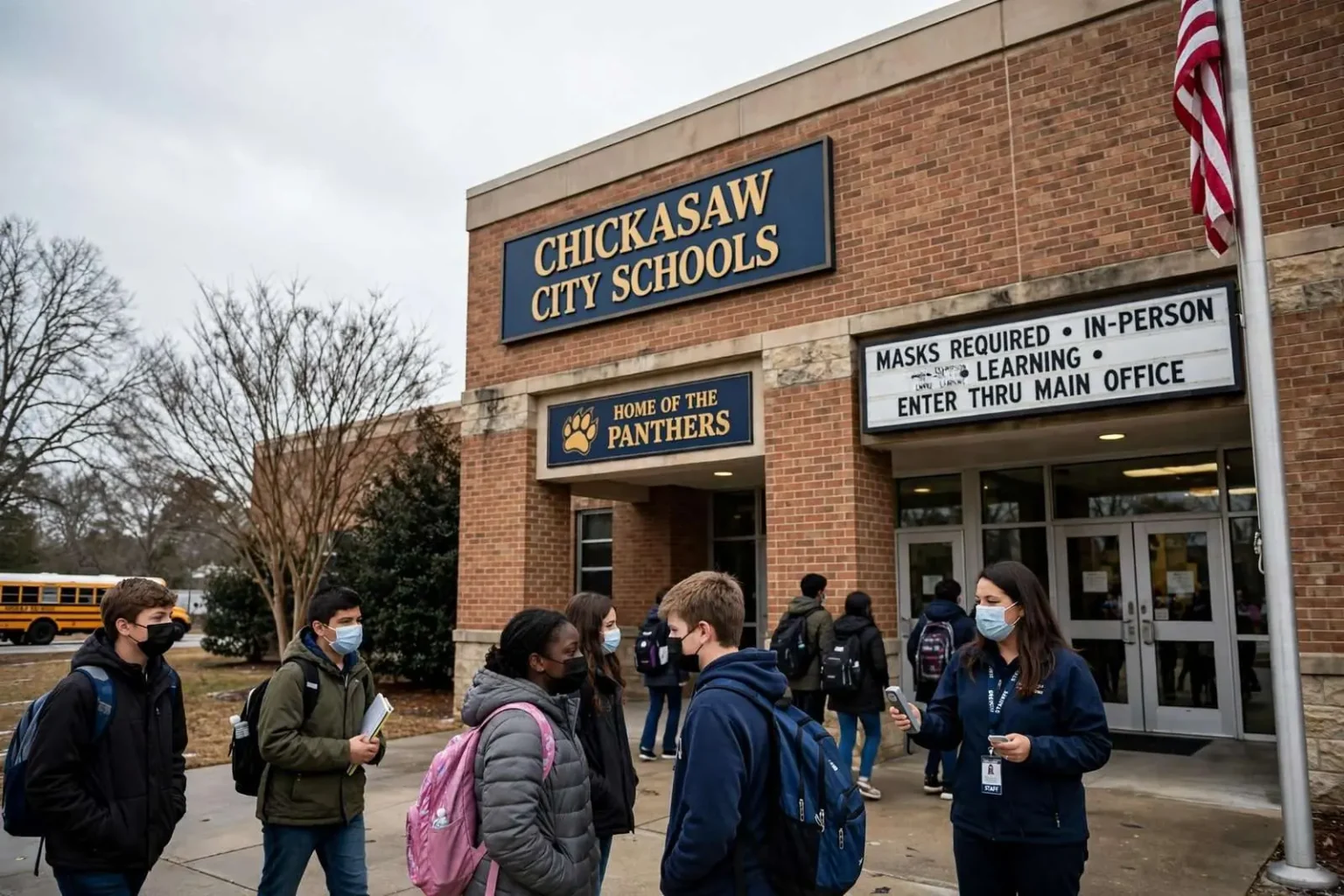
Chickasaw City Schools is extending its mandatory mask policy until further notice, keeping students in classrooms while other districts around south Alabama shift to remote learning. School officials moved to continue the requirement after the existing policy was set to expire on Friday, Jan. 14, choosing in-person instruction and universal masking as the combination that lets school continue safely.
The decision comes as a wave of COVID-19 cases continues to strain school operations across the region. The omicron variant, spreading faster than any previous version of the virus, filled classrooms and staff rooms alike with absences during the first weeks of January, and every district in the area had to decide how to keep students learning while the wave crested.
Chickasaw’s answer was to stay open. The small city school system, which serves the municipality of Chickasaw just north of Prichard in Mobile County, kept its students on campus for in-person instruction, with classes proceeding as scheduled beginning Tuesday, Jan. 18, after the Martin Luther King Jr. holiday weekend.
Other districts go remote
Several nearby systems that do not have mask requirements have temporarily gone virtual because staff shortages left them unable to safely staff buildings. Districts that made the switch include Mobile County Public Schools, Satsuma City Schools and Washington County schools, as employees continued to test positive for the virus.
The arithmetic behind those closures is simple and unforgiving. A school needs a minimum number of teachers, bus drivers, cafeteria workers and aides to supervise and instruct children safely, and when omicron sidelined enough employees at once, the only responsible option left was to send students home. The affected districts announced remote schedules while they waited for staff to return from isolation.
The contrast between districts with mask mandates and districts without them became a live experiment during the omicron wave. Chickasaw’s leaders reasoned that universal masking reduces in-school transmission enough to keep classrooms staffed and students present, and the extension of the policy was designed to hold that line while case counts in the surrounding community remained extreme.
Behind the decision: a quadrupled case count
The mandate was first put in place as students returned from winter break for the spring semester, with Superintendent David Wofford saying it would run through Jan. 17 before being re-evaluated. The re-evaluation date arrived with the outbreak still accelerating, and the district chose to extend rather than let the requirement lapse into a worsening situation.
The backdrop was a stark spike in infections: after the omicron variant reached Mobile County, reported active cases more than quadrupled in just over a week, from 86 on Dec. 22 to 977 by Dec. 30, according to the Mobile County Health Department. Those figures, drawn from the county’s official case reporting, put a number on what families and schools were experiencing in their own households and workplaces.
A case count moving that quickly leaves institutions little time to react. Between the December figures and the mid-January re-evaluation, the region’s hospitals, employers and school systems all reported the same pattern of sudden, sweeping absences. For a school superintendent, the question was not whether the wave would reach the district’s buildings but whether the district’s precautions would let it stay open through the surge.
A region-wide return to masking
Chickasaw was not alone in tightening rules. All Catholic schools in Mobile, along with the University of South Alabama and Spring Hill College, also announced returns to mandatory masking as the omicron wave crested across the region. The coordinated moves meant that students and families across nearly every level of education in the Mobile area, from elementary classrooms through college, faced the same requirement at the same time.
The alignment mattered practically. Families with children in different school systems, and college students moving between campuses and part-time jobs, faced one consistent rule rather than a patchwork. The return to masking across Catholic schools, the two Mobile universities and the Chickasaw public schools reflected a shared read of the same data: case counts were rising too fast for institutions to do nothing.
The University of South Alabama and Spring Hill College each announced the requirement as students prepared to return for the spring semester, joining school districts in recognizing that January’s case surge posed a direct operational threat. Omicron’s defining feature, its ability to spread among vaccinated and unvaccinated people alike faster than any earlier variant, made universal precautions the common denominator across the institutions.
What the extension means for Chickasaw families
For families in the Chickasaw City Schools system, the extension means students continue to wear masks in school buildings until the district announces otherwise. “Until further notice” is the operative phrase: unlike the original mandate, which carried a Jan. 17 expiration date, the extended policy has no fixed end point, leaving the duration tied to the course of the outbreak.
The district’s choice keeps the rhythms of the school year intact for now. Students attend classes in person, athletics and school activities proceed under the district’s health rules, and working parents avoid the sudden childcare burdens that remote-learning announcements create overnight. Those practical effects are why Chickasaw’s decision drew attention from surrounding communities watching their own districts cycle between in-person and virtual schedules.
The trade-off the district accepted is equally clear. Staying open with a mask mandate requires families to comply with the requirement, requires the district to manage quarantines when cases appear, and asks school staff to carry additional responsibilities during a stressful period. Chickasaw’s leadership concluded that those costs were smaller than the costs of closing, and the extension of the mandate was the mechanism for acting on that judgment.
How Chickasaw City Schools fits the regional picture
Chickasaw City Schools is one of Alabama’s newer city school systems, formed when the community broke away from the Mobile County Public Schools system to run its own district. Small systems operate with small margins: a handful of staff absences can touch every grade level, and a single building serves multiple grades at once. Those realities shaped the district’s calculus during the omicron surge.
Being small also allowed quick, unified decision-making. Where a large district must coordinate dozens of schools and announce system-wide remote schedules, Chickasaw’s leadership could evaluate its situation and extend the mask requirement with a single decision communicated directly to its community. The district did exactly that as the Jan. 14 expiration approached, replacing a dated mandate with an open-ended one.
The surrounding context made the decision harder, not easier. With Mobile County Public Schools, the district Chickasaw sits within the boundaries of, temporarily remote, and with Washington County schools also closed for in-person instruction, Chickasaw families could see both models operating at once in their own region. The district bet that masks and in-person learning would serve its students better than a return to remote schedules.
What happened next across south Alabama
The omicron wave that prompted these decisions moved fast on both the way up and, eventually, the way down. Case counts that had quadrupled in the final week of December continued climbing into January before cresting, and school districts throughout the region adjusted week by week as staffing improved and quarantines ran their course. Districts that went remote returned to classrooms when they could safely staff buildings again.
For Chickasaw, the extended mask policy was the tool that bridged the surge. Whether students and staff experienced the period as a manageable inconvenience or a difficult stretch depended largely on the outbreak’s course, but the district’s stated aim held throughout: keep children learning in buildings with their teachers, using masking to slow the virus’s spread through the school community.
The episode also added to the region’s record of how communities handled the pandemic’s later phases. Chickasaw’s extension, the surrounding districts’ remote periods, and the coordinated masking at Mobile’s Catholic schools and universities together showed a region using every tool available, different tools for different systems, in response to the same wave.
As of the extension’s announcement, the district’s message to families was consistent: classes would continue in person on the regular schedule beginning Tuesday, Jan. 18, masks would be required in school buildings until further notice, and the district would keep evaluating conditions as the outbreak evolved.
The pandemic-era playbook for small districts
Chickasaw’s approach reflected lessons school systems had accumulated over two years of pandemic management. Districts learned early that remote instruction carried real costs in learning, childcare and student wellbeing, and that keeping schools open required layered precautions rather than any single measure. Masking, ventilation, quarantining and vaccination all played roles in the layered approach, and the mask mandate was the piece most directly under the district’s daily control.
Small city districts also learned the value of communicating decisions clearly and repeatedly. An extension announced before an old policy expires avoids the confusion of a lapse, and a message that states the schedule plainly, in-person classes on Tuesday, Jan. 18, masks required until further notice, gives families one clear picture of what the coming weeks look like. Chickasaw’s announcement followed that playbook.
The district’s staff carried the heaviest load. Teachers and school employees nationwide worked through the omicron wave in classrooms that were fuller than the remote model but safer than unmasked buildings, managing their own households’ exposures alongside their students’. The extension of the mandate was, in part, a protection for the staff whose presence made in-person school possible at all.
What families should know going forward
Families in the district should watch for official communications from Chickasaw City Schools for any change to the mask policy or the instructional schedule. Because the extended policy has no fixed expiration, the district will announce any end to the requirement separately, and families should treat school communications as the source of record for whatever comes next.
The practical guidance during the extension is unchanged: students attend school in person as scheduled, wear masks in school buildings, and stay home when sick or quarantined. Families with questions about exposures, quarantine lengths or reported cases in their child’s school should contact the school directly, as district staff coordinate those decisions with county health guidance.
The period Chickasaw is navigating is shared by school communities across the Gulf Coast, and the district’s choices will be judged by the measure that mattered most during the omicron surge: whether students kept learning, in person, in classrooms with their teachers, while the wave passed through. With the mandate extended and classes proceeding on schedule, that is the course Chickasaw City Schools has chosen to steer.