Chickasaw Civic Theatre Opens Auditions for ’12 Angry Jurors’ Stage Adaptation
Chickasaw Civic Theatre holds open auditions Aug. 14-15 for its fall staging of the courtroom classic '12 Angry Jurors,' running Oct. 20-29.
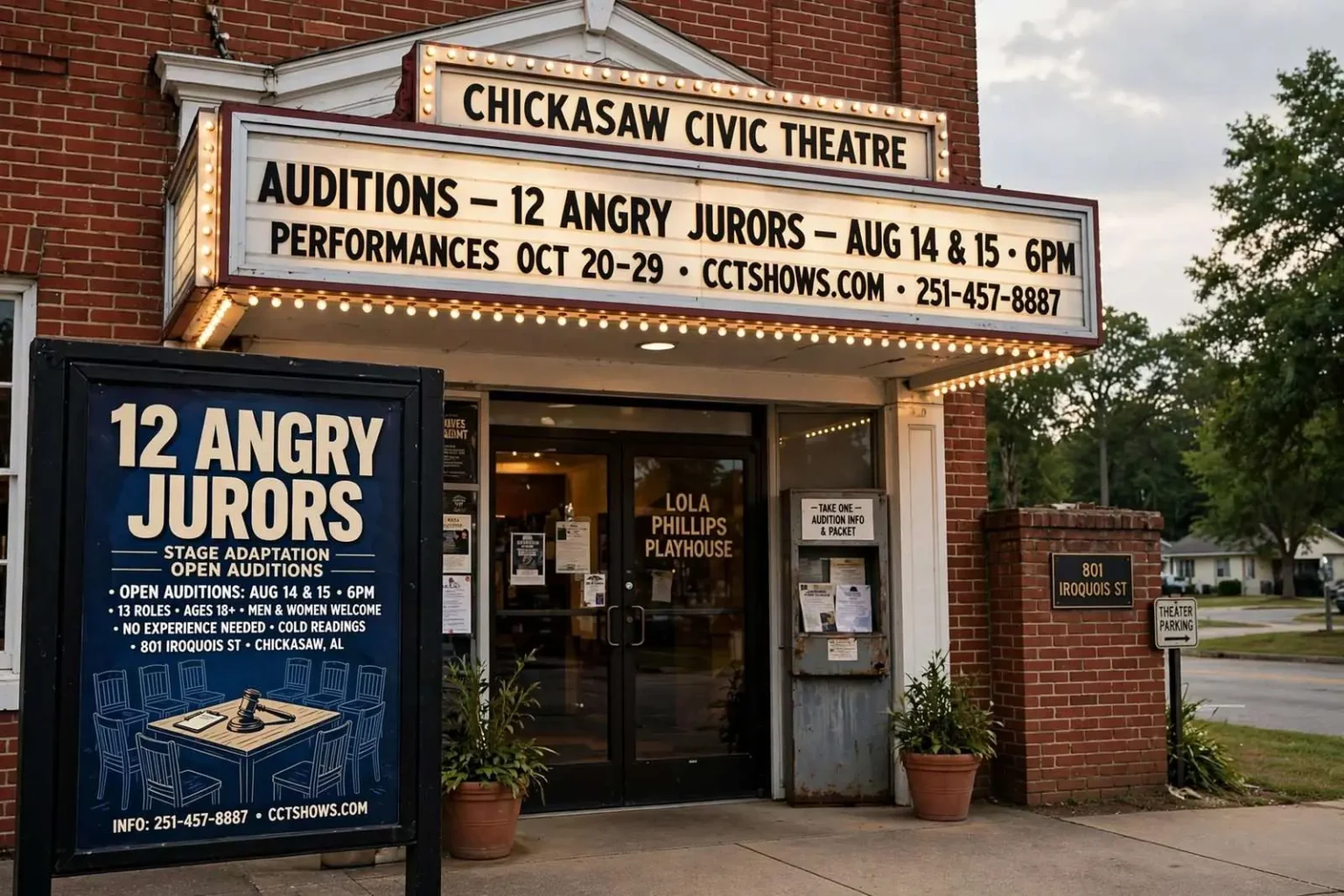
CHICKASAW, Ala. — Chickasaw Civic Theatre will hold open auditions later this month for its fall production of “12 Angry Jurors,” the stage adaptation of Reginald Rose’s classic courtroom drama “12 Angry Men,” giving Gulf Coast actors a shot at one of American theater’s most demanding ensemble pieces.
Auditions run Aug. 14 and 15 at 6 p.m. at the Lola Phillips Playhouse, 801 Iroquois St. in Chickasaw. Directors will be filling 13 roles, and the production will use the gender-neutral “12 Angry Jurors” version of the script, opening the cast to both men and women ages 18 and older.
Rose’s drama, first broadcast live on television in 1954 before being reimagined for film and stage, remains one of American theater’s most durable studies of jury-room deliberation and the flaws of the justice system. The story traps twelve jurors — and, in the stage version, a guard — in a single room as they weigh a murder case, and it unfolds almost entirely through conversation, argument, and the slow shifting of minds.
Performances are set for Oct. 20-29, with Friday and Saturday evening shows at 7:30 p.m. and Sunday matinees at 2 p.m. Prospective cast members can find more information by calling 251-457-8887 or visiting cctshows.com.
The Play and Where It Came From
Reginald Rose wrote “Twelve Angry Men” for live television, and the 1954 broadcast established the template that every later version has followed: one room, twelve jurors, and a verdict that begins 11-1 in favor of conviction. The lone holdout — Juror Eight in the standard script — declines to vote guilty without talking the case through, and over the course of a sweltering afternoon the other eleven are forced to confront the gaps in the evidence, their own assumptions, and the pressures they brought into the room with them.
The story moved to the big screen with the celebrated 1957 film adaptation, which earned multiple Academy Award nominations and fixed the drama in the public imagination. From there the material returned to the stage, where Rose’s teleplay was adapted for live performance — most notably in the “12 Angry Men” Broadway revival of the mid-2000s and in the gender-neutral “12 Angry Jurors” version that community theaters across the country now mount as a standard of the repertoire.
The gender-neutral adaptation changes more than pronouns. By opening every juror role to actors of any gender, it widens the casting pool dramatically — a practical matter for a community theater and a meaningful one artistically, since the play’s subject is how a dozen strangers with different life experiences judge one defendant’s fate. The Chickasaw production’s use of that version makes all 13 roles available to the widest possible field of local actors.
What Auditioning at Chickasaw Civic Theatre Involves
Open auditions mean exactly that: no appointment, no headshot requirement, and no previous experience with the theater required. Actors who come out on Aug. 14 or 15 will be read from the script in front of the production’s directors, with cold readings from the play’s key scenes giving the directors a sense of each candidate’s instincts for the material.
That matters for this play more than most. A courtroom drama carried by dialogue rather than action lives or dies on casting, and the ensemble format means no role is decorative — each juror in Rose’s script carries a distinct background, temperament, and turn in the argument. Directors filling a cast of 13 for a show that runs nearly two hours without leaving the jury room need actors who can hold attention in silence as well as in speech, and the two-night audition window gives them the range of choices that kind of casting requires.
Prospective cast members who want to prepare can familiarize themselves with the story and its characters in advance; the juror roles run from the principled holdout at the center of the drama to the outspoken antagonists whose conflicts drive the play’s tension. The theater’s phone line and website, cctshows.com, carry the audition details and production information for anyone with questions before the first night of readings.
Chickasaw Civic Theatre and the Lola Phillips Playhouse
Chickasaw Civic Theatre operates out of the Lola Phillips Playhouse on Iroquois Street, a venue that anchors the small north Mobile County city’s cultural life. Community theaters of this size run on volunteers — actors, directors, stage crews, and box office staff — and their seasons typically blend well-known plays and musicals chosen to serve both the audience base and the local actors looking for roles close to home.
The theater’s fall slot is traditionally its most scrutinized, drawing audiences settling into the post-summer season and actors back from vacation schedules. Choosing “12 Angry Jurors” for that slot signals a production aimed at both: the play’s reputation gives audiences a title they recognize, while the 13 open roles and gender-neutral casting give a broad field of local performers a reason to come out on audition night.
For the city of Chickasaw itself, the theater is part of the civic identity of a community that has held onto its own institutions through the changes that have reshaped Mobile County’s smaller municipalities. Productions there draw audiences from across the Mobile area, and the playhouse’s location on Iroquois Street puts it within easy reach of everything from Prichard and Saraland to west Mobile.
The Run: October on the Playhouse Stage
The Oct. 20-29 run gives the production a two-weekend schedule — Friday and Saturday evenings at 7:30 p.m. and Sunday matinees at 2 p.m. — the standard pattern for community theater engagements on the Gulf Coast. The format lets the cast settle in over multiple performances while keeping the run within reach of audiences who plan around work weeks and weekend family schedules.
“12 Angry Jurors” is a natural fit for the intimacy of a playhouse stage. The drama unfolds in real time in a single room, with no scene changes and no intermission-dependent staging, and small-house productions give audiences the sense of sitting at the edge of the jury room table. The play’s tension builds through accumulation — a doubt here, a concession there — and the format rewards theaters and casts that can sustain that pressure across a full evening.
Tickets and show information will be available through the theater as the production approaches, with the contact number 251-457-8887 and cctshows.com serving as the points of reference for both audition candidates and audiences planning to attend the October run.
Why the Play Endures
The audition format at community theaters like Chickasaw Civic Theatre also tends to be forgiving. Newcomers to the stage can audition alongside experienced performers, and directors at the open-call level are generally looking for potential — voice, presence, and the ability to take direction — rather than polished resumes. For adults who have always wanted to try acting, a play built on natural conversation rather than stagecraft-heavy spectacle is one of the gentlest possible entry points.
Rehearsal demands are another practical consideration for the 13 actors who land the roles. A two-act drama carried entirely by dialogue requires the cast to build the timing and rhythm of the argument together, which means rehearsal schedules that prioritize full-cast attendance. Anyone offered a role should expect a sustained commitment between the August auditions and the October opening, with the theater’s directors setting the calendar once the cast is set.
Seven decades after its first broadcast, Rose’s jury-room drama keeps getting staged for reasons that have only sharpened with time. The play asks its audience to watch twelve people argue about reasonable doubt, prejudice, class, and the responsibility that comes with deciding another person’s future — and it does so without ever leaving the room, without spectacle, and without a single scene that would not feel familiar to anyone who has served on a jury or sat through a difficult family argument.
It is also a showcase piece. Ensemble dramas of this kind give community theater actors the kind of substantial, character-driven material that bigger productions rarely distribute so evenly, and for the actor cast in the central holdout role, the part is among the most rewarding in the non-musical repertoire. The 13 roles to be filled at the Lola Phillips Playhouse this month each come with a point of view, an arc, and a moment in the argument that belongs to them alone — an ensemble in the fullest sense of the word.
The theater’s invitation is open: actors 18 and older of any gender can present themselves on Aug. 14 or 15 at 6 p.m., and the production they may join will open in late October on Iroquois Street in Chickasaw. Anyone seeking details before audition night can call 251-457-8887 or visit cctshows.com.