South Alabama’s live arts scene is seeing both a return to the stage and a pandemic-driven delay this month, as two long-running local institutions navigate the ongoing effects of COVID-19 on programming.
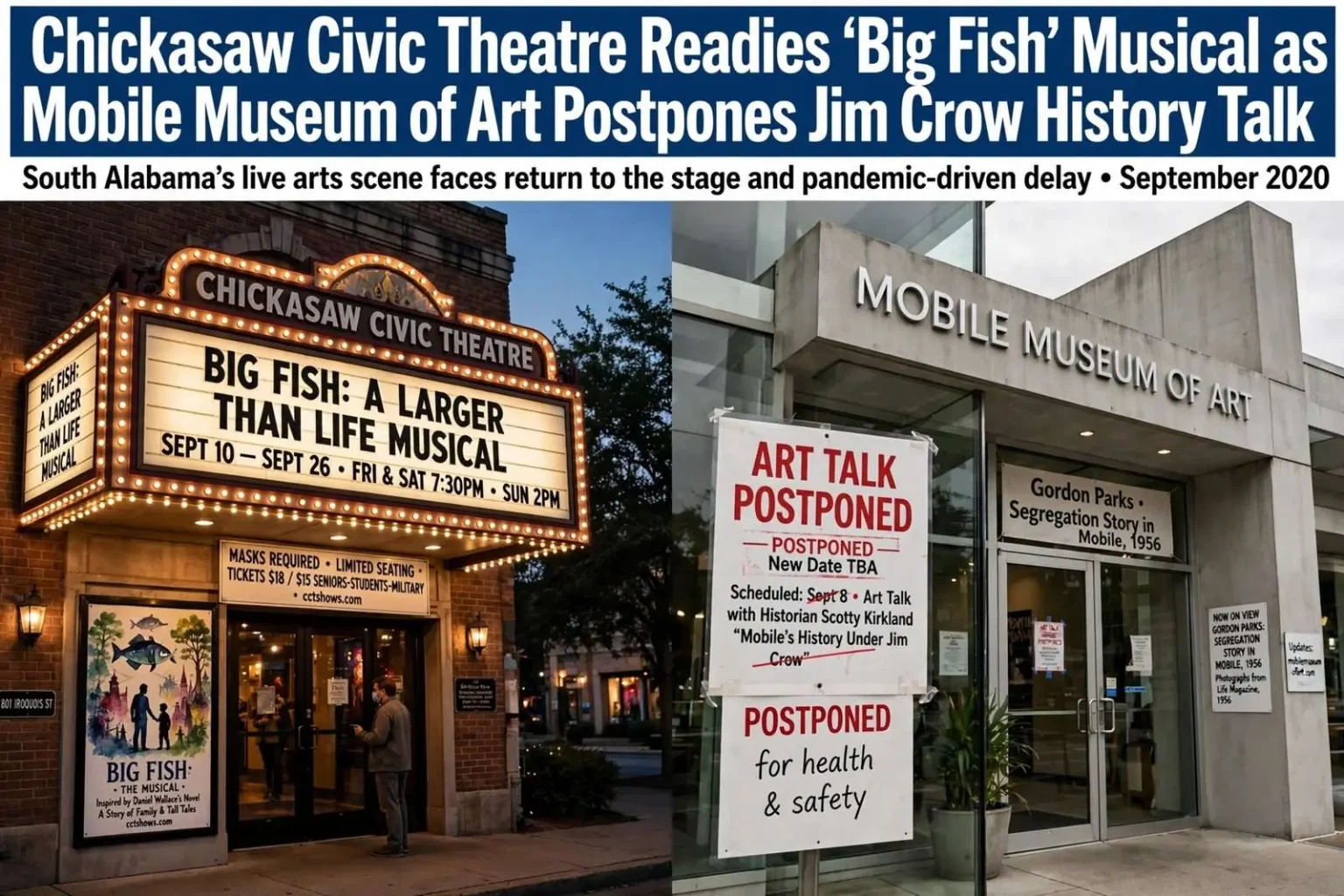
Chickasaw Civic Theatre (CCT) is set to debut its production of “Big Fish: A Larger Than Life Musical” on Sept. 10, after a run of scheduling setbacks tied to the pandemic. The show, inspired by Daniel Wallace’s 1998 novel of the same name, follows a father-son relationship woven through tall tales and larger-than-life storytelling. The story reached wide audiences roughly two decades ago through Tim Burton’s film adaptation, and the stage musical brings that same exploration of family and identity to the Chickasaw playhouse at 801 Iroquois St.
The production was originally scheduled to run in spring 2020 before being pushed to August 2020 and then to its current September date, reflecting the repeated disruptions community theaters across the region have faced since the pandemic began. Performances run through Sept. 26, with Friday and Saturday shows at 7:30 p.m. and Sunday matinees at 2 p.m.
To keep its plans flexible amid ongoing public health conditions, CCT has opted not to offer season tickets this year. According to the theater, it is instead developing some form of reward for loyal patrons who attend all five productions in the current season. Other precautions include limiting seating to half the house, spacing audience groups through ushering, and asking attendees to wear masks inside the venue. Holding a ticket is treated as an attendee’s agreement to those guidelines. Tickets are $18, or $15 for seniors, students and active military members. More information is available by calling 251-457-8887 or visiting cctshows.com.
Meanwhile, the Mobile Museum of Art (MMoA) has postponed a previously scheduled Sept. 8 Art Talk that was to feature historian Scotty Kirkland discussing Mobile’s history under Jim Crow. The talk had been planned in conjunction with the museum’s current Gordon Parks exhibit, “Segregation Story in Mobile, 1956.” In announcing the postponement, the museum cited the health and safety of visitors, students and others involved in the event. No makeup date has been announced. The talk had been slated to take place at the University of South Alabama’s Laidlaw Performing Arts Center.
Kirkland currently serves as coordinator of exhibitions, publications and programs at the Alabama Department of Archives and History. He studied at the University of South Alabama and previously worked as curator of history for the History Museum of Mobile from 2011 to 2015. More information on the museum’s programming is available at mobilemuseumofart.com.
Together, the two developments illustrate how deeply the pandemic has continued to shape scheduling for South Alabama’s arts and cultural institutions well into its second year, even as venues like CCT work to bring live audiences back into their seats.
This story unfolds across the distinctive landscape of South Alabama, a region defined by its pine forests, winding rivers, and Gulf Coastal Plain geography. The area’s communities—from the port city of Mobile to the agricultural heartlands of the Black Belt—share interconnected economies and histories shaped by timber, agriculture, shipping, and more recently, aerospace and advanced manufacturing. Local governance across county lines often coordinates on regional planning, workforce development, and infrastructure projects that affect residents throughout the southern tier of the state. The geography itself shapes daily life: low-lying coastal plains face hurricane exposure, while inland counties contend with river flooding and rural transportation challenges. Understanding the setting helps explain why local decisions carry weight far beyond municipal boundaries.
Education across South Alabama spans a network of public school districts, community colleges, and universities serving diverse student populations. The University of South Alabama in Mobile anchors higher education with medical, engineering, and marine science programs, while Troy University, Faulkner University, and Spring Hill College provide additional four-year options. The Alabama Community College System—including Coastal Alabama, Bishop State, Reid State, and Lurleen B. Wallace Community Colleges—delivers workforce training, dual enrollment, and transfer pathways. K-12 districts navigate state accountability measures, teacher recruitment challenges, and facility needs across urban, suburban, and rural settings, with local tax referendums often determining supplemental funding for programs and capital improvements. Partnerships between schools, employers, and nonprofits aim to keep opportunity tied to place, so that graduates can build careers without leaving the region.
Healthcare delivery in the region contends with the dynamics of a largely rural service area anchored by regional medical centers. USA Health’s University Hospital and Children’s & Women’s Hospital in Mobile provide tertiary care, while community hospitals in Baldwin, Escambia, Monroe, Clarke, and other counties serve as critical access points. The expansion of telehealth, federally qualified health centers, and rural health clinics addresses provider shortages that have long challenged underserved areas. Public health departments coordinate on immunization, disease surveillance, maternal health, and emergency preparedness, often in partnership with the Alabama Department of Public Health and federal HRSA-supported programs. Access to care remains a defining issue for the region, influencing everything from economic development pitches to quality-of-life rankings that prospective residents weigh when deciding where to live and work.
The cultural fabric of South Alabama weaves together Indigenous heritage, colonial-era settlements, Civil War history, civil rights milestones, and enduring folk traditions. The region’s Mardi Gras traditions—centered in Mobile as the birthplace of North American Mardi Gras—coexist with community festivals celebrating shrimp, peanuts, watermelons, cattle, and maritime heritage. Historic districts in Mobile, Fairhope, Monroeville, and elsewhere preserve architectural character while supporting heritage tourism. The Alabama Historical Commission, local preservation societies, and the Alabama Trust for Historic Preservation work to protect significant sites. Oral history projects and university archives document the stories of communities shaped by agriculture, timber, shipbuilding, and the ongoing negotiation of identity in a rapidly changing South. These traditions not only enrich daily life but also anchor a sense of place that newcomers and longtime residents share.
Sport occupies a central place in South Alabama’s community life, from Friday-night high school football that draws whole towns to the sidelines, to college athletics at the University of South Alabama and across the state. Mobile’s longstanding role as a cradle of football talent—producing legends who went on to the professional ranks—is a point of regional pride, reinforced by events like the Senior Bowl, which has showcased NFL hopefuls in the city for decades. Youth leagues, recreation departments, and booster clubs sustain participation at the grassroots level, while the area’s coastal setting supports fishing tournaments, regattas, and beach athletics that reflect the local environment. The economic and social lift from sporting events—hotel stays, restaurant traffic, and civic visibility—makes athletics a quiet but steady contributor to the regional identity and to the small-business economy that surrounds game days.
Animal welfare organizations across South Alabama operate with limited resources and a steady stream of need. Municipal animal shelters in Mobile, Baldwin, and neighboring counties manage intake, adoption, and reunification efforts, often partnering with nonprofit rescues that provide foster networks, spay-neuter assistance, and transport to out-of-region adopters. Volunteer-driven groups fill gaps that public funding cannot, relying on donations, fundraisers, and grant support to keep operations running. The Gulf Coast’s position as both a tourist destination and a growing residential region has increased demand for pet services, while rural areas contend with stray and feral populations that strain capacity. Community education on responsible ownership, microchipping, and low-cost veterinary care has emerged as a practical lever for reducing shelter overcrowding. Efforts like local giving campaigns demonstrate how resident participation can translate directly into care for animals that might otherwise go without.
As this situation continues to develop, stakeholders across the affected communities will monitor outcomes and adjust responses accordingly. The interconnected nature of South Alabama’s counties means that decisions in one jurisdiction often ripple outward, affecting neighbors in ways that underscore the value of regional communication and coordinated planning. Residents seeking to stay informed can engage with local government meetings, school board sessions, and community forums where these matters are discussed in public. The ongoing dialogue between officials, experts, and citizens reflects the democratic processes through which the region navigates change while preserving the character and resilience that define its communities. Continued attention from local news outlets helps ensure that decisions remain transparent and that the people most affected have the information they need to participate in shaping what happens next.
Economic activity in South Alabama reflects both deep-rooted industries and emerging sectors. The region’s forest products industry remains a cornerstone, while the Port of Mobile anchors global trade connections. Aerospace manufacturing has grown significantly around the Mobile Aeroplex at Brookley, and automotive suppliers feed assembly plants across the Southeast. Workforce development initiatives through community colleges and the Alabama Industrial Development Training program aim to align skills with employer needs. Broadband expansion and highway improvements—including the I-10 Mobile River Bridge project and I-65 corridor enhancements—address longstanding connectivity gaps that affect business recruitment and quality of life. Small businesses, agriculture, tourism, and the service sector round out a diverse regional economy that has weathered national downturns through a mix of resilience and adaptation.
The environmental context of South Alabama is inseparable from its waterways and Gulf coastline. The Mobile-Tensaw Delta, one of the nation’s most biodiverse river systems, filters freshwater into Mobile Bay while supporting fisheries, recreation, and flood mitigation. Coastal communities face recurring hurricane exposure and long-term sea-level considerations, shaping building codes, insurance markets, and emergency planning. Conservation efforts by organizations like the Alabama Coastal Foundation, The Nature Conservancy, and state agencies work to preserve critical habitat while balancing development pressures. Water quality monitoring, oyster reef restoration, and living shoreline projects represent collaborative approaches to sustaining the natural resources underpinning both ecology and economy. Inland, working forests and farmland form the backbone of a rural landscape where land use decisions carry generational significance.