Chickasaw Civic Theatre Sets Five-Show Lineup for 2014-15 Season
Chickasaw Civic Theatre has announced its 2014-15 season, featuring 'Shrek the Musical,' 'Driving Miss Daisy,' 'The Light in the Piazza,' 'Twelfth Night' and 'Mary Poppins.'
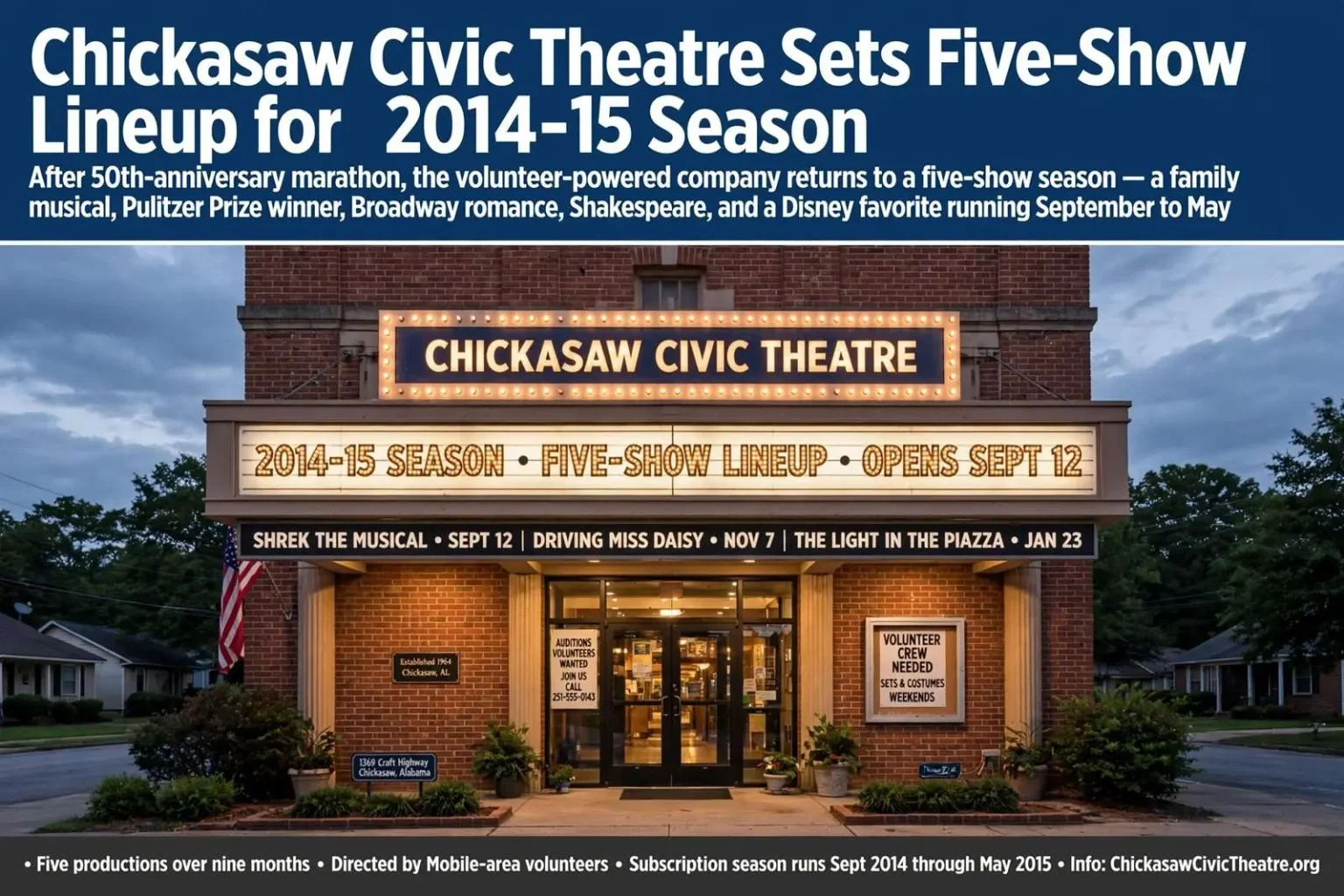
Chickasaw Civic Theatre has unveiled its lineup for the 2014-15 season, returning to a traditional slate of five productions after a supersized 50th anniversary year that featured nearly three times that number of shows. The schedule balances the troupe’s crowd-pleasing instincts against its artistic ambitions — a family musical, a Pulitzer Prize winner, a contemporary Broadway romance, Shakespeare and a Disney favorite — staged across nine months by directors drawn from the Mobile area’s deep bench of community theater talent.
For audiences, the return to five shows means a season that unfolds at a sustainable pace: one production opening roughly every two months, each with the rehearsal runway a volunteer company needs, and a calendar that stretches from the start of the school year in September to the end of May. For the company itself, the pared-down slate is a breather after an anniversary year that demanded a marathon of production from its volunteers.
The theater sits in Chickasaw, a small city along U.S. Highway 43 north of Prichard whose name and civic identity run deep in Mobile County history — a company town for the former Chickasaw Shipbuilding and Steel operations that later incorporated as its own municipality. Its civic theater is among the oldest continuously operating community companies in the region, and generations of Mobile-area performers made their first appearances on its stage.
Community theater runs on volunteers, and the arithmetic of a season is set by what those volunteers can sustain. Sets are built in evenings and weekends, costumes sewn at kitchen tables and rehearsals held after work — which is why the 50th-anniversary slate of nearly fifteen shows was such an extraordinary effort, and why the return to five productions reads as both a scaling back and a practical reset.
Opening With an Ogre
The season opens Sept. 12 with “Shrek the Musical,” the award-winning stage adaptation that follows a gruff, swamp-dwelling ogre on his unlikely path toward love and self-acceptance. Based on the 2001 DreamWorks film and William Steig’s picture book, the musical ran more than a year on Broadway and earned multiple Tony nominations, and its mix of fairy-tale satire, pop score and family appeal has made it one of the most requested titles at community theaters nationwide.
Director Scott Morlock, who has previously staged crowd-pleasing productions of “Scrooge: The Musical,” “Aladdin,” “Pinocchio” and “Kitty Cats” for Mobile-area audiences, will lead the musical through a three-weekend run. Morlock’s résumé points toward the family audience that “Shrek” draws — parents who know the movie, children meeting the story for the first time and the technical demands of a show whose cast runs from leads in heavy prosthetics to a chorus of fairy-tale characters.
The anniversary year also demonstrated the company’s range. A slate that large requires multiple directors, overlapping casts and a production pipeline running nearly continuously — the kind of schedule that builds depth in a troupe’s bench. The 2014-15 season draws on that accumulated depth, with directors whose names Mobile audiences have seen attached to productions across the area’s community stages for years.
“Shrek the Musical” presents the season’s largest technical lift. The title character performs in layers of prosthetic makeup, a cross-dressing dragon carries a showpiece ballad, and the cast requires a dozen fairy-tale characters plus a singing ensemble — a roster the company will fill from across the Mobile area, likely holding auditions in the weeks after the season announcement with a September opening looming.
Opening the season with a title like “Shrek” is also a box-office strategy. Family musicals with name recognition fill seats in September, build the subscription base that carries a company through its edgier offerings and give community theater the cash cushion that riskier programming requires later in the year.
Pulitzer on the Eastern Shore Road
“Driving Miss Daisy” follows on Nov. 7, opening a two-week run of Alfred Uhry’s Pulitzer Prize-winning play about the decades-long friendship between an elderly Southern woman and her African-American driver. Set in Atlanta across a quarter century that spans the civil rights era, the play compresses American history into a two-character relationship, and its popularity at the community level has hardly faded in the decades since it premiered Off-Broadway.
The story, which enjoyed two separate Broadway runs and was adapted into a film that won the 1989 Academy Award for Best Picture, remains one of the most frequently staged works in regional theater. Its small cast — the title characters and Daisy’s son Boolie — and single set make it an economical production, while the material asks more of its actors than most community theater audiences see in a season.
The November drama asks for something else entirely: two actors capable of carrying an entire relationship across 25 years of scenes. Productions of “Driving Miss Daisy” succeed or fail on the chemistry between the leads, and casting it is the director’s central task. The play’s endurance on community stages owes to that intimacy — no spectacle required, just an audience willing to watch two people change over a quarter century.
Leonora Harrison directs the Chickasaw production. November’s slot gives the play the contemplative spacing it needs — a drama between two musicals, timed for the weeks when Gulf Coast audiences are between Mardi Gras preparations and holiday obligations.
Beginning Jan. 23, 2015, “The Light in the Piazza” brings a two-weekend run of the musical by Craig Lucas and Adam Guettel, which premiered on Broadway roughly a decade before the Chickasaw staging. The show tells the story of an American mother and daughter whose tour of Italy leads to an unexpected romance, and it stands as one of the most admired American musicals of its era — a lush, through-composed score by Guettel, the grandson of Richard Rodgers, set against a book that probes the limits of protection and love.
It is the season’s reach — a recent, technically demanding Broadway title that community companies stage precisely to show what they can do. Stacy Driskell, a Mobile vocalist known for her performances with Mobile Opera, will direct, bringing a musical theater background of the kind the show’s score demands from both its cast and its music director.
“The Light in the Piazza” will test the company’s musical depth in a different direction. Guettel’s score runs through Italian and English, demands sustained legato singing from its leads and leaves little room for the amplification shortcuts smaller houses sometimes rely on. Casting a mother-daughter pair who can both sing it is the show’s known challenge, and Driskell’s opera background signals the company’s intent to meet it.
Shakespeare’s “Twelfth Night” takes the Chickasaw stage next, opening Feb. 27 and running through March 8 under the direction of Bill Watts. The comedy, centered on shipwrecked twins, mistaken identities and tangled romance, ranks among the most frequently produced of the playwright’s works — a choice that puts classical material on a community stage while remaining one of the most accessible entries in the canon, its plot of disguise and misdelivered letters as nimble as any sitcom’s.
Closing With a Nanny
The season is scheduled to close with “Mary Poppins,” set to open May 29 for a three-weekend run pending the availability of performance rights. The stage adaptation of the 1964 film — and of P.L. Travers’s books — layers new songs by George Stiles and Anthony Drewe onto the Sherman Brothers classics, and its flying nanny, chimney-sweep dance numbers and sprawling cast make it one of the most technically ambitious titles a community theater can attempt.
“Twelfth Night,” meanwhile, gives the company’s comic actors room to work. The play’s Viola-and-Sebastian twins plot, Malvolio’s gulling and the drunken household of Sir Toby Belch have made it a favorite of college and community companies alike, and a March run fits Shakespeare comfortably between the winter musical and the spring finale — provided the company can field the cross-gartered yellow stockings its best-known scene requires.
Mary Jo Alsip will direct the family favorite about a magical nanny who transforms the lives of the children and household she serves. The caveat about performance rights is standard practice: Disney-stage musicals are licensed in limited numbers per region and per season, and a company announces the title with the qualifier until the contract is signed. The May closing date puts the production after Mobile’s Mardi Gras season — a deliberate bit of scheduling in a city whose theaters go dark, or nearly so, every Carnival.
Chickasaw Civic Theatre, based in Mobile County, has staged community theater productions for decades and draws audiences from throughout the greater Mobile area. Founded half a century ago, the company has survived the forces that shuttered many of America’s small theaters — television, changing neighborhoods, volunteer burnout — and its 50th-anniversary celebration reflected the local loyalty that keeps a community stage alive: dozens of productions, returning performers and audiences with decades of memories in the same seats.
Ticket and season information is expected to be released closer to each production’s opening date, with the company’s traditional arrangements — evening performances on weekends and matinees for family titles — expected to carry over. For Mobile-area theatergoers, the five-show slate offers a familiar rhythm: a musical to open the fall, a drama for the holidays’ edge, a romance for the new year, the Bard for late winter and a family finale as school lets out.
What the season’s shape shows most clearly is a company in its sixth decade still testing itself. A Pulitzer winner, a modern Broadway score and Shakespeare are not safe programming for a volunteer company, and pairing them with two sure-fire family musicals is the balance every community theater strikes between art and box office. The 2014-15 season, spread from September to May, is the plan for striking it once more.