Chickasaw Families Turn Out for 4th Annual Back to School Bash and National Night Out
Chickasaw's 4th annual Back to School Bash paired inflatables and games with National Night Out, connecting kids with first responders before school.
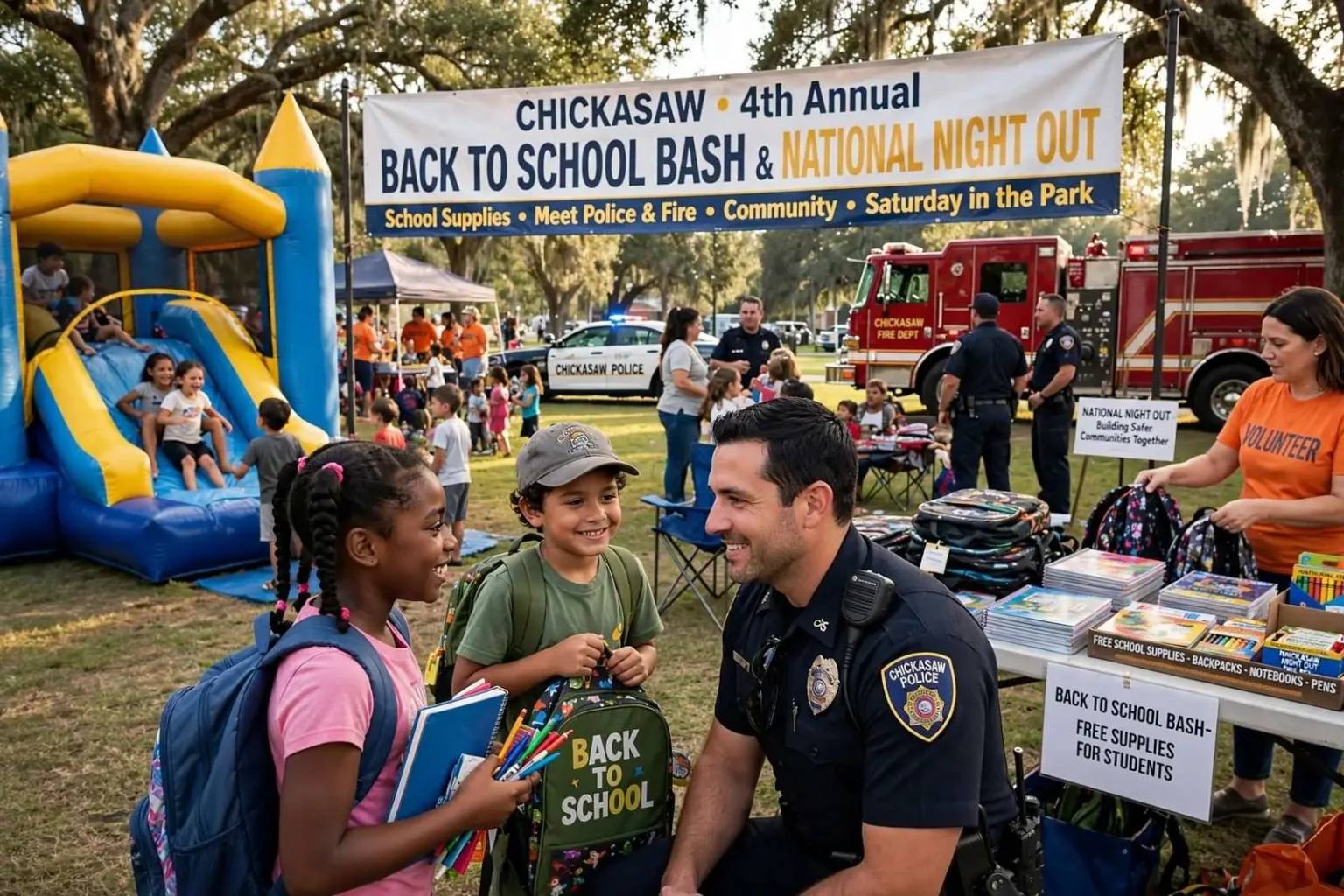
Chickasaw families filled the city park Saturday for a pair of back-to-back community events: the fourth annual Back to School Bash and the city’s National Night Out celebration, both aimed at sending students into the new school year on a positive note. The combination turned a summer Saturday into the small city’s biggest community gathering of the season, with the morning’s school-readiness festivities flowing straight into an evening built around the relationship between residents and the officers who serve them.
Chickasaw, the small city of roughly 6,000 tucked between Prichard and Saraland in northern Mobile County, has made these combined civic events a signature of its calendar. The city’s park grounds were packed with inflatable slides, jumping castles, and games, and children also had the chance to meet Chickasaw police officers and firefighters in person as part of National Night Out — the national community-building campaign that brings residents and first responders together in parking lots, parks, and front yards on summer evenings across the country.
National Night Out, observed by thousands of communities nationwide, was founded on a simple premise: communities that know their officers are safer and safer communities that know their neighbors. In Chickasaw’s version, the formality is stripped away. Children climb on the inflatables, then wander over to a fire truck or a patrol car; the officers and firefighters staffing the event are the same ones who respond to the city’s calls, and the conversations that happen over snow cones and bounce houses are the ones that community policing depends on the rest of the year. For a city Chickasaw’s size, where the police and fire departments are neighbor-scale institutions, the event functions as both celebration and working relationship-building.
The Back to School Bash, now in its fourth year, brought the practical side of the evening: sending students toward the first day of class with supplies, encouragement, and the sense that the whole city is invested in their year ahead. Cities across Mobile County stage similar back-to-school events every late summer, but Chickasaw’s pairing of the bash with National Night Out folds the school-year sendoff into the city’s broader civic identity — the message that school readiness and community safety are the same project, run by the same people.
Pulling the Community Together
Chickasaw Recreation Director Kathy Couey said the event was organized to pull the whole community together before classes resume, and she credited area churches, the city, and the police and fire departments with joining forces to put it on. The coalition is characteristic of how Chickasaw operates — a small municipal government working hand in hand with congregations and civic groups, pooling what each has: the city’s park and recreation machinery, the churches’ volunteers and outreach, and the departments’ personnel and equipment.
“They’re important to us in Chickasaw, and we want them to have a good time and get ready to learn in school,” Couey said of the city’s young people — the sentence that explains why a recreation director spends a summer Saturday coordinating inflatable rentals and volunteer schedules. The stated goal runs from fun to readiness: a child who ends the summer knowing the officers in town, having met the firefighters, and having picked up school supplies alongside his neighbors starts the year with a foundation that no single supply list captures.
Young attendees appreciated the atmosphere, too. Talaysia Lyles, a fifth grader at Ella Grant Elementary School, said she was glad to have a safe place to have fun — a statement that carried more weight than the person saying it perhaps intended. Violence touching children as young as nine and ten years old has been an ongoing concern across Mobile County, and the leaders who stage events like Chickasaw’s do so against that backdrop: the inflatables and games are offered precisely because safe, supervised places for children cannot be taken for granted anywhere in the county.
Ella Grant Elementary, the school Talaysia attends, is one of the anchors of Chickasaw’s community life, serving the city’s elementary students within the Mobile County Public School System. The city’s schools are its shared civic ground — the place where the children who met police officers at the park on Saturday will spend their weekdays, and the place the community’s back-to-school investment is aimed. Chickasaw students returned to school on August 10, a mid-August start that is standard across Mobile County’s public schools, which puts the bash in its final weeks-of-summer slot: late enough to matter for preparation, early enough to shape how the last stretch of break is spent.
The safety concern Talaysia’s remark touched on is not abstract in the communities around Chickasaw. Northern Mobile County — Prichard, Chickasaw, the Saraland borderlands — has seen generations of youth violence concerns, and the small cities there have responded with exactly the kind of programming Saturday’s events represent: recreation departments running activities, churches opening their halls, police departments making themselves familiar faces rather than emergency ones. The logic is preventive at its core. A child who spends a summer Saturday jumping castles with the city’s officers is building the trust that community policing requires, and a family that spends it in the park is meeting the network — churches, departments, the recreation staff — that the community counts on when harder days come.
The fourth annual staging of the bash also speaks to durability. Community events that repeat build expectations and attendance year over year; families plan around them, sponsors and volunteers return, and the event becomes part of the city’s rhythm. Chickasaw’s combination of school sendoff and National Night Out has now held that rhythm for four consecutive summers, growing from an idea into an institution — the day, as Couey’s framing put it, when the city pulls itself together before the school year begins.
By the time the inflatables came down Saturday evening, the city had accomplished what the double bill set out to do: students left with supplies and school on the calendar for August 10; residents left having shaken the hands of the officers and firefighters who serve them; and the children left, in the words of one fifth grader, with a safe place to have fun — which, in the Chickasaw organizers’ accounting, is the first step toward being ready to learn.
National Night Out’s history gives Chickasaw’s participation its frame. The campaign began in 1984 as a national effort to build police-community relationships and neighborhood camaraderie, and it has grown into an annual observance involving millions of residents across thousands of communities, typically held on the first Tuesday of August — though communities schedule their observances on the date that fits their calendars. The format varies widely: block parties, cookouts, flashlights walks, and park festivals like Chickasaw’s, all built around the same core interaction of residents meeting first responders outside of emergencies. In small cities, the effect is amplified by scale — at an event like Saturday’s, a child who meets an officer has very likely met the officer who patrols the street where she lives.
Chickasaw’s police and fire departments, for their part, gain as much as the residents do. Small municipal departments operate on familiarity — their officers know the city’s few square miles and many of its families by name — and events like this one deepen the informal intelligence that community policing runs on. Officers staffing a bounce house line hear what residents are worried about; firefighters showing children the engine recruit the good will that volunteer recruitment and millage votes quietly depend on. The evening’s fun is the medium, and the relationship is the product.
The Back to School Bash’s supply-and-readiness mission likewise fits the county’s late-summer pattern. Across Mobile County each August, churches, nonprofits, and municipalities stage giveback events that put backpacks, notebooks, and uniforms into students’ hands — a quiet necessity for families for whom back-to-school shopping strains an August budget. Chickasaw’s version folds that practical help into a celebration, so that receiving supplies is not a line outside a church but a festival in the city park, with the whole community present. The dignity of that format is part of its design, and part of why the event has drawn families back for four consecutive years.
The recreational machinery behind the event belongs to Couey’s department, which runs the city park’s year-round programming — leagues, camps, and the summer schedule that the bash culminates. Recreation departments in cities Chickasaw’s size operate on thin margins and heavy volunteer support, and their events function as the connective tissue of the community: the occasions when the city gathers, the kids run until dark, and the institutions — city hall, the churches, the departments — stand together in one place where everyone can see them.
When Chickasaw students walked into their classrooms on August 10, they carried more than the supplies collected at Saturday’s bash. They carried the memory of a summer Saturday when their city filled a park for them — officers and firefighters and church volunteers and a recreation director who considers them, in her own words, important to Chickasaw. The fifth grade class Talaysia Lyles is entering, and every class behind it, will spend the year inside the community that Saturday built.