Chickasaw Fire Truck Hit on I-65 Becomes a Countywide Warning to Drivers
A vehicle crashed into a Chickasaw fire engine working an I-65 scene — no firefighters hurt, and Mobile County departments say slow down.
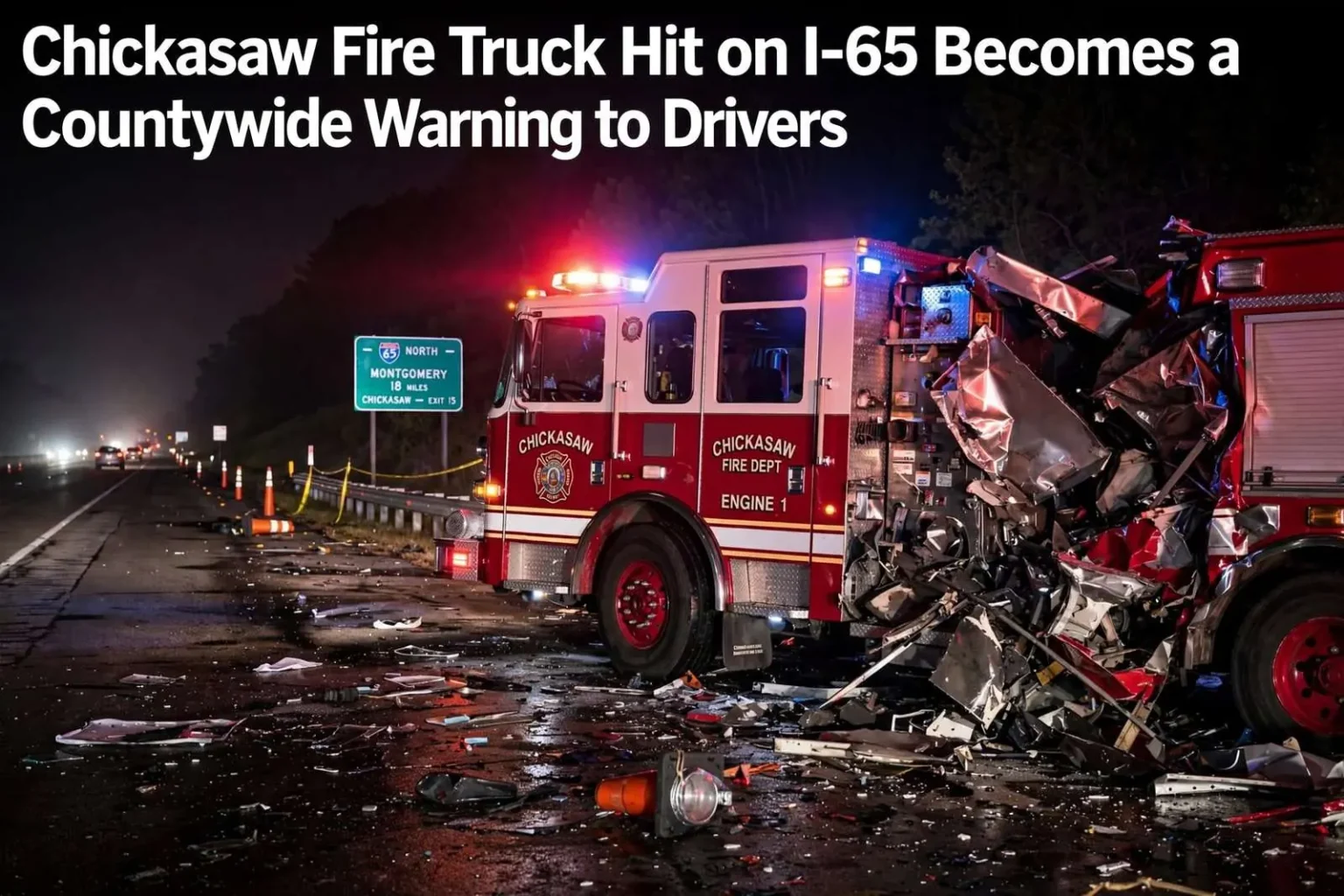
Chickasaw firefighters escaped injury Friday night only to see their own truck become the cautionary tale: a vehicle slammed into their fire engine while the crew worked another crash scene on Interstate 65. The Chickasaw Fire Department shared photos of the damage Saturday morning, saying the truck was struck by another vehicle while crews tended to an earlier incident. No firefighters were hurt, but the driver of the other vehicle had to be taken to a hospital.
The scene that produced the second crash is one firefighters across Alabama know well: an engine positioned to protect a working incident, emergency lights strobing against the dark, and traffic flowing past at highway speed only feet away. Interstate 65 carries some of the heaviest traffic volumes in southwest Alabama through the Chickasaw area, and its shoulders become improvised work zones every time a wreck disables a vehicle. When a driver fails to slow or move over, the responders become the next victims.
The Warning That Spread
The post spread quickly across Mobile County’s firefighting community, drawing hundreds of shares, including from the Theodore/Dawes, Creola, and McIntosh fire departments. Firefighters used it to hammer home a familiar message: slow down and give first responders room when passing scenes along the roadway. Each department that reshared the photos added its own endorsement of the same appeal, creating a countywide chorus within hours of the Saturday morning post.
That kind of rapid, department-to-department amplification has become the standard way the firefighting community addresses driver behavior after a near-miss. Departments document the damage, describe what their crews were doing when they were hit and let the images do the persuasive work. The Chickasaw post was effective precisely because the damage was to their own apparatus, proof that even a fully marked fire engine, parked with lights operating, is not protection enough against a driver who is not paying attention.
What the Law Requires
Alabama’s move over law exists for exactly these moments. The statute requires drivers approaching a stopped emergency vehicle, tow truck or other authorized vehicle with flashing lights to move over one lane when possible, and when a lane change is not possible, to slow to a speed that is safe for the conditions. Violations carry fines, and when a responder is struck, the legal consequences for the striking driver can escalate sharply. Yet enforcement after the fact is cold comfort to crews working in traffic, which is why fire departments invest so heavily in publicizing the rule itself.
The physics involved are unforgiving. A vehicle traveling at interstate speed covers roughly 100 feet per second, and the closing distance between a passing car and a roadside scene leaves drivers a fraction of a second to react to lights, workers and apparatus. Fire apparatus parked at scenes is positioned deliberately, upstream of the work area, angled to deflect impact, but the tactic depends on the vehicle absorbing a hit rather than preventing one. The Chickasaw engine did its job as a shield; the department would rather not need it to.
The stakes are not hypothetical. In 2015, Grand Bay firefighter William Storey Jr. was seriously injured when he was struck by a vehicle while his crew responded to a traffic crash on I-10 before dawn. Storey’s injuries made the danger concrete for departments across the region, and his case is cited whenever responders discuss roadside safety in south Alabama. The Grand Bay incident and the Chickasaw strike share the same anatomy: responders at an earlier crash, traffic passing in the dark, and a driver who did not slow down or move over in time.
The Chickasaw department’s Friday night experience followed a pattern that repeats across the country every year. Nationally, strikes on emergency responders and their apparatus number in the hundreds annually, and the rescuers-protection movement, high-visibility gear, apparatus lighting upgrades, blocker vehicles and the move over laws themselves, has grown from that toll. Fire departments train their members to treat every roadside scene as a potential hazard zone, but training cannot control what approaching drivers do, which is where public awareness efforts like the Chickasaw post come in.
The aftermath and the Message
In the Chickasaw incident, no firefighters were hurt, which is the outcome every department hopes for when an apparatus is struck. The driver of the striking vehicle was transported to a hospital, and the crash that the crew had been working, the original incident on I-65, was still being handled as the second scene unfolded. The chain-of-events dynamic, one crash producing conditions for another, is the core hazard of roadside response, and it is why agencies stage apparatus upstream and why traffic incident management has become its own discipline in emergency services.
The hundreds of shares the Chickasaw post drew, from Theodore/Dawes, Creola, McIntosh and departments beyond, reflect both solidarity and strategy. Fire departments in Mobile County operate independently but train together and face identical risks on the interstate corridors that thread the county, I-65, I-10 and the Causeway. A warning that circulates among them reinforces the shared standard: when passing a scene, move over or slow down, every time, even when the lane seems clear.
A Reminder With Personal History
For Mobile County’s firefighting community, the reminder carries a name and a face. William Storey Jr.’s 2015 injuries on I-10 remain a defining local example of what happens when a driver fails to yield to a working scene, and his case helped galvanize the region’s emphasis on responder safety in the years since. The Chickasaw department’s post stands in that line of warnings, less costly this time, but pointing to the same conclusion.
The lesson offered to drivers is simple and testable: when you see flashing lights ahead on the interstate, whether fire, police, EMS or tow operators, move over a lane if you safely can, and if you cannot, slow down well below the limit and pass with attention fully on the road. The Chickasaw firefighters whose engine absorbed Friday night’s impact went home uninjured because their truck took the hit for them. The next crew working a crash scene on I-65, or any highway in south Alabama, is asking for the same protection from the drivers who pass.
Interstate 65 through the Chickasaw area is one of the busiest and most consequential stretches of highway in southwest Alabama. The interstate runs north from Mobile toward Montgomery, carrying commuter traffic, commercial freight and the heavy flow of Gulf Coast travelers, and its junction with I-165 and the connections toward the city’s northern suburbs concentrate traffic in exactly the corridor where the Chickasaw Fire Department responds. Crashes on this stretch are frequent enough that area departments treat interstate incidents as a routine part of their workload, with all the roadside hazards that entails.
Responding to an interstate crash requires a different posture than a neighborhood call. Apparatus must travel at higher speeds to reach the scene, position themselves against live traffic on arrival and operate on shoulders and travel lanes that were carrying highway-speed vehicles moments before. Fire departments use blocker tactics, parking the engine or a rescue unit between the working area and oncoming traffic so that, if a driver fails to yield, the apparatus takes the impact instead of the people. That is precisely the role the Chickasaw engine was playing when it was struck Friday night, and the crew’s escape from injury is a direct result of that positioning.
How the Response Community Watches Itself
The speed with which the Chickasaw post moved through the county’s fire departments illustrates the communication network that connects them. Theodore/Dawes, one of the largest volunteer-based departments in the county, Creola to the north, McIntosh to the north near the Washington County line, and departments across the area all face the same interstate exposure, and their social media feeds function as a shared early-warning board for hazards, equipment lessons and safety appeals. When one department’s engine is struck, the others treat it as a preview of their own risk.
That solidarity has practical roots. Mobile County’s fire service is a mix of municipal departments and volunteer fire organizations that routinely assist each other on multi-alarm incidents, and their members train together, purchase equipment cooperatively and advocate together in Montgomery for responder safety measures. A struck engine in Chickasaw is understood across the county as an injury to the whole system, narrowly averted this time.
The Persistent Problem of Driver Attention
Strikes on responders persist despite the move over law, increased lighting and years of public appeals, and the reasons have changed over time. In earlier decades the problem was primarily speed and alcohol; today, distraction from mobile devices has added a category of hazard that no amount of emergency lighting can fully counter. A driver looking at a phone does not see flashing lights until it is too late to change lanes, and departments have documented crash scenes where the striking driver never braked at all.
Fire departments have responded with both equipment and messaging: brighter LED warning systems on apparatus, automated flare deployment, high-visibility apparel and the steady drumbeat of posts like Chickasaw’s. The message is always the same because the behavior it addresses is always the same, and each new set of damage photos refreshes an appeal that drivers seem to need to see repeatedly. Friday night’s images, a heavy fire engine shoved and damaged by a passing vehicle, make the abstract statistic of responder strikes concrete for anyone scrolling past.
Working a Scene Safely
The next time a crash disables a vehicle on I-65 near Chickasaw, the sequence will repeat: firefighters will arrive, position their apparatus to shield the scene, light it up and begin work with traffic streaming past. Their protection, as Friday night showed, comes from the engine’s steel and their own discipline, but the margin depends on the drivers who pass choosing to move over and slow down. The Chickasaw Fire Department’s Saturday morning post, and the hundreds of firefighters who shared it, are asking for that choice before the next set of photographs has to be taken.