Chickasaw Police: Student Who Collapsed at High School Did Not Overdose on Fentanyl
Chickasaw police say a high schooler who collapsed in class did not overdose on fentanyl; doctors are still determining what caused the collapse.
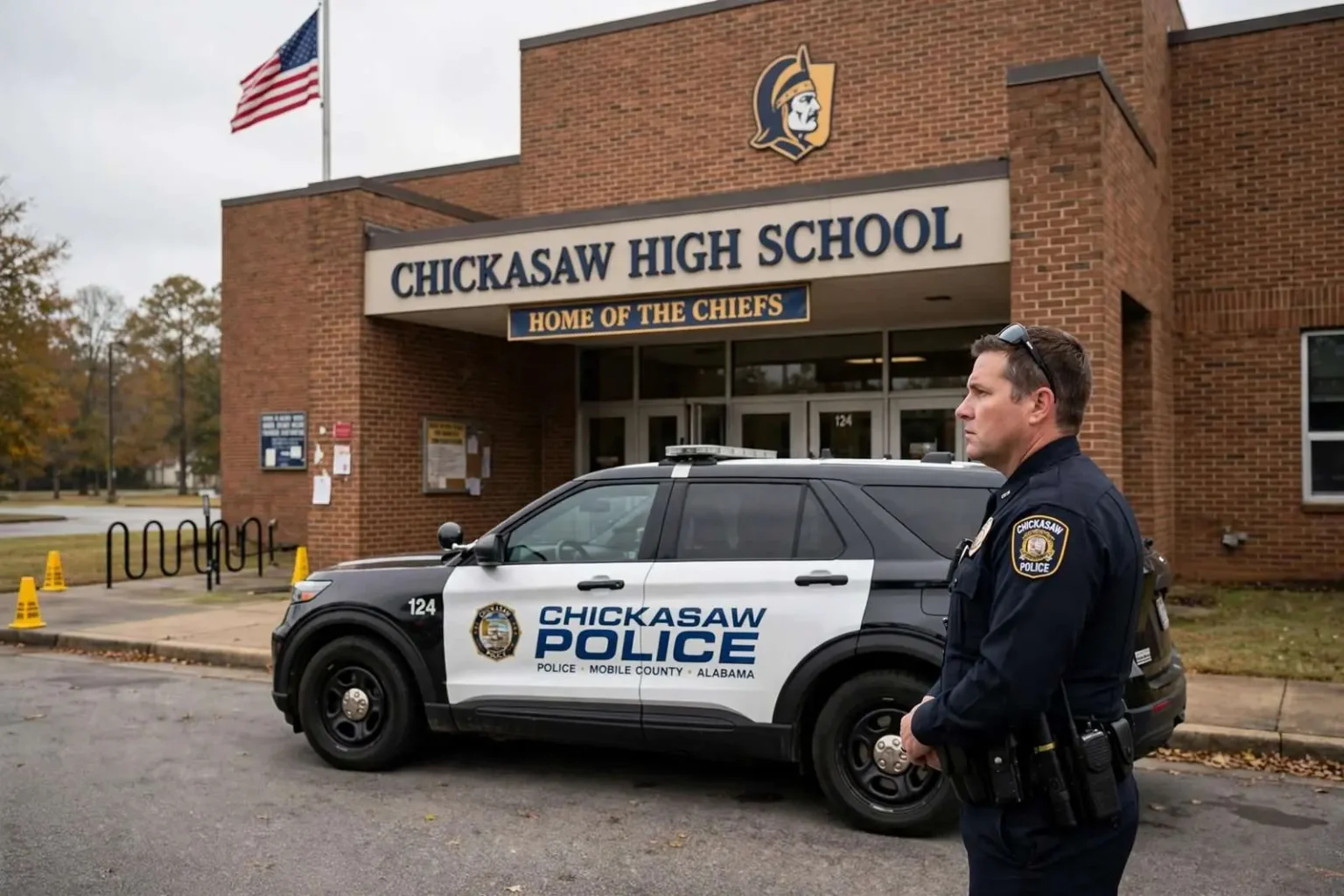
A Chickasaw High School student who collapsed in class did not overdose on fentanyl, according to Chickasaw police, who walked back an earlier suspicion that a pill containing the drug was behind the incident. The reversal came after doctors at the hospital where the teen was treated determined that fentanyl was not the cause of the collapse, though what did cause it remains under medical evaluation.
The scare began on Tuesday, Sept. 27, when officers were called to the school after a 10th grader passed out during class. Police said officers initially believed the 16-year-old had suffered an allergic reaction, until another student came forward and told them the teen had ingested a pill suspected of containing fentanyl before class began. Investigators believed the pill, if it existed, may have been taken in a school bathroom or hallway.
The school was placed on a soft lockdown while the student was rushed to a hospital, and the initial report set off alarm bells in the small Mobile County community, where the possibility of fentanyl inside a public school ranks among every parent’s worst fears. Doctors later determined the student had not overdosed on fentanyl. Police said physicians were still working to determine what caused the teen to lose consciousness.
A fast-moving morning
When a student collapses in a classroom, the first minutes belong to school staff. Teachers and school nurses are trained to check responsiveness and breathing, call 911 and, in many Alabama districts, administer aid within the limits of their training. Chickasaw police officers responded to the campus quickly, and the decision to transport the teen to a hospital came within the opening stretch of the response.
The informational turn came when a second student told officers that the 16-year-old had swallowed a pill suspected of containing fentanyl. That single report transformed the incident from a medical emergency of unknown origin into a potential poisoning case, and it triggered the more aggressive posture police and school officials adopted for the rest of the morning. Investigators worked to pin down whether the pill had been ingested in a bathroom or hallway before class, canvassing students and reviewing the school’s common areas.
The soft lockdown kept students in classrooms with exterior doors secured, a standard measure when police need hallway access and want to control movement through the building. It is a less restrictive posture than a full lockdown — instruction can often continue — but it halts normal passing periods and keeps the campus contained while officers work.
Why fentanyl suspicions demand immediate escalation
The mere suggestion of fentanyl changes the character of a school emergency. The synthetic opioid is extraordinarily potent — measured in micrograms rather than grams — and has driven a sharp rise in overdose deaths among adolescents nationwide, much of it tied to counterfeit pills pressed to look like common prescription medications. Health officials have repeatedly warned that pills obtained outside a pharmacy may contain fentanyl without the user’s knowledge.
That reality is why a report of a suspected fentanyl pill inside a school cannot wait for confirmation. First responders and hospital staff proceed on the assumption it is true, emergency protocols activate, and law enforcement begins working backward to find where the pill came from. Only later, once toxicology and physician evaluations come back, does the picture correct itself — which is what happened here.
Chickasaw police were candid about the reversal, acknowledging that their earlier suspicion — the one that raised community alarm — had not been borne out by the medical evidence. The clarification matters both for the family involved and for the wider school community, which spent the day processing the possibility that a lethal drug had circulated on campus.
What remains unknown
While fentanyl has been ruled out, the underlying cause of the collapse has not been publicly identified. Physicians were still working to determine why the teen lost consciousness, and police have not said whether the suspected pill was ever located or recovered, whether its reported ingestion actually occurred, or whether the student who provided the account was mistaken about what happened.
Those open questions are not unusual in cases that start with a secondhand report. Information provided in the first minutes of a crisis often proves incomplete or inaccurate, but it arrives at a moment when responders cannot afford to discount it. The gap between the initial report and the final medical determination is precisely the window in which a community’s fear runs highest.
The school district has not announced any disciplinary action or said whether the incident led to searches of the campus. Chickasaw police said the medical evaluation of the student’s condition remains the active thread, with results expected to clarify whether the episode was allergic, cardiac, related to another substance or something else entirely.
Chickasaw and its schools
Chickasaw is a small city in Mobile County, incorporated in its modern form in 2008 after decades as an unincorporated community north of Prichard. With a population of roughly 6,000, it is one of the smaller municipalities in the county, and its police department is correspondingly compact — which means an incident at the high school draws on nearly every officer the city has. Chickasaw City Schools, formed when the community broke away from the Mobile County Public School System, operate the high school that serves local students.
In a city that size, a report of a fentanyl-laced pill inside the school is not distant news; it travels by word of mouth within minutes and reaches most households before the lockdown has even lifted. That intimacy cuts both ways. It mobilizes support for a family in crisis quickly, but it also amplifies rumor, which is why the police department’s decision to publicly correct the record carried real weight locally.
Fentanyl and Alabama schools
The scare, even with its reassuring resolution, lands in a state that has watched fentanyl move steadily into its drug supply. Alabama law enforcement agencies have documented a dramatic increase in seizures of the drug, and public health officials have emphasized that counterfeit pills sold as Percocet, Xanax or oxycodone are a common vector for adolescent exposure. Several Alabama school systems have placed naloxone, the opioid overdose reversal drug, on campuses in recent years, and state legislators have debated measures aimed at fentanyl trafficking and at the counterfeit pills that carry it.
Schools across the Gulf Coast have responded with education campaigns urging students to assume that any pill not prescribed to them may contain fentanyl. The Chickasaw episode is a case study in how those warnings now shape behavior — a student who saw or believed they saw a classmate ingest a pill reported it immediately, and that report set the official response in motion within moments.
How the community processed the reversal
For parents who spent the day believing the worst, the police clarification offered relief with a residue of unease. The question that remains — what actually caused a healthy teenager to collapse in class — is a narrower one than the question the community began the day with, but it is still an open one, and open questions sustain concern.
School administrators have not detailed what communication went home to families during the incident, though districts in similar situations typically send rapid notifications once a lockdown is in place and follow-ups as facts firm up. The soft lockdown was lifted once officers concluded their initial work on campus, and the school day resumed on its normal schedule for the students who were never directly involved.
Lessons drawn by responders
Police agencies involved in incidents like this generally emerge with the same conclusion: treat the worst-case report as true until proven otherwise. Had the initial account been accurate, the minutes spent verifying it would have been minutes an overdose victim could not spare. The Chickasaw officers’ decision to escalate on the word of a single student — securing the school, rushing the teen to the hospital and beginning a drug investigation — is precisely the protocol public health officials advocate, even when the report later proves wrong.
The incident also illustrates the role classmates play in school emergencies. The account that changed the response came not from staff but from another student, and officials across the region have pressed the point that young people who report what they see — even imperfectly, even wrongly — are performing a service that responders depend on. The alternative, silence about a suspected pill, is the scenario every school drug prevention program is built to prevent.
Chickasaw police have not indicated whether any follow-up investigation into the reported pill is continuing now that fentanyl has been ruled out. The student’s condition and the eventual medical explanation for the collapse remain the outstanding questions in a case that, whatever its final answer, gave one small city a very long morning.