Chickasaw Residents Protest Ban on Speaking at City Council Meetings
Chickasaw residents protested a 2020 rule barring public comment at council meetings; a councilman moved to restore citizens' right to speak.
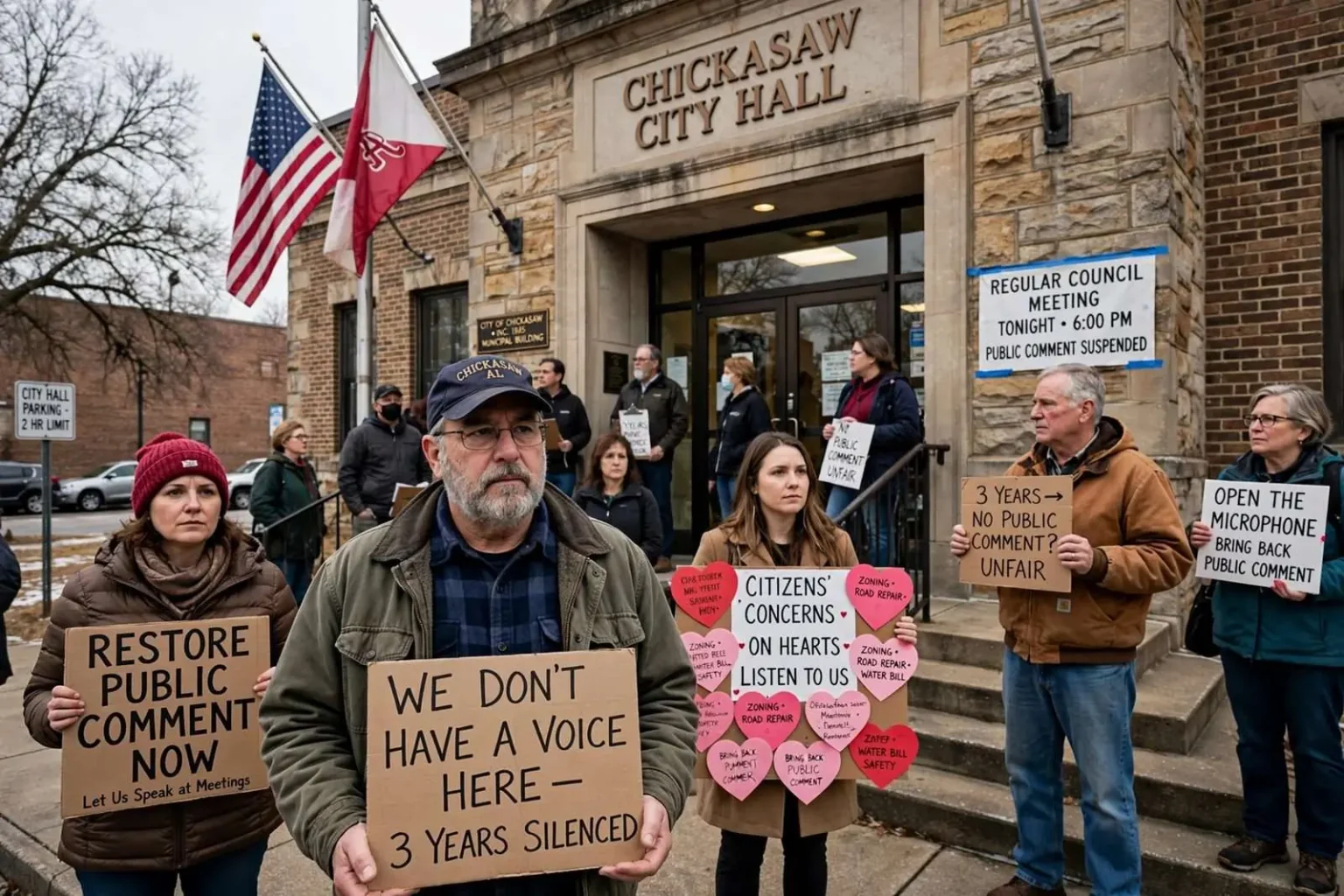
CHICKASAW, Ala. — Frustrated residents of Chickasaw took their complaint to the streets: they say they have been shut out of speaking at their own city council meetings for three years. Citizens rallied outside City Hall carrying signs, then brought the protest inside to a tense council session.
The restriction dates to 2020, when the council unanimously adopted a rule — originally justified by COVID-19 precautions — that ended open public comment during meetings. Three years later, with the pandemic long past, the rule remains in place, and a growing number of residents have decided it is time for it to go.
‘We don’t have a voice here’
“We don’t have a voice here,” said protester Bill Vallon. “We elected them to elect us and represent us and what we need and what we’re looking for.”
That sentiment ran through the crowd that gathered outside the municipal building before the council’s session — a demonstration organized not around a single issue but around the principle of access itself. Protesters said the ban has cut off the most direct channel between citizens and the officials they elected, leaving residents to wonder how their concerns reach City Hall at all.
Inside the chamber, the tension was unmistakable. Some attendees disregarded the rule during the meeting to speak out anyway, and one resident demanded the chance to address Mayor Barry Broadhead directly from the floor. The interruptions turned an ordinary agenda meeting into a public airing of the grievance the council had hoped its rule would prevent.
Broadhead defended the policy, saying residents can submit questions in advance through an online form and that officials are available before and after meetings. Under that system, he argued, citizens’ concerns still reach the city’s leadership — just not from the microphone during the meeting itself.
Protesters pushed back, saying submitted requests have gone unanswered. “Maybe,” said resident Joe Spinelli, “the mayor responds to one person, and maybe not to others.” The objection goes to the heart of the dispute: a submission system with no public accountability, critics argue, is not the same as a public forum where everyone can hear the question and hear the answer.
A councilman agrees it should change
The protest found an ally on the dais. Councilman Kendall Sterrett said the current policy plainly is not working and announced he would move to restore the previous practice allowing citizens to sign up and speak directly to the mayor and council. His position puts the question formally before the body rather than leaving it to simmer in the audience.
One resident tried a gentler tack ahead of the vote. Datokah Buley collected citizens’ concerns from Facebook and delivered them written on paper hearts for Valentine’s Day, hoping to “open the door to open conversation.” The gesture reframed the dispute in civic terms: not a fight with the city’s leadership, but a request for the relationship between citizens and council to function again.
The council was scheduled to vote on Sterrett’s motion at its February 28 meeting, and the measure needed a majority to pass. Until then, Chickasaw’s public-comment ban — adopted as a temporary pandemic measure — remained in effect, three years after the emergency that justified it had ended.
Why public comment matters
The debate in Chickasaw reflects a principle embedded in Alabama’s open-meetings tradition. State law requires that meetings of public bodies be open to the public, and while the specifics of citizen participation are left largely to local practice, the custom across most Mobile County municipalities is a public-comment period at each regular meeting — a stretch of the agenda where any resident can address the council directly and be answered in public.
Supporters of comment periods argue they serve purposes no form or sign-up sheet can replace. A public comment is on the record; it can be heard by every neighbor watching, by the press, and by the council members themselves at the same moment. Questions asked aloud get answered aloud, or the silence becomes its own statement. When that mechanism is suspended, residents say, the burden of communication shifts entirely onto the citizen — and the visibility of the response disappears entirely.
Chickasaw adopted its current rule as an emergency measure when councils across the country were reworking their procedures in 2020. Many municipalities restored open comment as restrictions eased; the fact that Chickasaw’s rule persisted became the protest’s central argument. If the precautions of 2020 no longer justify the policy, protesters asked, what does?
Small city, big question
Chickasaw is a small city in Mobile County’s northern tier, incorporated in 1945 around what had been a company town for the Chickasaw Shipbuilding Village during World War I’s industrial era. With a compact population and a part-time council, its municipal government operates on intimate scale — the kind of place where, historically, city hall felt like an extension of the living room. Residents who gathered outside its City Hall this month argued that something essential to that closeness was lost when the comment period ended.
The dispute also arrives as small cities across Alabama wrestle with the mechanics of resident engagement in a digital age. Online forms, social media pages and pre-meeting accessibility all offer new channels, and officials in Chickasaw have pointed to exactly those tools. The protesters’ counterargument is that digital channels supplement public dialogue rather than substitute for it — and that the test of any substitute is whether answers actually come back.
The February 28 vote will settle the immediate question of whether Chickasaw’s council restores the sign-up-and-speak practice Councilman Sterrett has proposed. Whatever the outcome, the episode has already clarified where residents stand: a crowd with signs outside City Hall, hearts full of written concerns, and three years of pent-up demand for a microphone.
The road to the February 28 vote
Sterrett’s motion gives the council a concrete choice after three years of drift. Restoring the prior practice would mean reinstating a sign-up list at each meeting — residents who wish to speak add their names before the session begins, and the mayor and council take comments in order. That structure, used in Chickasaw before 2020 and standard in municipalities across the county, balances order with openness: anyone can speak, but the meeting keeps its shape.
The vote requires a simple majority, which makes the arithmetic of the dais the story to watch. Sterrett is one vote for change; whether two colleagues join him determines whether the protest movement’s central demand becomes policy. Advocates have urged supporters to attend the February 28 session — where, ironically, they would once again be barred from speaking under the rule they want repealed, but their presence in the chamber would register with every member weighing the motion.
The mayor’s defense of the current system suggests the vote is no formality. Broadhead has framed the online form and the before-and-after availability of officials as a workable substitute, and he is unlikely to relish the return of open-floor exchanges after the interruptions that marked this month’s session. But the protest’s organizers believe the calculus has shifted: three years of quiet frustration turned into a public demonstration, and public demonstrations, in cities of this size, are how council members learn which way their constituents lean.
Buley’s paper hearts, collected from Facebook and delivered for Valentine’s Day, captured the movement’s tone better than any resolution could — a community asking, in the gentlest available language, for the door to conversation to be reopened. Whether the council answers with a majority vote on February 28, or with another term of closed microphones, will say much about how Chickasaw’s government hears its own citizens.
The protest itself is worth sitting with for what it shows about civic life in Mobile County’s smaller cities. The demonstrators who rallied outside City Hall did not gather around a tax dispute or a development fight — they gathered because the meeting room’s microphone had been taken away, and they judged that loss worth a street protest, a Valentine’s gesture and a season of persistence. Residents like Vallon, Spinelli and Buley framed their demand not as opposition to any official but as a claim on the basic machinery of representation.
Three years is a long time in a small city. The residents who watched the rule adopted in 2020 as a temporary health precaution have since watched budget seasons, zoning decisions and municipal projects pass without a public-comment period, and the February session suggested their patience has run its course. The council’s February 28 vote is, in that sense, a referendum on whether the emergency justification still holds — or whether, as Sterrett told his colleagues, the policy plainly is not working and should be retired.