Chickasaw Students Build Solar-Powered Classroom Bound for Honduras
Chickasaw High students converted a donated shipping container into a solar-powered computer classroom headed to Los Tabolones, Honduras.
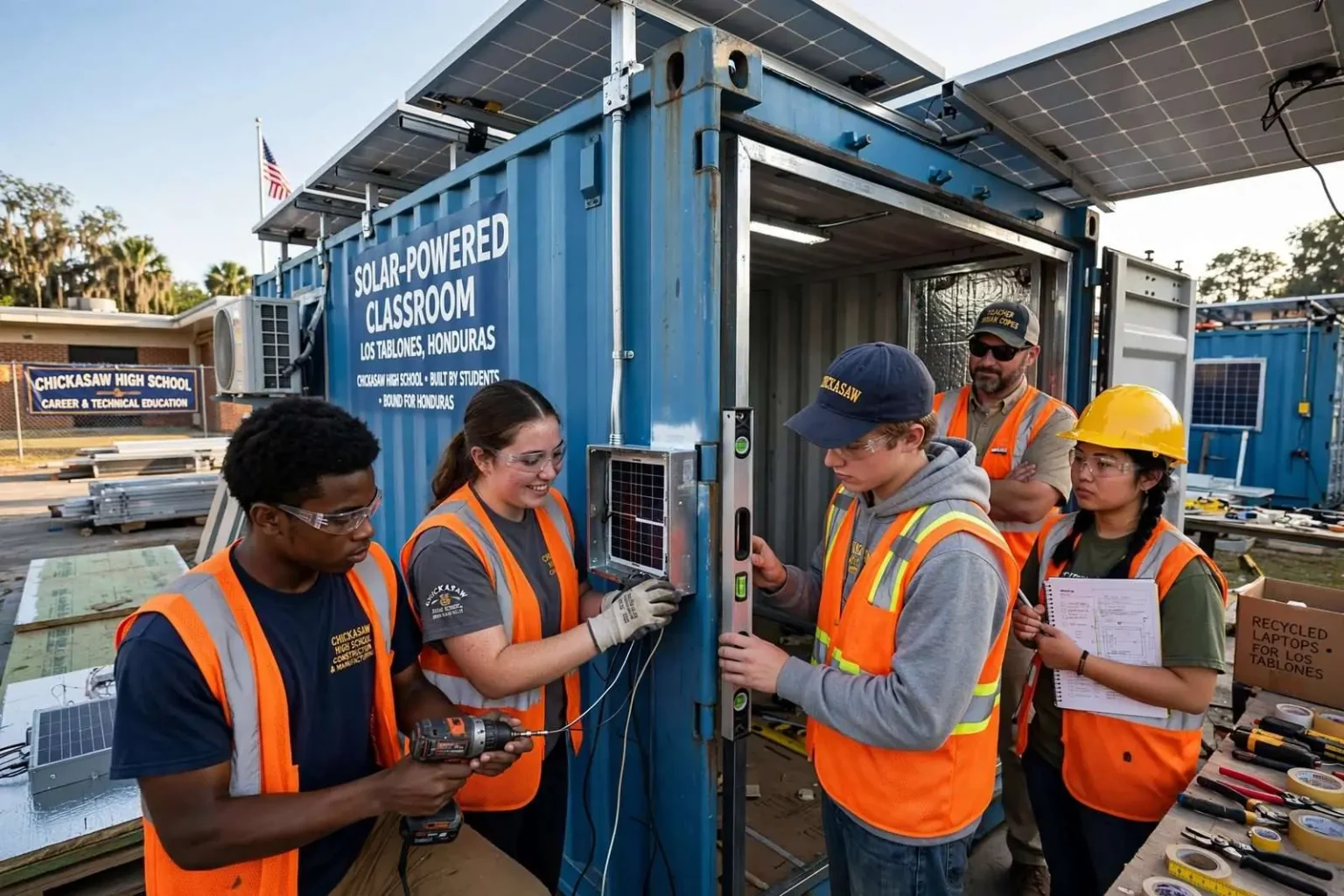
Construction and manufacturing students at Chickasaw High School have spent two and a half years on a project that will carry their education far beyond Alabama — all the way to a village in Honduras with no electricity. The students have been converting a shipping container donated by the Mobile Port Authority into a fully solar-powered computer classroom for Los Tabolones, a small Honduran community whose one-room school serves first through sixth graders with no air conditioning and no power.
The project is unusual for a high school program in nearly every dimension: its scale, its duration, and its destination. Rather than building a shed or a framing exercise that stays on campus, Chickasaw students have been building a functioning classroom that must generate its own electricity, cool itself in a tropical climate, and survive an ocean shipment before a single Honduran student ever sits down at one of its laptops. Two and a half years of class periods went into getting every detail right.
The work doubles as coursework toward the students’ National Center for Construction Education and Research core credential, the industry-recognized entry credential used by construction programs across the country. The hours spent wiring lights, mounting solar panels, and hanging insulation count not just toward a humanitarian project but toward certifications the students can carry into apprenticeships and jobs in the skilled trades after graduation.
Off-Grid Learning, Built by Teenagers
The students installed insulation, air conditioning, lights, and solar panels, then finished the unit with a fresh coat of paint. Each of those systems had to be planned around the container’s most important constraint: there is no electrical grid to plug into at the other end. The solar array has to produce enough power to run the air conditioning in the Honduran heat, light the room, and keep a bank of laptops charged — all from sunshine alone.
The solar setup will power laptops — recycled from Chickasaw classrooms — and provide internet access, letting students in Los Tablones join Zoom classes instead of hiking to the nearest electrified high school. That last detail captures what the project really means for the village. In many rural Honduran communities, children who want to continue their education beyond sixth grade face a long walk to a school in a town that has power, a barrier that pushes many students out of school entirely. A container classroom with internet access brings those classes to the village instead.
“These kids are actually not only taking charge of their education, but now they are helping with the education of the kids in Los Tablones,” said construction and manufacturing teacher Brian Copes. His framing gets at the two audiences the project serves at once: the Chickasaw students who designed and built it, and the Honduran children who will learn inside it.
How the Project Came Together
The raw material for the classroom came from the Port of Mobile, one of the busiest deepwater ports on the Gulf Coast and a natural source for the shipping containers that move through it. The Mobile Port Authority donated the container that became the classroom shell, giving the students a steel structure roughly the size of a small classroom to convert. Building materials were funded through sponsors including Harbor Freight Tools for Schools, the foundation arm of the tool retailer that funds skilled trades education in American high schools.
Programs like Chickasaw’s sit within a broader national push to rebuild career and technical education, which spent decades on the decline before educators and employers began rebuilding high school pathways into construction, manufacturing, and marine trades. On the Gulf Coast, where shipbuilding, aerospace, and port logistics drive much of the economy, the demand for workers with hands-on training has made programs that produce credentialed graduates especially valuable to local employers.
For the students themselves, the project demanded the full range of skills a construction career requires. Planning the electrical layout, calculating power loads, framing interior surfaces, installing mechanical systems, and finishing the interior are all trades in their own right, and a container conversion compresses them into a single compact build. Every component also had to be installed with an eye toward its final environment — a hot, humid, off-grid village where a repair crew is a plane ride away, not a phone call.
The Destination: Los Tablones
Los Tablones is a small community in Honduras where the single schoolroom serves first through sixth graders together, without air conditioning and without electricity of any kind. In such villages, the schoolhouse is often the only public building with any ambition of serving the whole community, and its limitations define what education is available to the children who live there. When the sun goes down, so does the ability to read, study, or — in the modern era — connect to the wider world online.
Honduras remains one of the poorer countries in the Western Hemisphere, and its rural communities are often the last to receive public infrastructure like grid electricity and paved roads. Off-grid solar installations have become a common way to bridge that gap, powering schools, clinics, and homes that the electrical grid may not reach for years. The Chickasaw students’ design puts their build squarely in that tradition: a self-contained unit that arrives by truck and starts working the day it is set down.
The recycled laptops from Chickasaw classrooms will give Los Tablones students machines of their own, and the internet connection will link the village school to teachers and lessons far beyond it. For first through sixth graders, that means educational resources that simply did not exist in the village before — and for older students in the community, it can mean the difference between continuing school and leaving it.
A Trip to Deliver It — and More to Come
Every stage of the build has been treated as a teaching moment, from the first measurements of the empty container to the final coat of paint. Students who began the project as inexperienced underclassmen finished it with a working knowledge of how a building’s systems fit together — and with the rare satisfaction of knowing their schoolwork has a purpose that stretches well past their own report cards.
In March 2024, the Chickasaw students who built the classroom planned to travel to Honduras to set it up themselves. The trip would put the builders on site for the final installation, connecting the solar array, positioning the unit, and seeing the classroom come to life with the students it was built for. Copes said watching students experience the community firsthand is the true lesson of the course — a perspective that no shop project on an Alabama campus can provide.
And the work isn’t stopping at one container: two more shipping containers have been donated to Chickasaw, with plans to partner with Atmore High School in Alabama and Gulfport High School in Mississippi to build more classrooms for other communities abroad. The expansion turns a single school’s project into a regional one, drawing in students from two more Gulf Coast communities and extending the model to additional villages that need classrooms of their own.
The partnership structure also spreads the workload and the learning. Students in Atmore, in south Alabama’s Escambia County, and in Gulfport, on the Mississippi coast, will gain the same combination of trade skills, credentialing, and cross-cultural experience that Chickasaw’s builders have gotten — while villages that have never had a powered classroom gain access to one built by American high schoolers who learned the trades by building it.
What the Project Means
For the Honduran community, the arrival of a powered classroom changes the practical shape of daily education. Air conditioning makes the room usable through the hottest months, lighting extends learning past dark, and charged laptops give teachers tools that a chalkboard cannot replace. The internet connection is the largest shift of all, since it allows the one-room school to draw on instruction and materials from far beyond the village.
For Chickasaw, a small city in Mobile County, the project has given its high school program a reach that few classrooms anywhere can claim. Students who spent two and a half years converting a donated container have learned insulation, electrical work, solar power, climate control, and finishing carpentry — and have done it for an audience of children they may soon meet face to face in Honduras.
The model also demonstrates what donated materials and sponsored programs can accomplish in public education. A container from the port, funding from a national trades foundation, recycled laptops from the school’s own classrooms, and the labor of teenagers earning their first industry credential add up to a working school building. When the classroom opens in Los Tablones, both communities will have gained something lasting: one a door to education that electricity can open, and the other a generation of builders who know exactly what their skills are worth.