Chickasaw Students Return to Class With New Programs and a First-Ever Stadium
Chickasaw City Schools launched new college-readiness and career programs for 2022, plus its first football stadium and a 12-classroom elementary wing.
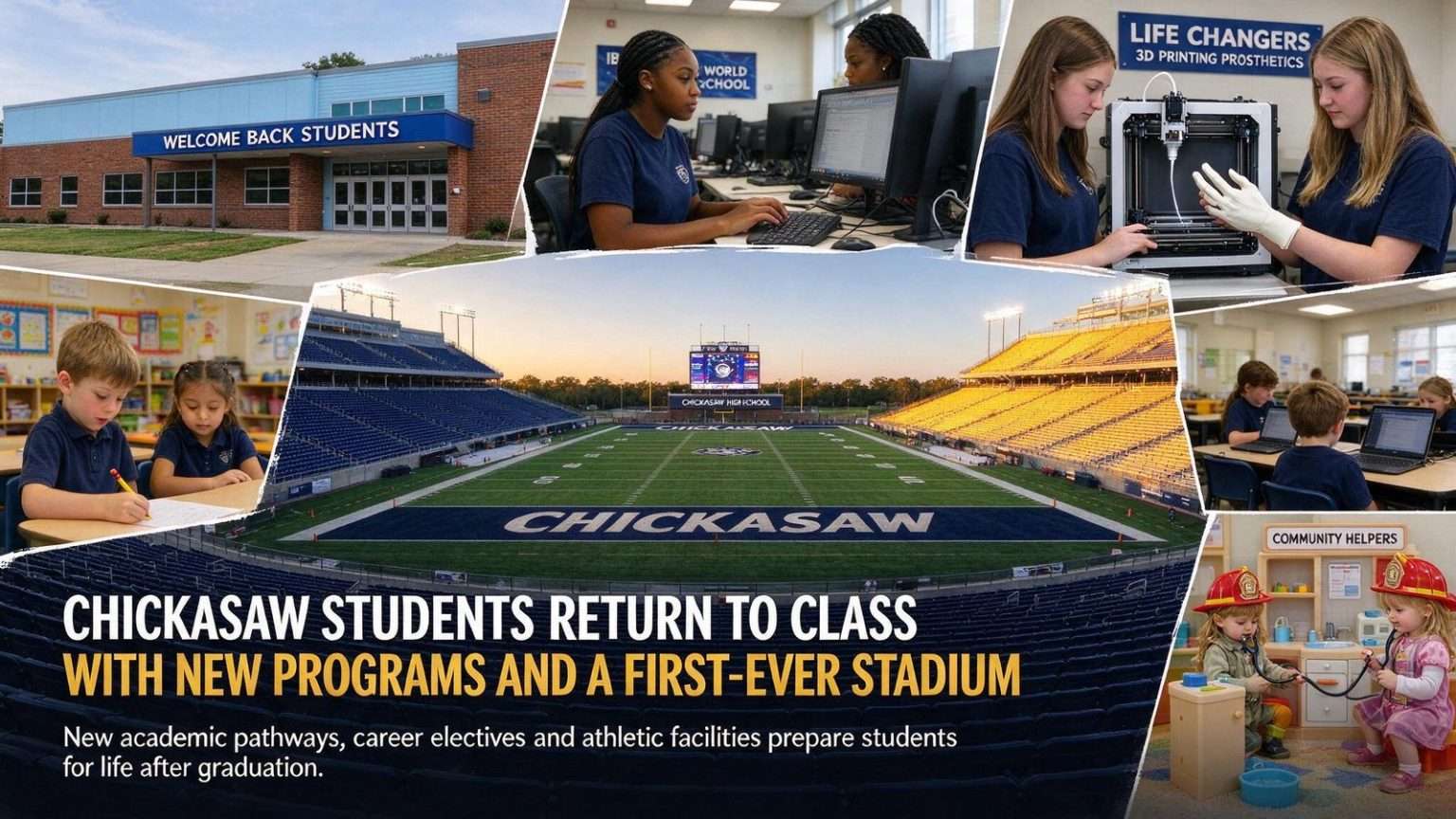
CHICKASAW, Ala. — Students across Chickasaw headed back to school Wednesday with a slate of new academic programs spanning every grade level, from pre-K through high school, along with major additions to the district’s physical campus. The changes touch classrooms, curriculum, and athletic facilities alike, and school leaders say they are designed with one destination in mind: life after graduation.
Superintendent David Wofford said the district’s goal across all of its new offerings is preparing students for whatever comes after they walk across the graduation stage, whether that is college, technical training, the military, or the workforce. The message from the administration has been consistent: every program added this year, from dual enrollment courses to play-based career exploration for four-year-olds, is meant to build toward that same endpoint.
Advanced Coursework Sets the Tone
At Chickasaw Middle and High School, Principal Arnold Cox said the emphasis this year is on advanced course options. The school is expanding its dual enrollment partnership with Bishop State Community College, the Mobile-based two-year institution, which allows qualified high school students to earn college credit while still working toward their diplomas. For families in Chickasaw, that can translate into real savings on the eventual cost of a degree, since credits earned in high school do not have to be paid for again at a university.
The school is also building on the A-Plus College Ready curriculum, a program associated with the Alabama education nonprofit A+ College Ready that supports schools in expanding access to rigorous Advanced Placement-style coursework. The approach includes intensive teacher training, structured lesson support, and expectations that students who might once have been steered away from difficult classes will instead be encouraged to take them. School leaders in Chickasaw say the point is not simply to offer tough courses but to build a culture in which students expect rigor from themselves.
International Baccalaureate programs are also part of the expanded lineup. The IB framework, recognized by universities around the world, emphasizes inquiry-based learning, writing across subjects, and global awareness alongside traditional content. For a district of Chickasaw’s size, offering an internationally benchmarked curriculum gives students a credential that travels with them wherever they apply after graduation.
Together, the three tracks give middle and high school students multiple ladders to climb. A student can begin with a career-inspired elective, move into dual enrollment at Bishop State, and graduate with both a high school diploma and a semester or more of college credit already banked. Administrators say the design is deliberate: no single program serves every student, but the combination gives families choices that were not available in the district a few years ago.
Printing Prosthetics on Campus
Among the new career-inspired electives is a program called Life Changers, and it may be the most distinctive offering in the district. In the class, students use 3D printers to produce prosthetic limbs on campus for amputees in developing countries. The work pairs classroom skills — design software, measurement, tolerance, materials — with a humanitarian purpose that students can see and hold.
Educators often note that career and technical education works best when students produce something real, and Life Changers takes that idea to an unusual extreme. A student who learns to operate a 3D printer for the class is not making a trinket for a grade; the device that comes off the printer may one day be fitted to a child thousands of miles away. Teachers say that sense of consequence tends to change how students approach the technical material, because the measurements matter in a way a worksheet never conveys.
The program also reflects a broader shift in how Alabama school systems think about career preparation. Rather than treating electives as filler between core classes, districts are building pathways that blend engineering, health science, and service learning. For Chickasaw, a small city school system in Mobile County, the elective signals an ambition that belies its size: graduates who have already designed and manufactured a working medical device before they turn 18.
Values and Early Foundations
The expansion is not limited to older students. Elementary principal Christy Amick said the school is bringing in a character education speaker to help set values-focused themes for the year, an effort aimed at establishing expectations for behavior and citizenship from the earliest grades. Character education programs of this kind typically weave traits such as responsibility, honesty, and respect into daily routines rather than treating them as a one-time assembly topic.
At the pre-K level, the district is introducing what program director Jodie McPherson describes as a “crayons to careers” approach, which introduces children to different professions early through play-based learning. Four-year-olds might spend a morning pretending to run a clinic, a fire station, or a construction site, activities that look like ordinary play but are structured to plant early ideas about the world of work.
Research on early childhood education has long suggested that children form impressions about careers surprisingly young, and that play is the natural language through which they explore them. By naming professions, dressing the part, and acting out the work, pre-K students build vocabulary and familiarity that educators hope will make later academic choices feel connected to a future. McPherson’s framing — crayons to careers — captures the arc the district is trying to draw from a child’s first classroom to the day the same student, grown, collects a diploma.
The pre-K and elementary efforts also serve a practical purpose for the district: families who see a coherent pathway from pre-K through high school, with advanced coursework and distinctive programs at every stop, have less reason to look elsewhere. In a county where parents can choose among the large Mobile County system, private schools, and neighboring city districts, retention of young families is part of the long-term math.
A Stadium Rises at John Dotson Park
The district is also expanding its facilities, and the most visible change sits at the former John Dotson Park site, which has been converted into the school system’s first football stadium. For a district that has historically sent its teams on the road for home games, the new stadium is more than a sports facility. It gives Chickasaw a gathering place — Friday night lights, band performances, graduations, and community events — that small city school systems often struggle to provide.
Home stadiums carry practical weight beyond athletics. Teams no longer spend money and travel time renting or borrowing facilities, and the community gains a regular reason to come onto campus in a celebratory frame of mind. School leaders across Alabama frequently point out that a stadium becomes a town square in miniature, and in a city the size of Chickasaw, where the school system and the municipal government grew up together, that role is particularly visible.
Construction is also underway on a 12-classroom elementary wing, an addition that speaks to enrollment and instructional needs at the other end of the building. New classroom space allows the district to relieve crowding, add programs, and give younger students modern learning environments without resorting to portable buildings, which many Alabama districts have relied on during periods of growth.
The building projects represent a notable chapter for a school system that is still comparatively young. Chickasaw operated its own schools for generations before the city’s schools were folded into the Mobile County Public School System, and the city later re-established its own independent district — one of the smallest in Alabama — after residents voted to break away from the Mobile County system. Districts that small typically must be resourceful, and Chickasaw’s leaders have argued that the system’s size is an asset: programs can be added quickly, and every administrator knows every student’s name.
First Bell Rings a New Chapter
The first bell rang Wednesday at 7:45 a.m. for elementary students and 7:25 a.m. for middle and high schoolers, sending students into buildings that now house more programs, more construction activity, and higher expectations than a year ago.
For parents, the practical question through the fall will be logistics — new schedules, new wings under construction, and the return of football season at a brand-new stadium. For educators, the question is whether the new structures deliver: whether dual enrollment numbers grow, whether IB and A-Plus College Ready coursework raises achievement, and whether a pre-K student who pretends to be a firefighter this year walks into the Life Changers lab a decade from now.
Wofford’s framing offers the measure by which the district says it should be judged. The goal, he said, is preparing students for life after graduation — and with the expansion now in place across every grade level, Chickasaw has assembled the programs it believes will get them there. The rest will be measured one report card, one prosthetic limb, and one Friday night at a time.