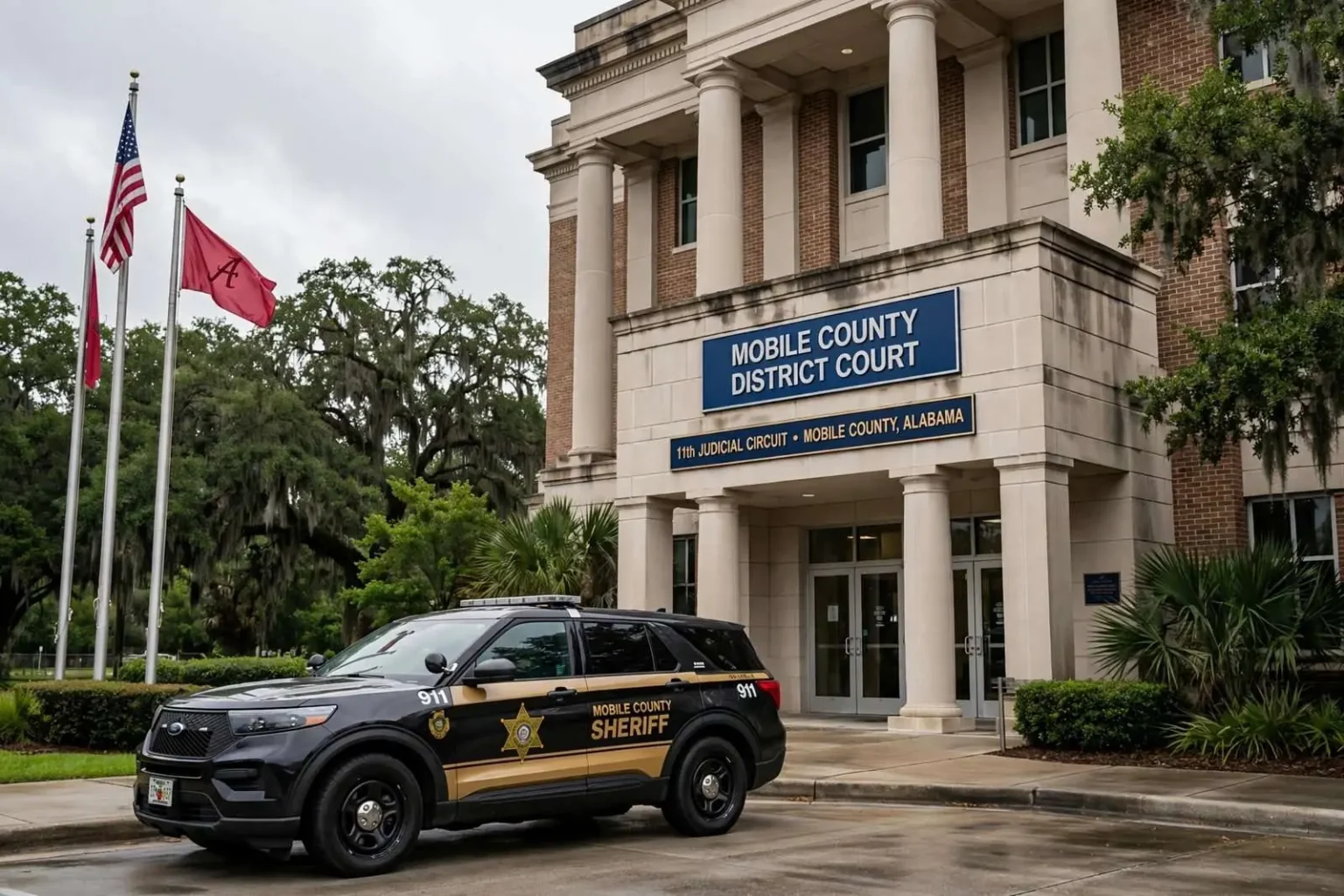
CHICKASAW, Ala. — A Chickasaw woman faces two doxing charges after investigators said she published personal identifying information about a Mobile County sheriff’s deputy and another woman in a social media post earlier this month. Lisa Marie Roddy, 42, was booked into Mobile Metro Jail on Thursday and released roughly two hours later.
The arrest stems from complaints filed in Mobile County District Court, where misdemeanor charges originate before any trial proceedings begin. Roddy’s release within hours of booking is consistent with the typical handling of misdemeanor defendants in Mobile County, who are generally processed, arraigned on a schedule, and released on their own recognizance or bond rather than held for extended periods before trial.
What the complaints allege
According to the criminal complaint, Roddy posted information about her ex-husband, Chester Cochran, a deputy with the Mobile County Sheriff’s Office, in an Aug. 10 social media post. The complaint states that her intent was to slander Cochran’s name, discredit him in court, and get him fired from his job. Complaints of this kind are sworn statements, and the allegations they contain have not been tested in court.
A second complaint alleges she published Tiffany Cochran’s full name and place of employment with the intent of getting her fired. Under Alabama’s doxing statute, publishing another person’s identifying information — a category that can include names tied to employers, addresses, phone numbers and similar details — becomes a criminal matter when it is done with the intent to harass, intimidate or cause the person harm, including harm to their livelihood.
The fact that one of the alleged victims is a sworn law enforcement officer adds a distinct dimension to the case. Deputies and their families have increasingly become targets of online publication of personal details, and prosecutors and sheriffs’ offices across the country treat such posts as potential safety threats rather than ordinary online disputes, since home addresses and family information can expose officers to retaliation connected to their official duties.
Roddy and Chester Cochran’s prior marriage is acknowledged in the complaint itself, which references the couple’s children in connection with a court order. Domestic relationships that have broken down are a common backdrop in doxing complaints, as personal knowledge of an ex-spouse’s workplace, home and family details makes the information easy to publish — and gives prosecutors a straightforward picture of intent.
Doxing under Alabama law
Doxing — the publication of someone’s private identifying information with intent to harass, intimidate or cause harm — is a Class A misdemeanor in Alabama. That is the most serious misdemeanor classification in the state, carrying a potential sentence of up to one year in county jail and a fine of up to $6,000.
Alabama’s criminal code sorts offenses into a ladder of severity, and Class A misdemeanors sit at the top of the non-felony tier. Other offenses in the same classification include third-degree domestic violence, first-degree theft of property valued at modest amounts, and certain repeat driving-under-the-influence offenses. A conviction at that level can also carry collateral consequences, including a permanent criminal record that surfaces in employment background checks.
Because each complaint is a separate charge, a defendant facing two counts of doxing is exposed to the penalties of the statute twice over if convicted on both. In practice, misdemeanor cases frequently resolve through plea agreements, dismissals or pretrial diversion, but that is a matter for the parties and the court as the case develops, not something predetermined at the charging stage.
The statute has drawn increasing attention as disputes that once played out privately migrate to social media, where a single post can reach an audience far beyond the people involved. Legislatures in Alabama and elsewhere have responded to the reality that a person’s workplace, home and family details can now be broadcast to thousands of strangers in seconds, with consequences — harassment, lost jobs, threats — that traditional harassment laws were slow to address.
Cases involving law enforcement officers carry particular weight, given the safety concerns associated with publishing an officer’s personal details. A deputy’s employer is public knowledge in a general sense, but prosecutors have argued that deliberately amplifying identifying information about officers — or their spouses — with hostile intent crosses the line from speech into conduct that puts people at risk.
The booking process at Mobile Metro Jail, the main intake facility serving Mobile County law enforcement agencies, follows a standard sequence: photographing and fingerprinting the defendant, running identity checks, and confirming the charges before release. For misdemeanor defendants who pose no flight risk, release within hours — as occurred here — is the norm rather than the exception.
The Mobile County Sheriff’s Office, one of the largest law enforcement agencies in the state, patrols unincorporated Mobile County and operates the county jail system. Deputies there handle everything from patrol duties to court security, and incidents involving the families of deputies are handled carefully to avoid any appearance that the agency is using its authority in a personal dispute. That separation matters both to the integrity of the case and to how it will be viewed by a defense attorney and a judge.
Chickasaw, where Roddy lives, became a city in 2008 when residents voted to incorporate after separating from Mobile’s police jurisdiction, and the city maintains its own police department. In a case like this one, however, jurisdiction follows the alleged victims’ status as a sheriff’s deputy and the location where the complaints were filed, with the sheriff’s office and district attorney’s office taking the lead rather than the small municipal department.
Doxing charges differ from defamation claims in an important way. Defamation concerns the truth or falsity of statements made about someone, while doxing concerns the act of publishing identifying details regardless of whether those details are accurate. A defendant in a doxing case cannot defeat the charge by showing the information posted was true — only by showing the publication lacked the intent to harass, intimidate or cause harm.
Separate from the criminal case, publishing damaging information about a former spouse can open the door to civil litigation, including claims for harassment, invasion of privacy or intentional infliction of emotional distress. Civil suits carry a lower burden of proof than criminal cases and can result in monetary judgments, though many such disputes are resolved without ever reaching a courtroom.
What a conviction would mean
If Roddy were convicted of a Class A misdemeanor, the sentencing options available to a district court judge include an active sentence in the county jail of up to one year, a suspended sentence with probation, or a fine of up to $6,000, along with any combination of those penalties. Judges in misdemeanor cases frequently impose probation for first-time defendants, particularly where the underlying conduct involved no physical harm.
A conviction would also create a record that, under Alabama law, can be difficult to erase. Misdemeanor convictions may be eligible for expungement only after a waiting period and only in limited circumstances, meaning the charge would remain visible to employers and licensing boards for years if it ends in a guilty plea or verdict.
For the alleged victims, the criminal process is only one layer. A deputy whose employment details were published faces potential professional fallout even when the claims against him are baseless, and courts in these situations sometimes remind parties that the family-court track — where custody disputes play out — is the proper venue for grievances about a co-parent, not a public social media audience.
Family-court judges across Alabama have increasingly had to address social media conduct between ex-spouses, and posts targeting a co-parent’s job can factor into custody and contempt proceedings independently of any criminal charge. That parallel track can continue long after the misdemeanor case is resolved.
How these cases are built
Evidence in doxing prosecutions is typically digital: screenshots of the post, metadata showing when it was published, witness statements from people who saw it, and any follow-up messages or threats linked to it. Investigators preserve this material early, since posts are frequently deleted after an arrest, and Alabama courts have grown accustomed to handling social media evidence with proper authentication from the platforms or the people who captured it.
Prosecutors must also establish identity — that the account that published the information belonged to the defendant. In cases involving personal disputes between people who know each other, that element is often straightforward, because the details included in the post itself tend to point to the person who would have that knowledge.
The district attorney’s office will weigh several factors in deciding how to proceed, including whether the published information prompted threats or harassment, whether the defendant has prior contacts with the court system, and whether the parties reached any private resolution. Diversion programs, which allow a defendant to complete conditions such as counseling or a no-contact period in exchange for dismissal, are sometimes offered in first-offense misdemeanor cases.
Defense attorneys in doxing cases commonly argue that the information published was already available publicly, that the post was protected commentary rather than a threat, or that the prosecution cannot prove intent beyond a reasonable doubt. Where the parties share children and an ongoing custody case, defense counsel may also point to the family court’s jurisdiction as the more appropriate forum for the underlying dispute.
A signal for the Gulf Coast region
Whatever the outcome, the case illustrates how Alabama’s newer digital-era statutes are being applied in the Mobile area. Lawmakers wrote the doxing law in response to a landscape where a single post can cost someone a job or expose a family to strangers, and prosecutors in urban counties have begun using it in exactly the kind of dispute this case represents: a broken relationship, a public post naming workplaces, and an alleged purpose of getting people fired.
For members of the public, the practical lesson is that identifying information about others — addresses, employers, phone numbers, family members — is not ordinary conversational material when posted online with hostile purpose. What reads as venting to the person writing it can read as targeted harassment to a prosecutor reviewing the same post, and the difference is measured in misdemeanor charges rather than deleted comments.
The arraignment on Aug. 25 will mark the first formal court appearance in the case, and the docket in Mobile County District Court will show how the charges move forward from there. Until then, the allegations remain unproven, both alleged victims remain under the protection of the no-contact notation, and the criminal justice process — slow, procedural and evidence-driven — takes over where the social media post left off.