Chickasaw Woman Turns Herself In After Her Edibles Sickened Students at Football Game
Kristy Lane, 44, turned herself in after THC edibles from her Chickasaw home hospitalized three students at a football game, MCSO says.
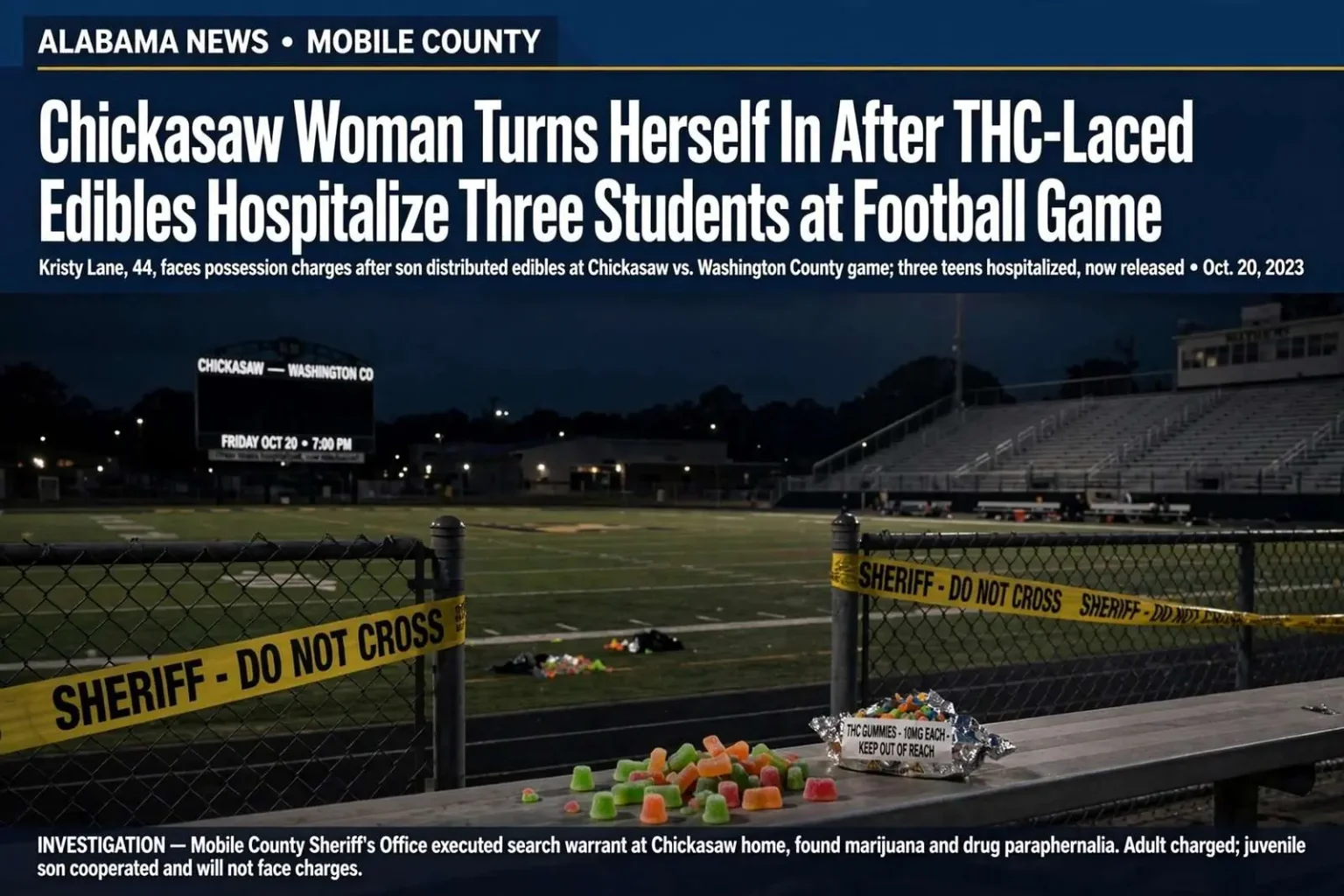
A Chickasaw woman faces criminal charges after THC-laced edibles taken from her home left three students hospitalized during a high school football game, according to the Mobile County Sheriff’s Office.
Kristy Lane, 44, turned herself in to authorities after deputies executed a search warrant at her home and found marijuana and other drug paraphernalia. She is charged with possession of marijuana and possession of drug paraphernalia, and she has been released from jail on a $1,500 bond.
Sheriff’s officials said Lane’s son took the edibles from their home and distributed them at the Chickasaw vs. Washington County football game on Friday, Oct. 20. Before kickoff that night, three students were hospitalized after eating them. All three have since been released and are doing well.
Sheriff’s officials said her son will not face charges in connection with distributing the edibles, a decision that deputies said reflected the circumstances of how the teenager obtained the drug-laced food — from an adult’s home — and his cooperation in the investigation that followed.
How the Incident Unfolded
The Friday night football game between Chickasaw and Washington County was the kind of community event that draws students, families and fans from both schools. Before kickoff, according to the Mobile County Sheriff’s Office, three students ate THC-laced edibles that had been distributed at the game, and each became sick enough to require hospital treatment.
Edibles — food products infused with THC, the psychoactive compound in marijuana — present a particular danger in settings like a crowded stadium. Unlike smoked marijuana, the effects of an edible can take an hour or more to appear, which leads many users, especially young ones, to eat more before the first dose takes hold. The delayed onset, combined with food that looks like ordinary candy or snacks, makes accidental and unknowing consumption far more common with edibles than with other forms of the drug.
Medical staff treated the three students, and all three were released and are doing well, according to the sheriff’s office. But the incident transformed a routine Friday night into a cautionary tale for schools across the region about how easily drug-laced products can move through a crowd of teenagers.
The Investigation
Deputies with the Mobile County Sheriff’s Office traced the edibles to their source, and the trail led to Lane’s home in Chickasaw. Investigators said her son had taken the edibles from the home and distributed them at the game, and a search warrant executed at the residence turned up marijuana and other drug paraphernalia.
The execution of a search warrant requires investigators to present evidence to a judge showing probable cause that contraband would be found — a step that in this case followed the students’ hospitalizations and the identification of where the edibles originated. What deputies found at the home supported the two possession charges Lane now faces.
Lane turned herself in to authorities after the warrant was executed, and she was booked into the Mobile County Metro Jail on the possession counts. Her release on a $1,500 bond — a modest figure reflecting the misdemeanor-level nature of the charges — means she will await her day in court without remaining in custody.
Why the Son Will Not Face Charges
Sheriff’s officials said Lane’s son will not face charges in connection with distributing the edibles. The decision, according to deputies, reflected the full circumstances: a teenager who took drug-laced food from an adult’s home and shared it, followed by his cooperation with investigators as they traced the source.
Prosecutors and law enforcement agencies routinely weigh age, circumstances and cooperation when deciding whether to charge a juvenile. The alternative — pursuing charges against a minor whose access to the edibles stemmed from an adult’s failure to secure them — would have shifted the focus of the case away from the person authorities hold responsible.
The decision also tracks a broader shift in how agencies treat marijuana cases involving juveniles, where diversion and education have increasingly replaced prosecution for young offenders. But the message from the sheriff’s office was clear: the adult who kept THC edibles accessible in a home with a teenager bears the legal responsibility for what followed.
Edibles and the Risk to Young People
The incident at the Chickasaw game highlights a problem that school officials and health workers across Alabama have been warning about for years: THC-infused foods that look indistinguishable from ordinary snacks. Gummies, cookies, brownies and candies laced with THC are widely sold in states where recreational marijuana is legal, and they circulate through informal channels into states like Alabama, where marijuana remains illegal for recreational use.
For young people, the risks are compounded in several ways. A single commercially produced edible can contain multiple doses of THC; homemade versions carry unpredictable potency. Teenagers who consume them unknowingly can experience severe anxiety, rapid heart rate, vomiting and disorientation, and pediatric emergency rooms have reported rising numbers of cases tied to edible consumption.
School systems in Mobile County and across the state have cautioned parents about storing any THC products securely at home. Alabama’sMedical Cannabis Act, which created a tightly regulated medical program, does not authorize edible products, meaning any food-based THC circulating in the state comes from outside legal channels entirely.
The Charges Lane Faces
Possession of marijuana in the second degree and possession of drug paraphernalia are the counts on Lane’s docket. Second-degree possession covers small amounts of marijuana for personal use and is typically charged as a misdemeanor, though a prior felony record can elevate it. Paraphernalia possession is likewise a misdemeanor, covering items used to store, consume or distribute controlled substances.
The penalties for such misdemeanors include potential jail time and fines, though first offenders often resolve them through diversion programs. What the charges do not fully capture, sheriff’s officials indicated, is the broader responsibility the investigation laid at Lane’s door: THC edibles left accessible in her home ended up in three students’ stomachs and sent them to the hospital.
Lane’s case will proceed through Mobile County’s district court, where misdemeanor matters are handled. She has been released on bond pending that process, and like any defendant she is presumed innocent unless and until proven guilty.
Chickasaw and Its Schools
Chickasaw, a city in northern Mobile County, incorporated as its own municipality in 2013 after decades as an unincorporated community, taking with it its own city schools — a rarity among Alabama’s newer cities. The Chickasaw City School System serves students from kindergarten through high school, and the town’s football games function as the community’s largest regular gathering, drawing families from across the small city.
That civic intimacy is part of why the incident resonated locally. A game between Chickasaw and Washington County is a small-stadium affair where most attendees know one another, and word that three students had been hospitalized spread quickly through the crowd and through the community over the weekend that followed.
School officials have not announced disciplinary measures connected to the incident, which occurred at an athletic event rather than on a school campus during instructional hours. But incidents involving students and drugs at school-affiliated events typically trigger reviews of security procedures, and administrators across the county took note of how the edibles moved — not smuggled in by an outsider, but taken from a student’s own home.
What Parents Should Know About Edibles
Health and law enforcement officials have a consistent message for parents about THC edibles: store them like medication, out of reach and out of sight of children and teenagers. Because edibles look like ordinary food, teenagers may take them without understanding their potency, and younger children can mistake them entirely for candy — a scenario that has produced pediatric emergency cases across the country.
The delayed onset of edible effects makes the problem worse. Users who do not feel anything within 30 to 60 minutes frequently consume more, and the accumulated dose arrives all at once. For young or first-time users, that can mean severe intoxication, panic reactions and vomiting — the symptoms that sent three students for hospital treatment before kickoff on Oct. 20.
Officials also urge parents to talk with their teenagers about never consuming food items offered at parties, games or gatherings when they cannot confirm what is in them. The edibles distributed at the Chickasaw game moved hand to hand in a crowd, and none of the students who ate them apparently understood what they were consuming until they became sick.
The Sheriff’s Office Message
For the Mobile County Sheriff’s Office, the case offered a public teaching moment that sheriff’s officials have repeated in similar cases: adults who keep THC products at home are legally responsible when those products reach minors. Possession charges like the ones Lane faces may be misdemeanors, but they are the legal system’s mechanism for assigning responsibility for the downstream consequences.
The sheriff’s office also highlighted the speed of the investigation — from three hospitalizations at a football game to a search warrant, a surrender and charges within a short period — as an example of how tips and cooperation from the community and the schools accelerate these cases.
Anyone with information about THC edibles being distributed to minors, officials said, can contact the Mobile County Sheriff’s Office or leave an anonymous tip through its tip lines. As for Lane, her case now moves through the court system, where the two possession counts will be adjudicated under the presumption of innocence that applies to every defendant.