Chief Assistant DA Keith Blackwood Announces Run for Mobile County District Attorney
Chief Assistant DA Keith Blackwood announces his candidacy for Mobile County District Attorney, backed by retiring DA Ashley Rich.
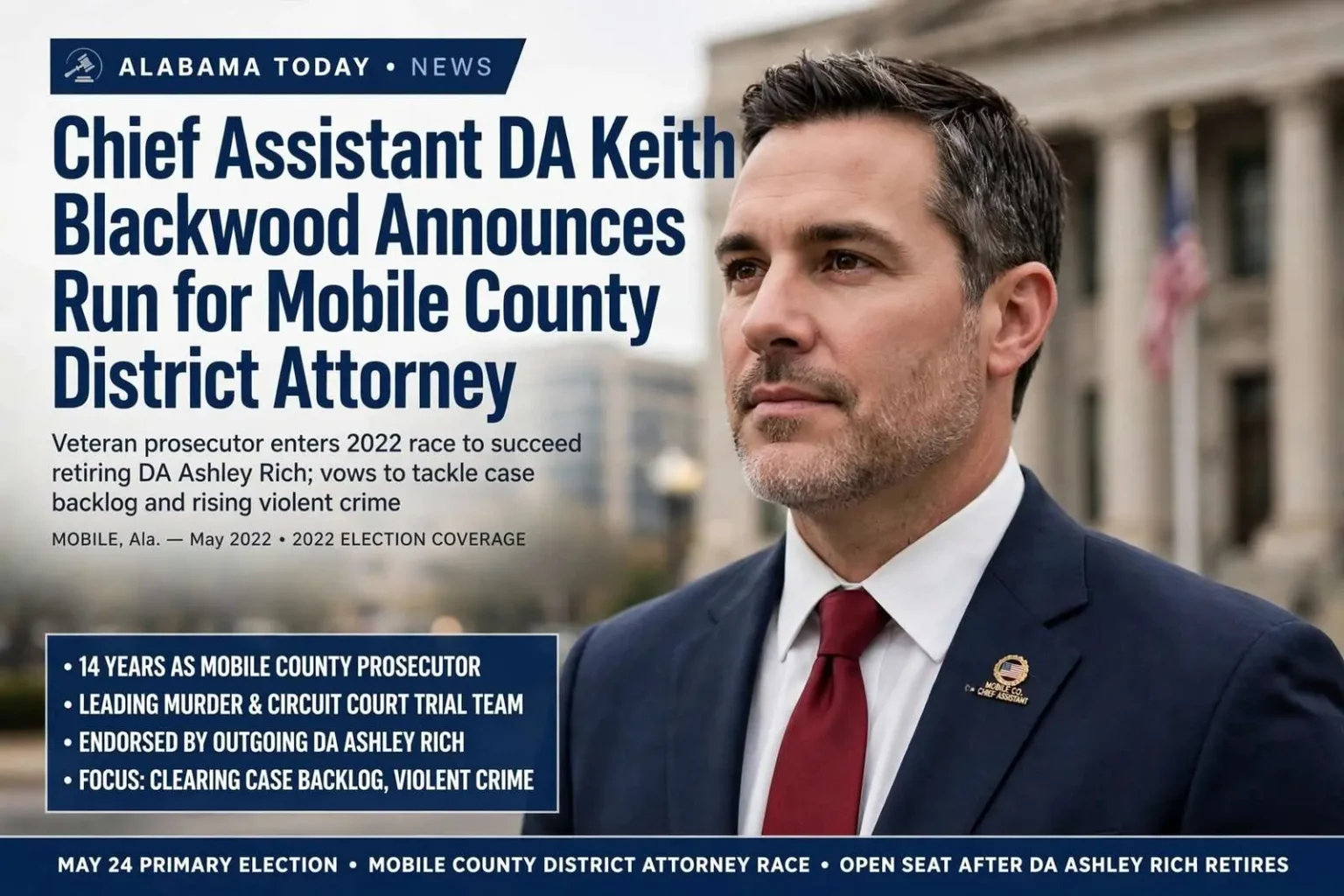
MOBILE, Ala. — Keith Blackwood, the chief assistant district attorney for Mobile County, has announced his candidacy for Mobile County District Attorney in the 2022 election, entering a race that took shape when the office’s longtime leader decided to step away. The announcement sets up a contest to lead one of Alabama’s most consequential prosecutorial offices at a time when violent crime and case backlogs dominate the conversation about criminal justice in Mobile.
Blackwood has spent nearly fourteen years as a prosecutor, working in roles that included the Circuit Court Team and the murder team before his 2020 promotion to chief assistant under District Attorney Ashley Rich. His career inside the office he now seeks to lead gives him an intimate knowledge of its caseload, its prosecutors, and its procedures — experience he presents as the foundation of his candidacy.
His entry into the race follows Rich’s recent announcement that she is retiring and will not seek reelection. Rich, who has served as Mobile County’s district attorney since 2011, has endorsed Blackwood, a significant boost in a race to succeed an incumbent who has led the office through some of its most challenging years.
Blackwood was so far the only announced candidate, though the race remained in its early stages and the qualifying period had yet to close. Party primaries in Alabama set the stage for the general election, and prosecutorial races in Mobile County historically draw intense interest from the legal community and law enforcement.
A Prosecutor’s Career
Blackwood has tried more than 100 jury trials, a volume that places him among the most experienced trial prosecutors in the county. Jury trial work — the core function of a felony prosecutor — spans everything from robbery and assault cases to capital murder, and the ability to present a case to a jury is the skill that defines a career in the office he hopes to run.
His assignments within the office trace a typical path to leadership: Circuit Court Team, where the county’s most serious felony cases are tried, and the murder team, where prosecutors handle homicide cases from investigation through verdict. The 2020 promotion to chief assistant put him in the office’s number-two role, responsible for supervising prosecutors and helping manage the office’s operations under Rich.
That background shapes his campaign’s central argument: that the office needs continuity of experienced leadership at a moment of rising caseloads. Running an office of Mobile County’s size means managing dozens of prosecutors and support staff, coordinating with every law enforcement agency in the county, and setting policy on charging, diversion, and plea practices that affect thousands of cases a year.
He acknowledged the rise in violent crime in recent years and said clearing the office’s backlog of cases would be his biggest challenge if elected. The pandemic emptied courtrooms across Alabama for months, delaying trials and stacking cases behind an overwhelmed docket — a backlog that falls hardest on victims awaiting their day in court and defendants held in jail awaiting trial.
The Backlog Problem
Court systems across the country accumulated backlogs during the pandemic shutdowns, and Mobile County was no exception. Grand juries operated on reduced schedules, trials were postponed, and the flow of new arrests continued unabated. The result was a docket in which cases wait years from arrest to resolution — a delay that strains witnesses, memories, and public confidence.
“I have a plan in place. Day one hitting the office, we have a strong group of prosecutors,” Blackwood said, adding that steps could be taken to work through the backlog and deliver justice sooner for victims of crime. His emphasis on the office’s existing staff reflects a view that the path through the backlog runs through the prosecutors already handling the cases.
The Office He Seeks to Lead
The Mobile County District Attorney’s Office prosecutes felony and misdemeanor cases across the county, from the city of Mobile to Prichard, Saraland, Satsuma, Chickasaw, and the county’s communities south to the bay. Its work touches every law enforcement agency in the jurisdiction, and its policies — on charging, plea offers, diversion programs, and victim services — shape how justice is administered for roughly 400,000 residents.
Rich’s tenure included the challenges that have defined prosecutorial work in recent years: rising gun violence, the opioid epidemic, and a statewide debate over criminal justice reform that played out in sentencing laws and prison overcrowding. Her endorsement of her chief assistant signals an effort to extend the office’s current direction under new leadership.
The election was set for May 24, when Alabama voters go to the polls for party primaries. In a county where Republican primaries often decide the ultimate winner, the race for district attorney could effectively be settled in the primary, giving announced candidates an incentive to enter early and organize.
Prosecutorial elections draw particular attention because the district attorney wields broad discretion: which cases to charge, what to offer in plea negotiations, when to seek the death penalty, and which diversion and treatment programs to support. Those decisions collectively define how a county experiences its criminal justice system.
Crime and Politics in Mobile
Violent crime has been a dominant issue in Mobile city politics, with homicides drawing community meetings, law enforcement initiatives, and debate over prevention versus enforcement. Whoever leads the District Attorney’s Office will sit at the center of that response, working with the Mobile Police Department, the sheriff, and municipal agencies across the county.
Blackwood’s focus on the backlog ties his campaign to the everyday experience of the courts: victims waiting years for trials, witnesses whose memories fade, and defendants — some guilty, some not — held in the county jail while cases wait. Clearing that backlog is both an administrative challenge and a justice issue, and it has become a central promise of his candidacy.
The office’s murder team and Circuit Court divisions will remain the proving ground for the office’s work, and Blackwood’s trial experience is his answer to questions about readiness. Having supervised prosecutors as chief assistant, he argues he can hit the ground running without a learning curve — an argument that carries weight in a race focused on operational competence.
Whether additional candidates enter the race remains to be seen, and Mobile County’s legal community will watch the qualifying deadline closely. For now, the succession of one of Alabama’s most prominent district attorneys runs through her chief assistant, whose campaign begins with an endorsement from the office’s current leadership and a promise to keep its cases moving.
As the May 24 election approaches, voters will hear competing visions for the office. Blackwood’s vision, laid out at his announcement, is built on his fourteen years inside the building: experienced prosecutors, a plan for the backlog, and a promise that victims of crime will see justice delivered sooner rather than later.
Rich’s decision to retire rather than seek another term opens a rare openings in county leadership. District attorneys in Alabama serve six-year terms, and incumbents frequently run unopposed, making an open seat the one moment when voters get a genuine choice about how the office will be run.
What the Job Demands
The district attorney’s responsibilities begin well before a trial. Prosecutors review cases presented by law enforcement, decide what charges the evidence will support, and manage the flow of thousands of felony and misdemeanor files. The office also runs victim services, grand jury presentations, and the appeal work that follows convictions.
Leadership of the office means setting priorities: how aggressively to prosecute nonviolent offenses, which diversion and mental health programs to support, and how to allocate prosecutors among the county’s courts. Those choices shape everything from jail populations to the office’s relationship with the communities it serves.
Blackwood’s pitch leans on internal experience as the qualification that matters most. Managing a large prosecutorial office, his campaign suggests, is not a job for on-the-job training — it requires someone who knows the personnel, the docket, and the partners in law enforcement from day one.
The backlog promise gives the campaign a concrete, measurable goal. Voters will be able to judge it against numbers: the size of the pending caseload, the time from indictment to trial, and the pace at which older cases reach resolution. Few campaign promises in a prosecutor’s race lend themselves to such direct accountability.
The May 24 election will decide who takes the office into the second half of the decade. With Rich’s endorsement and the only announced candidacy so far, Blackwood enters the race with the advantages of continuity and institutional support — and with the burden of proving that the office’s future should look like its present.
Community groups in Mobile have increasingly weighed in on prosecutorial races, pressing candidates on how they will handle violent crime, juvenile cases, and programs that steer first offenders away from prison. Blackwood will face those questions on the campaign trail, and his answers — grounded in trial experience and office management — will help define the choice Mobile County voters make in May.