
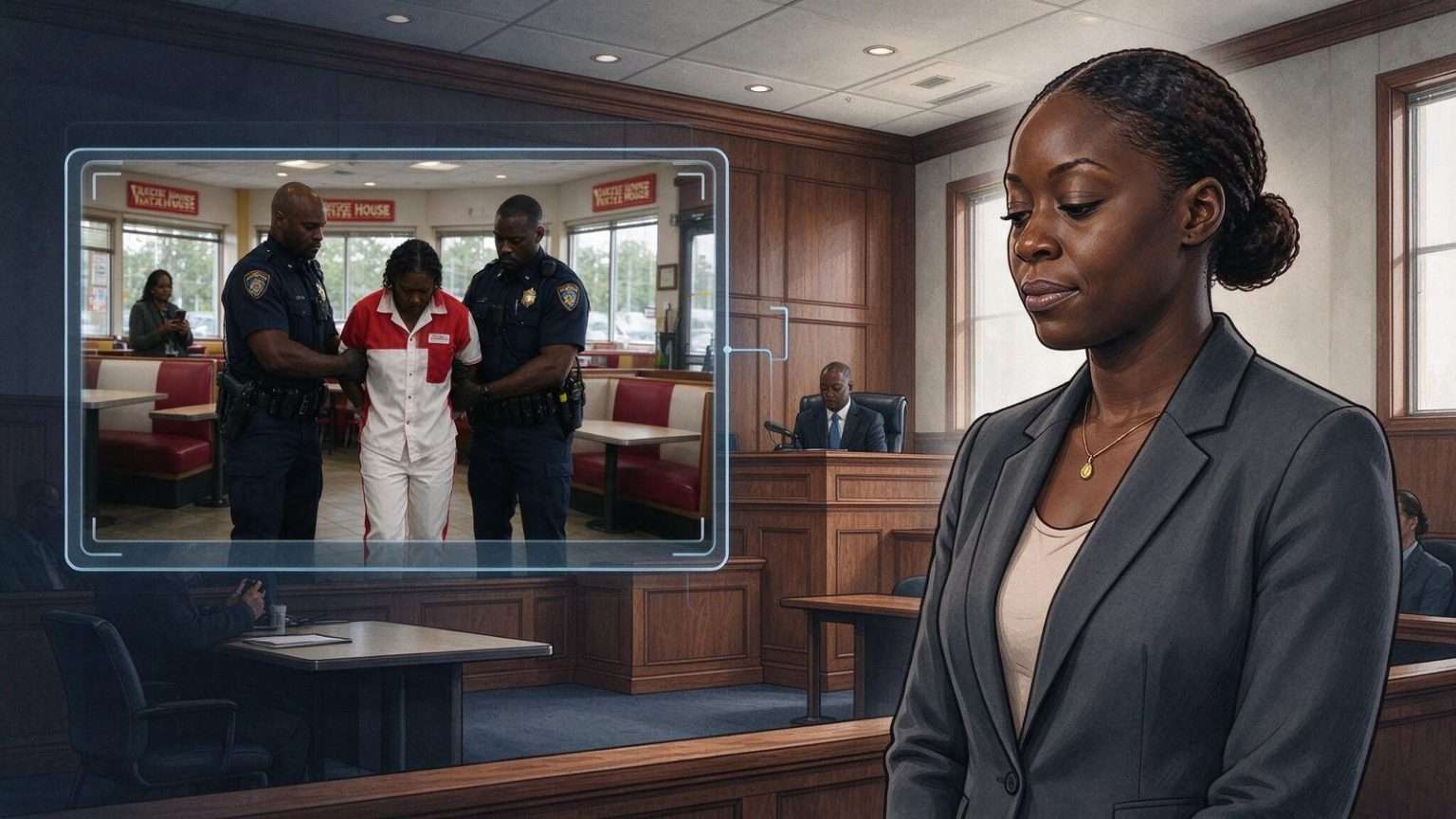
Chikesia Clemons, whose 2018 arrest at a Saraland Waffle House made national headlines, has been sentenced after a jury convicted her of resisting arrest. A judge imposed a six-month jail term but suspended it, meaning Clemons will not serve the jail time so long as she complies with the conditions the court set. Clemons was also fined $500 and placed on one year of probation, closing the court chapter of a case that began with a cellphone video and grew into one of the most widely discussed arrest incidents on the Gulf Coast in recent years.
The sentence followed an August trial in which a Mobile County jury returned a split verdict: guilty on the resisting arrest charge, not guilty on disorderly conduct. The split outcome reflected the evidence the jury weighed over the course of the trial, which centered on the April 2018 encounter inside the Saraland restaurant and the officers’ efforts to take Clemons into custody. Resisting arrest carries its own penalties under Alabama law, and the judge’s decision to suspend the six-month term in favor of probation placed the emphasis of the sentence on supervision and compliance rather than incarceration.
Cellphone video of the April 2018 arrest showed officers taking Clemons to the ground inside the restaurant, footage that circulated nationally within days of the incident and drew wide attention to the case. Police said she was drunk and had threatened workers before officers arrived. The competing narratives around the video — what it showed, what it did not capture, and what led up to the arrest — drove the public discussion that followed and followed the case all the way through the trial and sentencing.
How the case moved through the courts
The path from the April 2018 arrest to the August trial ran through the Saraland municipal and Mobile County court systems, with the charges tested in front of a jury drawn from the county. At trial, prosecutors presented the case for the resisting arrest conviction, built around the officers’ testimony about the arrest and the events inside the restaurant. The defense presented its account of the encounter, and the jury’s split verdict — conviction on resisting arrest, acquittal on disorderly conduct — marked the distinction the panel drew between the two charges based on that evidence.
Sentencing followed the verdict, and the judge’s choices mapped the standard options available in such cases. The six-month jail term reflected the range for the offense, while the suspension of that term tied the consequence to probation compliance. The $500 fine and the one-year probation period became the operative terms, and the conditions of probation — standard supervision requirements such as reporting, fee payment and staying clear of new offenses — govern whether the suspended sentence remains suspended.
For Clemons, the sentencing ends the criminal proceedings that grew out of the 2018 arrest, though the case’s public footprint extends well beyond the courtroom. The incident drew civil-rights attention, community meetings and national media coverage in the weeks after the video circulated, and the discussion it generated about policing, bystander video and restaurant disputes continued through the years the case took to reach trial.
The arrest that drew national attention
The incident began inside the Waffle House in Saraland, a city just north of Mobile along the U.S. 43 and Interstate 65 corridor. Police said Clemons was drunk and had threatened workers before officers arrived, and the encounter between Clemons and the Saraland officers was recorded on cellphone video by a bystander inside the restaurant. The video showed officers taking Clemons to the ground inside the restaurant, and its spread across social media put the Saraland restaurant at the center of a national conversation within days.
The case became part of a broader national discussion about how arrests are carried out in public businesses and what bystander video reveals — and does not reveal — about the moments before recording begins. Advocates and commentators weighed in from multiple directions, and the Saraland Police Department’s account of the arrest stood alongside the video in the public record. Through all of that attention, the case itself remained a set of misdemeanor charges moving through the local courts.
What the split verdict means
A split verdict — guilty on one count, not guilty on another — is the jury’s way of saying the evidence met the standard for one charge but not the other. Resisting arrest, the count on which the jury convicted, concerns the defendant’s conduct toward the officers making the arrest, while disorderly conduct concerns the defendant’s behavior in the restaurant more broadly. The acquittal on disorderly conduct meant the jury was not persuaded beyond a reasonable doubt on that count, even as it convicted on resisting arrest, and the sentence that followed rested on the resisting conviction alone.
The judge’s sentence balanced several considerations visible in the outcome. A suspended six-month term with one year of probation keeps the defendant under court supervision while allowing them to remain in the community, and the $500 fine adds a financial consequence to the record. Courts in Alabama have wide latitude in sentencing on misdemeanor convictions, and the suspended structure means the jail term returns only if probation conditions are violated — a structure designed to reward compliance rather than to punish at the outset.
The resolution also closes a procedural arc that took years. Cases that draw heavy public attention move on the ordinary calendar of the courts: arrest, initial appearance, motions, trial and sentencing, each stage slower than public discussion expects. The August trial and the sentencing that followed put the judicial ending on a case that began with a cellphone video in April 2018.
Saraland and the context of the incident
Saraland sits in Mobile County just north of the city limits, one of the suburban municipalities that ring Mobile along the Interstate 65 corridor. Its police department handles the range of calls a growing suburb generates, and restaurant incidents — disputes between customers and staff, disturbances late in the evening — are among the routine calls officers answer. The April 2018 Waffle House call was that kind of routine response before the video made it anything but routine in the public eye.
The Waffle House itself, as a 24-hour restaurant along the corridor, is one of the late-night landmarks of the Saraland commercial strip. Incidents inside such businesses turn on the accounts of workers, customers and officers, and the Clemons case drew its national significance from exactly that contested terrain — a set of claims by police, a bystander’s recording and a dispute that escalated inside the restaurant.
The trial in Mobile County Circuit Court placed those accounts before a jury under the rules of evidence, a process far slower and more deliberate than the social-media reaction that followed the arrest. The jury’s split verdict and the judge’s suspended sentence are the products of that process, and they stand as the legal resolution of the incident.
The sentence and what follows
The terms of the sentence — a six-month jail term suspended, a $500 fine and one year of probation — now govern Clemons’ obligations to the court. Compliance with probation conditions completes the case; violations would activate the suspended term. The conviction on resisting arrest remains part of the record, while the acquittal on disorderly conduct means that charge ends in acquittal.
For Saraland and Mobile County, the sentencing closes a case that brought national attention to a local restaurant incident and tested how the courts would weigh a case built on cellphone video, competing accounts and a public conversation that long outran the legal process. The judge’s sentence is the final word of that process, and the years-long arc from the April 2018 arrest to the August trial and sentencing is now complete.
Resisting arrest under Alabama law
The charge on which Clemons was convicted occupies a specific place in Alabama’s legal code. Resisting arrest applies when a person knowingly obstructs or resists an officer carrying out an arrest, and the charge is evaluated on the defendant’s conduct toward the arrest itself rather than on whether the underlying reason for the encounter was justified. That structure is why juries can convict on resisting arrest while acquitting on other counts stemming from the same incident, as the Mobile County jury did here. The offense is typically a misdemeanor, with sentencing ranges that give judges room to tailor outcomes to the circumstances presented at trial.
The suspended-sentence structure the judge chose is common in such cases. A suspended six-month term means the jail time is imposed on paper but held in reserve, activated only if probation conditions are violated during the supervision period. The one-year probation term requires compliance with the standard conditions the court sets — reporting to a probation officer, paying the $500 fine and associated fees, avoiding new arrests — and successful completion closes the case without the defendant serving the jail term.
For defendants, the practical effect is a year of court supervision measured against the alternative of incarceration. For the courts, the structure conserves jail capacity while keeping accountability in place, a balance that Alabama judges weigh in misdemeanor sentencings across the state.
Cellphone video and the modern arrest case
The Clemons case entered the national conversation because a bystander recorded it, and the video’s role illustrates how such recordings shape cases from arrest to verdict. The footage showed officers taking Clemons to the ground inside the restaurant, and its rapid spread made the incident a public matter within days. But video also has limits that became part of the debate: a recording captures what the camera sees from where it stands, not the words and events before recording began, and both sides in a contested arrest case use that gap. Police said Clemons was drunk and had threatened workers before officers arrived — a claim about moments the video did not show.
At trial, the video became one piece of evidence among many, weighed alongside officer testimony, the accounts of restaurant workers and the arguments of both sides. The jury’s split verdict reflects that fuller weighing: the panel found the resisting arrest charge proved while finding the disorderly conduct charge unproven, a distinction the raw video alone could not have settled.
The years between the April 2018 arrest and the August trial also illustrate the pace of the court system relative to public attention. The national discussion rose and faded within weeks; the case moved through the courts on the ordinary calendar, reaching its verdict and sentence years after the incident that started it.
The case’s place in the community’s memory
For Saraland and the wider Mobile County community, the Waffle House arrest became a reference point in local discussions about policing and public accountability, cited in community meetings and covered by outlets far beyond the Gulf Coast. The sentencing marks the legal end of that arc, though the questions the case raised — about how arrests unfold in public businesses, what bystander video shows and how courts weigh contested encounters — remain part of the region’s ongoing conversation.
The final accounting of the case is now on the record: a jury’s conviction on resisting arrest, an acquittal on disorderly conduct, a six-month jail term suspended, a $500 fine and one year of probation. It is the outcome the courts, not the headlines, were always going to deliver, and with the sentence imposed, the case that began with a cellphone video inside a Saraland Waffle House in April 2018 is complete.